
The moon in the 4th house synastry has a strange first symptom. You feel oddly at ease with someone before you have earned the right to. You catch yourself talking about your childhood ten minutes into a conversation you meant to keep light. You picture this person in your kitchen, not your bed. That gap between how fast the comfort builds and how little time you have actually spent together is the tell.
After years of reading synastry charts for couples, siblings, and close friends, I keep seeing the same pattern. When one person’s Moon lands in the other’s 4th house, the relationship skips the getting to know you phase and goes straight to the getting to know your family phase. It does not ask permission. It just happens, and it usually happens to both people at the same time, even if neither one can explain why.
This guide breaks down what this celestial blueprint actually does, why it feels different depending on which zodiac sign the Moon is in, what changes about it in 2026, and where the comfort can turn into a problem if nobody names it. You will also see how to check for the placement yourself and what to do with it once you find it.
What does Moon in the 4th house synastry mean?
This placement happens when one person’s Moon sits inside the other person’s 4th house of home, family, and roots. It creates fast emotional closeness and a strong sense of familiarity, because the Moon person’s feelings tune directly into the house person’s private, unguarded self.
In a natal chart, the Moon is one of the two luminaries, along with the Sun. It rules instinct, mood, memory, and the way you seek comfort when you are not okay. The houses, on the other hand, are the twelve life areas the chart is divided into. The 4th house sits at the bottom of the chart and covers home, family history, your sense of belonging, and the private self you rarely show at work or on a first date.
Synastry is the practice of laying two birth charts side by side to see how they interact. When you do that here, the Moon person’s emotional instincts fall directly into the house person’s most guarded room. The Moon person does not knock. They walk in already sensing the layout, because their feelings are literally sitting in the part of the chart that governs the house person’s roots.
What emotional blueprint does this overlay create?
This overlay builds an emotional blueprint centered on safety before anything else. The Moon person reads the house person’s need for comfort almost automatically, and the house person feels recognized on a level that is hard to fake or rush.
That speed is the whole story here. Most relationships build trust in stages. This one often starts near the end of that process instead of the beginning. The house person may say things like “you remind me of home” within weeks of meeting the Moon person. The Moon person, for their part, often feels calmer and more themselves around the house person than they expected to.
Howard Sasportas, writing with Liz Greene in their work on psychological astrology, described the Moon as the part of us that seeks safety and instinctive comfort long before conscious choice enters the picture (Sasportas and Greene, The Development of the Personality). That framing fits this placement closely. Nothing about it is a decision either person makes. It is closer to a reflex.
The risk sits right next to the benefit. Fast comfort can blur into fast dependence if neither person keeps a separate emotional life outside the relationship. Watch for that early rather than after it has become a habit.
Does it matter whose Moon it is?
Yes. The Moon’s zodiac placement changes how this configuration behaves, because the sign shapes how a person expresses emotional needs and how they handle vulnerability once they are inside someone else’s private world.
A Cancer or Pisces Moon in the 4th house tends to merge quickly and deeply, sometimes too deeply. An Aquarius or Gemini Moon in the same house brings warmth but keeps a thread of independence even at close range. Below is a breakdown by element, since the four elements group signs with similar emotional instincts even when their specific styles differ.
| Moon element | Emotional needs in this overlay | Shadow traits | Best self care practice |
| Fire (Aries, Leo, Sagittarius) | Wants the home to feel alive, active, and spontaneous | Can dominate the house person’s space without meaning to | Ask before changing routines instead of assuming |
| Earth (Taurus, Virgo, Capricorn) | Wants stability, routine, and visible follow through | Can turn caretaking into quiet control | State needs directly instead of managing outcomes |
| Air (Gemini, Libra, Aquarius) | Wants conversation and shared understanding of feelings | Can talk around emotions instead of sitting with them | Name the feeling before explaining it |
| Water (Cancer, Scorpio, Pisces) | Wants deep emotional merging and unspoken understanding | Highest risk of losing personal boundaries | Keep one part of life that stays separate from the bond |
If you are not sure which element your Moon falls under, a sun moon and rising sign calculator will show your full astrological profile, including your Moon sign, in a few seconds.
How do you know if this placement is strong?
You check the strength of this overlay by looking at the orb, meaning how many degrees separate the Moon from the house cusp, and by checking whether other planets form hard aspects to that Moon.
A tight orb, generally under 3 degrees, makes the effect sharper and harder to ignore. A wide orb, closer to 7 or 8 degrees, softens it into something you feel more than you can name. Aspects matter just as much. A Moon that also trines or sextiles the house person’s Venus tends to feel easy and warm. A Moon squared by Saturn or conjunct Pluto can bring the same closeness but with more pressure, more control, or more emotional weight attached to it.
A few questions help you read your own chart:
1. How close is the orb between the Moon and the 4th house cusp or Imum Coeli (IC)?
2. Does anything else in either chart touch that same Moon with a hard aspect?
3. Is this a one way overlay, or does the other person’s Moon also land in your 4th house?
4. How does the placement compare to other overlays between the two of you, like Sun or Venus contacts?
5. Has the pattern shown up in past relationships with a similar chart shape?
How does this play out in romance, friendship, and family?
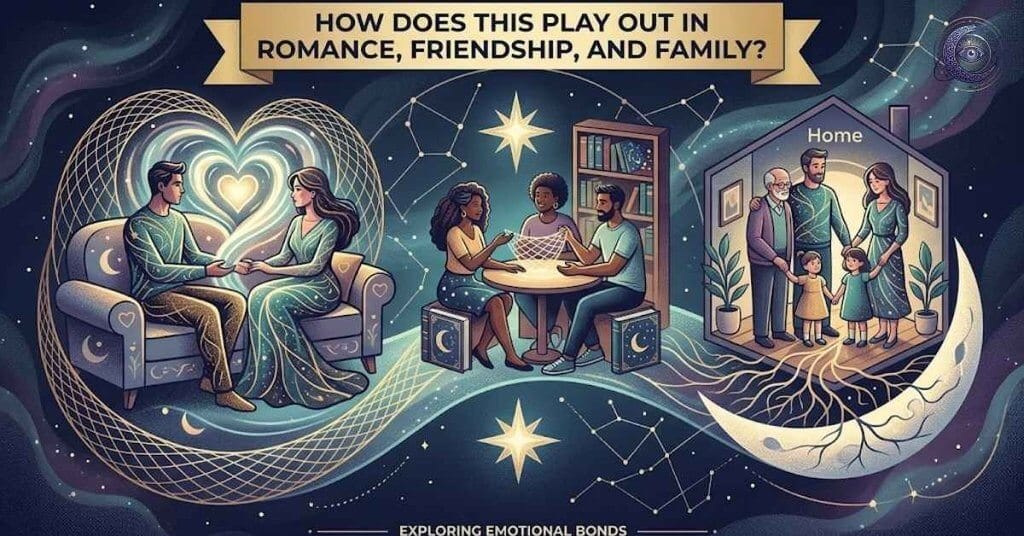
The context changes the flavor of this placement, even though the underlying pull toward comfort and familiarity stays the same across romantic, platonic, and family relationships.
In romance, this overlay often shows up as an early pull toward cohabitation or long term planning, sometimes faster than either person’s dating history would predict. In friendship, it looks like a friend who becomes family without much of a transition period, the kind of person who ends up at every holiday dinner within a year. In parent child or sibling relationships, this overlay can deepen an already close bond, or it can intensify old family patterns if the relationship carries unresolved history.
Liz Greene’s work on relationship astrology treats the 4th house as psychological territory tied to family of origin, not just a physical home (Greene, Relating: An Astrological Guide to Living With Others). That lens is useful here. This placement often surfaces feelings connected to your actual family, even in a relationship that has nothing to do with them.
How does 2026’s lunar cycle affect this placement?
The 2026 eclipse cycle adds extra weight to this synastry aspect for anyone whose 4th house or IC sits near the Virgo or Pisces axis, since eclipses on that axis activate home, family, and emotional foundation themes across the year.
If your natal 4th house cusp falls in early or mid degrees of Virgo or Pisces, expect this synastry placement to feel more active in 2026, for better or worse. Couples may face real decisions about moving in together, starting a family, or confronting old family issues that resurface without warning. Outer planet transits moving through either person’s 4th house this year, particularly from Saturn, add a practical layer on top of the emotional one, often in the form of decisions about money, property, or caregiving responsibilities tied to home.
None of this means the placement turns negative in 2026. It means the themes it always carried, home, roots, emotional security, get louder for a while.
Our chart observations
In the charts we read at TheCosmicCalc, this placement shows up more often between people who end up living together within the first year of knowing each other, whether that is a couple, roommates, or an adult child moving back in with a parent. We also notice that when this placement pairs with a hard aspect to Saturn, at least one person tends to describe the relationship as comforting and heavy at the same time, rarely one without the other.
We are not claiming a fixed statistic here. Chart samples like ours are not controlled studies, and any specific percentage would be a guess dressed up as data. What we can say is that the pattern repeats often enough to be worth naming, and it is one reason we built a moon soulmate calculator, so two people can compare their own charts instead of relying on someone else’s averages.
Shadow side and growth path
The shadow side of this placement is dependency that neither person notices building until it is already there. The growth path is keeping the closeness without losing the separate person you were before the relationship started.
Common shadow patterns include one partner absorbing the other’s moods as their own, decisions that quietly start running through only one person’s comfort level, or family roles from childhood getting replayed instead of examined. The growth path is not distance. It is differentiation, meaning you can stay close and still keep your own emotional center.
Donna Cunningham’s writing on family patterns in astrology points to the same idea, that unresolved dynamics from childhood tend to resurface in adult relationships until someone names them directly (Cunningham, Healing Pluto Problems). Naming the pattern is usually the first step that changes it.
A few practical habits help here:
1. Keep at least one routine, hobby, or friendship that exists outside the relationship.
2. Say what you need out loud instead of expecting the other person to sense it, even though they often can.
3. Ask each other directly whether a family pattern is repeating, rather than assuming closeness explains everything on its own.
Frequently asked questions
Hassan Raza is a dedicated digital tool architect and independent celestial researcher specializing in astronomical data modeling. Combining technical precision with deep cosmological studies, he develops intuitive astro-computational tools designed to make intricate natal charts, planetary transits, and celestial alignments accessible to everyone worldwide. Driven by accuracy and user-centric web design, Hassan ensures that every calculation on The Cosmic Calc bridges the gap between historical cosmic tracking and modern, real-time technology.