
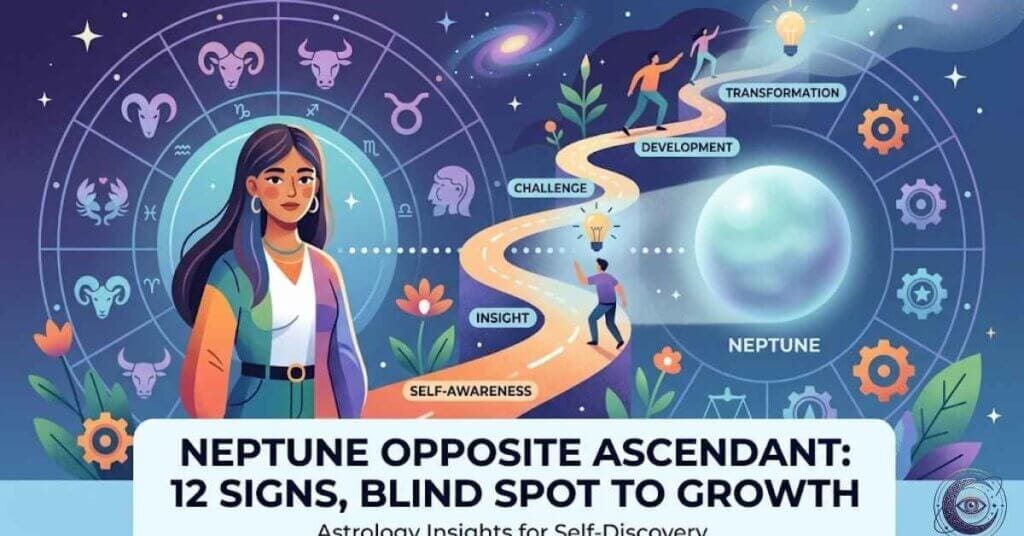
Neptune opposite ascendant is one of the strangest aspects to feel in your own body, because it never shows up as one clear symptom. It shows up as fog. You catch yourself mid relationship and cannot remember when you stopped trusting your own opinions. You look in the mirror after a breakup and do not fully recognize the person staring back, because so much of what you thought was your personality was actually someone else’s reflection of you.
After going through hundreds of birth charts for clients at TheCosmicCalc, I keep seeing the same pattern in people with this aspect. Their confusion is relational. It surfaces next to a partner, in the middle of comparing their own preferences to someone else’s. Liz Greene, the Jungian analyst and astrologer who wrote The Astrology of Fate, makes a related point about Neptune in her work: it dissolves the walls that normally keep one person’s identity separate from someone else’s.
This guide covers what neptune opposite ascendant actually means in your natal chart, how your Sun and Moon sign change the way it plays out, what the 2026 Neptune transit through Aries means if this aspect sits in your chart, and how each rising sign carries its own shadow pattern and its own way through it.
What does neptune opposite ascendant mean in a natal chart?
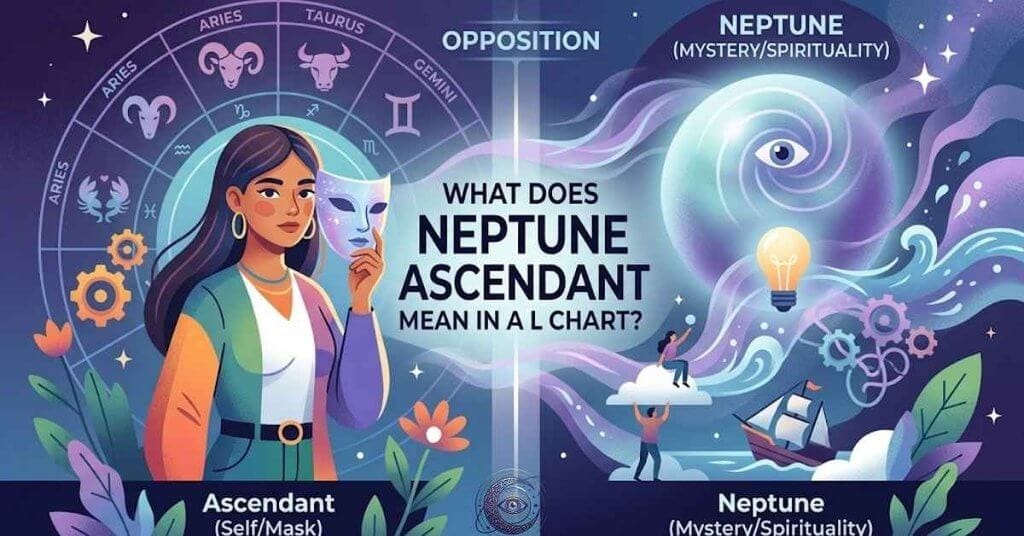
Neptune opposite ascendant means Neptune sits close to the exact opposite point of your rising sign, which usually places it in your seventh house. It softens your personal boundaries and makes it easy to absorb another person’s moods, beliefs, or expectations as if they were your own.
Your natal chart is a map of where every planet sat in the sky at the exact time and place you were born. Your Ascendant is the sign that was rising on the eastern horizon at that moment. It marks the start of your first house, the house of self, appearance, and instinctive reaction to the world. Sitting directly opposite the Ascendant is your Descendant, which rules the seventh house, the house of one-on-one partnerships, marriage, and open enemies.
An aspect in astrology is the angle formed between two points in the chart. When Neptune sits in opposition to your Ascendant, roughly 180 degrees away, it is technically conjunct your Descendant. Most astrologers work with an orb of 6 to 8 degrees for outer planets like Neptune, so if your natal Neptune falls within a few degrees either side of your Descendant, this aspect is active for you.
This is different from synastry, where Neptune opposite ascendant describes a dynamic between two separate people’s charts rather than a placement inside one person’s own birth chart. The natal version, the one this guide focuses on, is about your own chart alone.
People with this placement often describe the same experience in different words. They fall in love fast and hard, they see qualities in a partner that turn out to be projections rather than facts, and they struggle to say where their own needs end and their partner’s needs begin. It is a specific, describable pattern that shows up again and again across real birth charts.
How do your sun and moon sign change how this aspect feels?
Your Sun sign shapes how this aspect gets expressed on the outside, and your Moon sign shapes how it feels on the inside. A confident Sun sign can mask the fog with charisma, while a sensitive Moon sign can turn the same fog into deep emotional dependency.
Astrologers call the Sun and Moon your luminaries, the two lights of the chart that shape identity and emotion. Your Sun sign shapes how this aspect gets expressed on the outside, and your Moon sign shapes how it feels on the inside.
Someone with Neptune opposite ascendant and a Leo Sun might perform the role of the perfect partner, because Leo wants to be admired and Neptune wants to merge, so the two combine into someone who becomes whoever their partner needs them to be. Someone with the same aspect and a Cancer Moon might feel the dissolving boundary as an aching need to be needed, since Cancer already runs on emotional attachment.
This is why two people with the identical Neptune to Ascendant aspect can look completely different in real relationships. One withdraws into fantasy. The other over gives until they lose track of their own preferences entirely. The aspect sets the theme. The Sun and Moon decide how loud it plays.
What does the 2026 neptune transit mean if you have this aspect?
In 2026, transiting Neptune sits in Aries for the full year after settling there for good on January 26, following a brief return to Pisces in late 2025. This puts direct pressure on natal Ascendants in Libra through opposition, and adds friction for Cancer and Capricorn risings through square aspects.
Neptune entered Aries for the first time since the 1860s on March 30, 2025, dipped back into Pisces from October 22, 2025 to January 26, 2026, then moved into Aries for a stay of roughly thirteen years. This is a rare, generational shift that will not repeat for roughly another 165 years.
If your natal Ascendant is in Libra, this transit brings the Neptune opposite ascendant pattern into sharper focus during 2026, since transiting Neptune is now sitting close to opposition with your natal rising sign. If you already carry a natal Neptune to Ascendant aspect, this transit tends to pull the pattern out of the background and into your actual choices, especially around who you idealize and why.
Sign by sign: shadow side and growth path for each ascendant
Each rising sign experiences Neptune opposite ascendant differently, because the sign on your first house cusp sets the baseline identity that Neptune is dissolving. Below is the shadow pattern and the growth path for all twelve.
Aries rising tends to lose its edge around a partner it admires, quietly dropping its own opinions to keep the peace.
Growth path: deciding what you actually want before you agree to what someone else wants.
Taurus rising often romanticizes unstable partners, mistaking chaos for passion.
Growth path: checking a partner’s actions against their words over a period of months, not days.
Gemini rising can talk itself into believing a story about a relationship that the facts do not support.
Growth path: writing down what actually happened, not what it felt like it meant.
Cancer rising slips into caretaking so completely that its own needs go unspoken for years.
Growth path: naming one need out loud per week, even a small one.
Leo rising performs a version of itself designed to be chosen, then resents the partner for loving a performance instead of a person.
Growth path: letting one unpolished moment show before trust is even asked for.
Virgo rising serves a partner as a way to prove worth, then feels invisible when the effort goes unnoticed.
Growth path: asking for something in return before resentment builds.
Libra rising the sign most directly affected by the 2026 Neptune transit, tends to lose its own identity inside the idea of “we,” sometimes forgetting what it liked before the relationship started.
Growth path: keeping one hobby, friendship, or interest that has nothing to do with the partner.
Scorpio rising mistakes intensity for closeness, staying in relationships that run hot and cold because calm feels like distance.
Growth path: noticing that steady is not the same as boring.
Sagittarius rising chases an idealized partner who matches an internal picture, then loses interest once the real person shows up.
Growth path: dating the actual person in front of you, not the future you imagined with them.
Capricorn rising hides vulnerability behind competence, staying so composed that a partner never learns what is actually needed emotionally.
Growth path: saying “I need help” before it becomes a crisis.
Aquarius rising keeps enough emotional distance to feel safe, then wonders why relationships feel hollow.
Growth path: staying in the room during an uncomfortable conversation instead of intellectualizing it.
Pisces rising already ruled by Neptune’s own sign association through Pisces, can dissolve almost entirely into a partner’s world, losing track of separate plans, friendships, or goals.
Growth path: treating personal boundaries as an act of care, not selfishness.
Where does neptune actually fall: sixth, seventh, or eighth house?
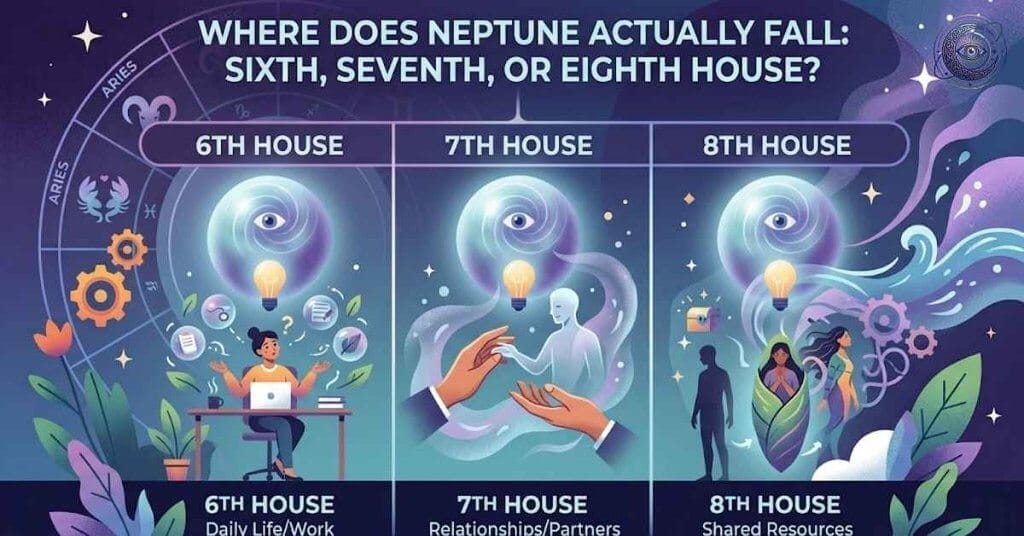
Neptune opposite ascendant usually places Neptune in the seventh house, but a wide orb can push it into the sixth or eighth house depending on your birth time and house system. This changes the reading from a partnership pattern into a health and service pattern, or into a deeper pattern about shared resources and psychological merging.
If your Neptune sits closer to your Descendant with a tight orb, expect the seventh house reading: partnership idealization, projection, and boundary blur with significant others. If Neptune spills earlier into the sixth house, the fog shows up more in daily routines, coworkers, or physical health, where boundaries around work and rest get blurry instead. If Neptune spills later into the eighth house, the pattern deepens into shared resources, intimacy, and psychological merging, often showing up as difficulty knowing where your own desires end and a partner’s begin on a much deeper level.
To check which house applies to you, look up your birth chart using an accurate birth time, since even a 15 minute difference in birth time can shift the Ascendant enough to move Neptune from one house into another. A tool like our sun, moon, and rising sign calculator can confirm your exact Ascendant degree before you read further into house placements.
Comparing elemental ascendants and how they carry this aspect
Fire, earth, air, and water Ascendants each carry Neptune opposite ascendant with a different emotional need, a different shadow trait, and a different way back to balance. The table below lays out the pattern by element rather than by individual sign, since the elements share a core emotional logic.
| Element | Ascendant signs | Emotional need | Shadow trait | Best self care practice |
|---|---|---|---|---|
| Fire | Aries, Leo, Sagittarius | To be admired and chosen | Performing a role instead of being seen | Naming one honest, unpolished feeling out loud each week |
| Earth | Taurus, Virgo, Capricorn | To feel useful and secure | Over functioning until resentment builds | Asking for something in return before giving more |
| Air | Gemini, Libra, Aquarius | To feel understood and connected | Rationalizing away red flags | Writing down facts separately from feelings after conflict |
| Water | Cancer, Scorpio, Pisces | To feel emotionally merged | Losing personal boundaries entirely | Keeping one daily habit that belongs only to you |
Our chart observations
In our own reading sessions, the clearest pattern with Neptune opposite ascendant is quiet erosion. Clients with this aspect often describe a slow slide where they agreed to small things they did not actually want, month after month, until the relationship barely resembled what either person originally signed up for.
We have also noticed that clients who run their placements through our moon soulmate calculator alongside this aspect tend to get more clarity from comparing their Moon sign compatibility with a partner than from the Sun sign alone, since Neptune’s fog sits closer to emotional instinct than to outward personality. This is a pattern we track across reading sessions, based on lived observation rather than a formal, controlled study.
Howard Sasportas wrote about outer planet transits in The Gods of Change. One of his central arguments is that Neptune style dissolving experiences ask a person to slowly rebuild a sturdier sense of self after the fog clears, rather than rushing back to old boundaries that were not working in the first place.
Working with this aspect instead of fighting it
Neptune opposite ascendant works best as something you learn to work with on purpose, since the same sensitivity that creates boundary confusion also creates real empathy and creative insight once it is grounded.
Steven Forrest, in The Inner Sky, frames outer planet aspects as growth points rather than flaws, arguing that the discomfort they create is often the exact pressure that pushes a person toward a more honest version of themselves. Applied here, that means the goal is keeping enough of a boundary that your own preferences survive contact with someone else’s, while staying open rather than guarded.
A few grounded practices help. Keep at least one interest, friendship, or daily habit that has nothing to do with your partner. Write down what you actually want from a relationship before you meet someone, so a strong Neptune pull does not overwrite it later. Pay attention to the gap between how someone describes themselves and how they actually behave over a few months, since that gap is where projection usually lives.
If you want to see exactly how this aspect combines with your Moon and Sun sign, run your details through our sun, moon, and rising sign calculator, and compare emotional compatibility patterns with our moon soulmate calculator to see where the same Neptune fog might be shaping how you read a partner’s signals.
Frequently asked questions
Is neptune opposite ascendant a hard aspect?
Astrologers generally treat oppositions as tension aspects rather than purely hard or purely easy ones. Neptune opposite ascendant creates a pull between your instinctive sense of self and your tendency to merge with partners, which plays out as ongoing tension rather than a single hard event.
What house is neptune in if it opposes my ascendant?
In most charts, Neptune opposite your Ascendant places Neptune in your seventh house, the house of one-on-one partnerships. A wide orb or an unusual house system can shift it into the sixth or eighth house instead.
Is neptune opposite ascendant the same as neptune conjunct descendant?
Yes. Since the Descendant sits exactly opposite the Ascendant, Neptune opposite your Ascendant and Neptune conjunct your Descendant describe the same placement from two different reference points.
Does this aspect affect how other people see me?
Often, yes. Because Neptune softens the edges of the Ascendant, which governs first impressions, people with this aspect are sometimes seen as mysterious, dreamy, or hard to pin down, even when they do not feel mysterious to themselves.
Hassan Raza is a dedicated digital tool architect and independent celestial researcher specializing in astronomical data modeling. Combining technical precision with deep cosmological studies, he develops intuitive astro-computational tools designed to make intricate natal charts, planetary transits, and celestial alignments accessible to everyone worldwide. Driven by accuracy and user-centric web design, Hassan ensures that every calculation on The Cosmic Calc bridges the gap between historical cosmic tracking and modern, real-time technology.