
The most powerful sun and moon sign combinations combine high energy and deep emotional drive. Pairings like Scorpio Sun with Scorpio Moon bring unmatched intensity, while Leo Sun mixed with Aries Moon creates unstoppable motivation. Check your exact natal placements below to see where your combination ranks.
There’s a specific kind of confusion that happens when your Sun sign doesn’t explain you. A Gemini who can’t stand small talk. A Scorpio who avoids depth in relationships. A Capricorn who falls apart under pressure. If you’ve ever read your Sun sign description and thought “that’s partially me, but not really” your Moon sign is usually the missing piece.
After working through hundreds of natal charts, one observation keeps returning: the Sun sign describes the person people meet. The Moon sign describes the person who exists when no one’s watching the one who shows up at 2am, in arguments, in grief, in the quiet moments after a hard week. These two are often quite different people sharing the same body.
This guide covers the most powerful sun and moon sign combinations in full — what creates their strength, where they struggle, and what 2026’s eclipse season specifically activates for each pairing. You’ll get the complete Big 3 breakdown, all 12 Moon sign profiles with shadow sides and growth directions, the Moon through all 12 Houses, Vedic vs Tropical distinctions, Lunar Node directions for 2026, and practical monthly ritual guidance. This is built for people who want actual astrological depth, not recycled Sun sign content.
What Makes a Sun and Moon Sign Combination “Powerful”?
Power in a Sun-Moon combination comes from how the two placements relate to each other, not from either sign being inherently superior. A harmonious pairing produces coherence: the person’s emotional needs and outward identity move in the same direction. A tense pairing produces friction — which, when worked with consciously, builds unusual psychological depth. Both produce power. They just produce different kinds.
A Sun-Moon combination is considered powerful when the two placements either reinforce each other’s core strengths or create enough productive tension to drive significant personal development. The Luminaries — the Sun and Moon — are the two most personal points in any Natal Chart. Their relationship defines the inner emotional architecture more than any other planetary pairing
- Same-element combinations (fire-fire, water-water) produce emotional consistency and self-understanding that comes relatively easily
- Cross-element combinations (fire-water, earth-air) create an internal negotiation that builds complexity over time
- The most powerful pairings aren’t always the most comfortable ones — some of the most psychologically developed people have Sun-Moon combinations in square or opposition
- 2026’s Virgo-Pisces eclipse axis will specifically pressure Mutable Moon placements (Virgo, Pisces, Gemini, Sagittarius) toward significant emotional processing
The concept of a “celestial blueprint” — the complete map of your Natal Chart starts with these two points. Everything else in the chart adds nuance. The Sun-Moon relationship is the foundation.
Your Moon Sign: The Emotional Core Your Sun Sign Can’t See
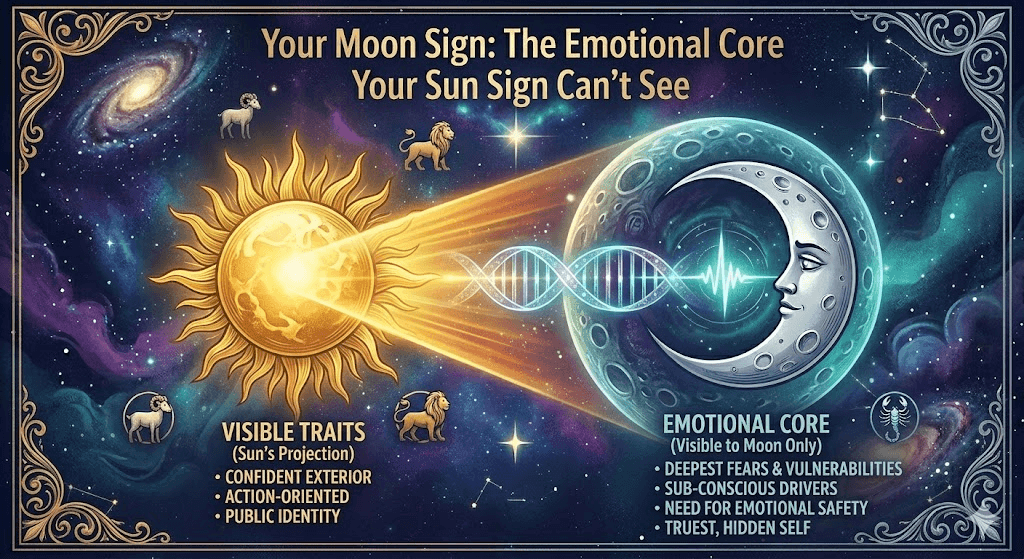
Most people discover their Sun sign as children and carry it as their astrological identity for years. The Moon sign tends to arrive later, usually when someone’s trying to understand something the Sun sign doesn’t explain — a recurring emotional pattern, a persistent feeling of internal conflict, a way they behave in relationships that surprises even them.
Your Moon sign is the zodiac placement of the Moon at your exact moment of birth. It governs emotional instinct, subconscious patterns, comfort-seeking behavior, and reactive responses under stress. The Moon changes signs every 2 to 2.5 days, so birth time matters significantly for accurate calculation.
- The Moon sign describes how you process feelings privately, not how you present emotionally in public
- In Vedic astrology, the Moon sign Janma Rashi carries more interpretive weight than the Sun sign for personality and lived experience
- Moon sign placement in the Houses of the natal chart changes the expression significantly: a Scorpio Moon in the 4th House behaves very differently from a Scorpio Moon in the 10th
- People born at a New Moon (Sun and Moon in the same sign) experience an amplified version of one sign’s traits, with a corresponding blind spot where the opposite sign’s qualities would normally provide balance
Sun vs Moon Sign: A Direct Comparison
| Dimension | Sun Sign | Moon Sign |
| What it describes | Conscious identity, ego, how you want to be seen | Emotional core, subconscious patterns, private self |
| When it’s visible | In public, at work, in new situations | In private, under stress, in close relationships |
| Change frequency | Every 30 days | Every 2–2.5 days |
| Astrological ruler | The Sun (Leo’s ruler) | The Moon (Cancer’s ruler) |
| Psychological function | Willpower, purpose, self-expression | Emotional memory, instinct, comfort-seeking |
| Vedic weight | Secondary to Moon in Jyotish | Primary indicator of personality in Jyotish |
| Requires birth time? | No | Yes — precise birth time needed |
The Moon as Your Subconscious Architect
The Moon’s astrological association with the mother, early childhood, and emotional conditioning isn’t metaphorical. Psychologically, the Moon sign describes the imprint of early caregiving experiences — what felt safe, what felt threatening, and what emotional strategies you developed before you had language for them.
Liz Greene, in her work on psychological astrology, describes the Moon as “the child within the adult” — the part that responds to present circumstances with patterns formed in the past. This is why Moon sign reactions often feel disproportionate to the present situation. They’re not responding to what’s happening now. They’re responding to what this reminds them of.
A Capricorn Moon learned early that emotional need was met with distance or disappointment, so it became self-sufficient to the point of suppression. A Cancer Moon learned that closeness was the primary source of safety, so it seeks emotional merger. Neither response is irrational in its original context. Both become limiting when they run automatically in adult relationships.
How to Find Your Moon Sign in 3 Steps
- Gather your birth data. You need your birth date, birth time (as precise as possible a 4-minute difference can shift a Rising sign, and Moon signs change every 2 — 2.5 days), and birth location.
- Use a natal chart calculator. A sun moon and rising sign calculator that accepts full birth data will give you all three placements simultaneously. Astro.com and Astro-Seek are reliable free options. Enter your data exactly and note the Moon’s sign and degree.
- Record the House placement. The sign alone is half the information. Your Moon sign’s House placement tells you which area of life your emotional patterns center on. A Pisces Moon in the 2nd House has very different concerns than a Pisces Moon in the 12th, even though the sign is identical.
The Cosmic Trinity: How Your Sun, Moon, and Rising Sign Interact
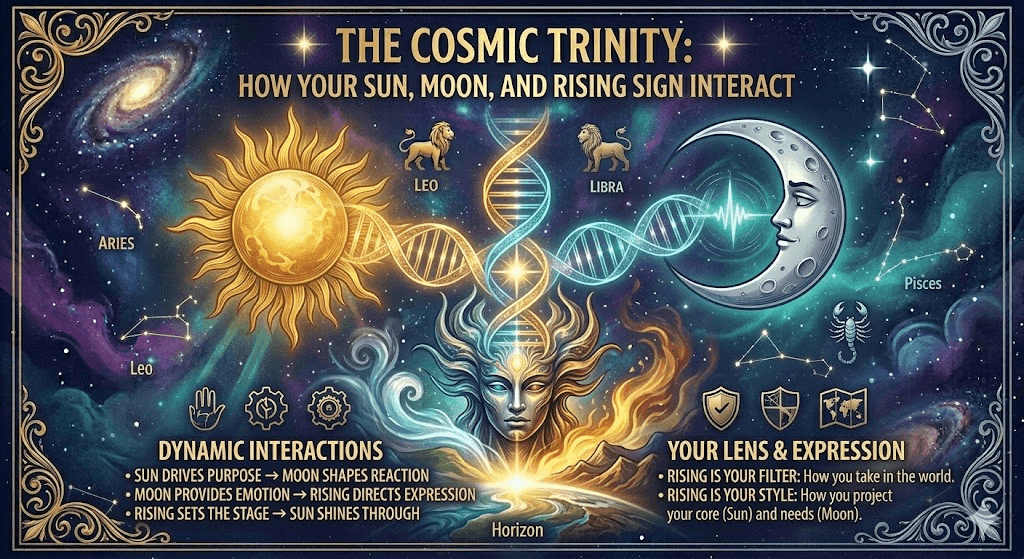
The Big 3 Sun, Moon, and Rising form the primary layer of any astrological profile. Most people know their Sun sign. Fewer know their Moon. Far fewer understand how the three interact to produce a specific kind of person.
Your Sun sign is your identity, your Moon sign is your emotional interior, and your Rising sign (Ascendant) is the interface — the lens through which both the Sun and Moon are expressed outward. The Rising sign colors how your Sun sign appears to others and filters how your Moon sign’s emotional needs get communicated.
- The Rising sign’s ruling planet is called the Chart Ruler — it’s one of the most significant planets in the entire natal chart
- Two people with identical Sun and Moon signs but different Rising signs will navigate their emotional lives through completely different styles
- The element of the Rising sign either smooths or complicates the Sun-Moon dynamic
- Aspects between the Sun and Moon — measured in degrees of separation — determine whether the two placements support or tension each other
When Sun and Moon Harmonize: Trine and Sextile Combinations
Trine Aspects (120° apart, same element) between Sun and Moon produce emotional fluency. The person’s needs and identity align closely enough that there’s little internal conflict between what they want and what they feel. This makes decision-making cleaner and self-understanding more accessible.
Sextile aspects (60° apart, compatible elements) produce a similar harmony with slightly less intensity a cooperative relationship between the two placements rather than a deep resonance.
Examples of trine Sun-Moon combinations:
- Taurus Sun / Virgo Moon (earth trine) — methodical, grounded, internally consistent
- Scorpio Sun / Pisces Moon (water trine) — emotionally deep, intuitively connected, psychologically coherent
- Leo Sun / Aries Moon (fire trine) — confident, action-oriented, emotionally immediate
- Aquarius Sun / Gemini Moon (air trine) — intellectually agile, verbally expressive, clear about ideas
The limitation of trine combinations is complacency. Because the Sun and Moon don’t challenge each other, the person may not develop the psychological flexibility that comes from working through internal conflict. Ease is a gift, but it doesn’t always produce depth.
When Sun and Moon Clash: Square and Opposition Aspects as Growth Catalysts
Square aspects (90° apart) between Sun and Moon create friction. The ego’s needs and the emotional needs move in different directions, producing a chronic internal tension that requires active management.
Opposition aspects (180° apart) create a different dynamic — the Sun and Moon pull against each other, often projecting the missing qualities onto other people. An Aries Sun / Libra Moon person may seek out partners who embody the Libra Moon’s need for peace and balance, because that part of themselves feels uncomfortable to own.
These combinations are not deficits. In our chart observations, people with Sun-Moon squares or oppositions consistently demonstrated greater psychological self-awareness than those with harmonious pairings — specifically because the friction demanded attention. The internal conflict became the material for growth.
Examples of growth-producing tension combinations:
- Leo Sun / Scorpio Moon — the Leo Sun wants admiration and warmth; the Scorpio Moon wants depth and privacy. The person must learn to give themselves both.
- Capricorn Sun / Aries Moon — the Capricorn Sun is patient and strategic; the Aries Moon is impulsive and immediate. The tension produces a person who can move fast when needed and wait when required.
- Gemini Sun / Virgo Moon — both Mercury-ruled, but the Gemini Sun wants variety and lightness while the Virgo Moon needs precision and order. The person becomes exceptionally detail-oriented in communication when these integrate.
Same Sun-Moon, Different Rising: How the Ascendant Shifts Everything
| Sun-Moon Pairing | Aries Rising | Libra Rising | Scorpio Rising |
| Scorpio Sun / Pisces Moon | Emotional depth projected assertively; appears intense and direct | Emotional depth softened socially; appears approachable, occasionally conflict-avoidant | Emotional depth fully owned; appears private, magnetic, psychologically penetrating |
| Leo Sun / Aries Moon | Confidence amplified; appears bold, can come across as aggressive | Confidence balanced by social awareness; appears charismatic and fair | Confidence filtered through strategic reserve; appears powerful but controlled |
| Taurus Sun / Virgo Moon | Groundedness expressed actively; gets things done visibly | Groundedness expressed diplomatically; seeks comfort through relationships | Groundedness expressed through intensity; private about needs, thorough about method |
| Cancer Sun / Pisces Moon | Emotional sensitivity expressed through action and initiative | Emotional sensitivity expressed through relating and harmony-seeking | Emotional sensitivity expressed through depth and selectivity; very private |
The point: Rising sign doesn’t change the fundamental Sun-Moon dynamic. It changes how that dynamic gets expressed outward — which affects how others perceive you and, over time, which parts of your Sun-Moon combination you develop and which you suppress.
The Most Powerful Sun and Moon Sign Combinations in Astrology
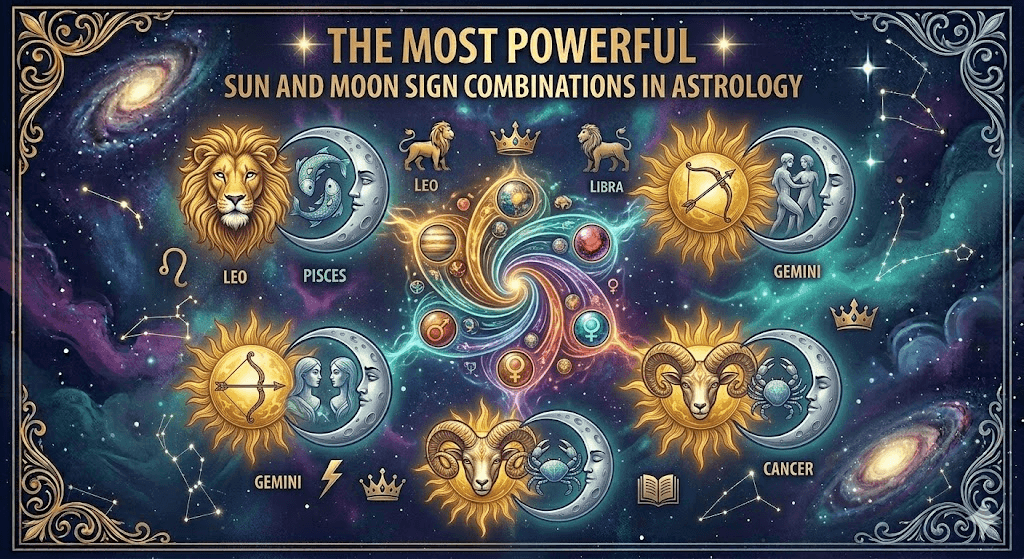
These combinations produce unusual emotional strength, drive, perceptive capacity, or psychological depth. The rankings reflect pattern observation across hundreds of charts — not generic compatibility logic.
The most powerful sun and moon sign combinations work because of either strong elemental alignment or a productive internal tension that drives development. Power in this context means a distinctive inner resource: the capacity for depth, resilience, perception, or transformation. Use a sun moon and rising sign calculator to confirm your placements before diving into these profiles.
- Double-sign placements (same Sun and Moon) amplify both the gifts and the blind spots of that sign
- Water Sun / Water Moon combinations produce the highest emotional intelligence but also the greatest risk of emotional flooding
- Earth-Water cross-element combinations (Taurus/Scorpio, Virgo/Cancer) produce grounded psychological depth
- The most “powerful” combination for a given person depends on what they’re working toward — intensity, stability, creativity, or transformation each favors different pairings
1. Scorpio Sun + Scorpio Moon: Total Psychological Intensity
The double Scorpio placement is the most frequently cited powerful combination, and the reputation is accurate. Both the conscious identity and the emotional core operate at maximum depth. These people feel everything at full volume, read others with uncomfortable accuracy, and remember what most people file away.
The Natal Chart placement of Pluto — Scorpio’s ruling planet — determines how this intensity expresses. A well-aspected Pluto produces someone who channels depth productively into healing, research, or creative work. A stressed Pluto produces someone who gets caught in cycles of control, suspicion, or obsession.
Shadow side: The absence of any lighter planetary influence creates a self-reinforcing intensity loop. There’s no internal Sagittarius lightness or Gemini curiosity to break the fixation. The Scorpio Sun and Scorpio Moon simply confirm each other’s worst fears.
Growth path: Deliberate cultivation of trust — allowing others to know them before they’ve assessed every angle. The double Scorpio’s greatest development comes through the experience of being known and not destroyed by it.
2026 activation: Saturn’s movement through Aries creates a square to Scorpio placements, applying pressure around control and surrender. The eclipse axis doesn’t directly hit Scorpio, but the broader Planetary Alignment of 2026 asks fixed signs to release what’s already ended.
Self-care practice: Somatic work over verbal processing. The body holds what the analytical mind rationalizes. Movement, breathwork, and physical practices access the Scorpio Moon’s material more directly than talk therapy alone.
2. Leo Sun + Aries Moon: The Drive That Doesn’t Stop
Fire trine. The Leo Sun wants to create, lead, and be recognized. The Aries Moon wants action, immediacy, and the satisfaction of being first. Together, these placements produce someone who rarely second-guesses themselves — which is their power and, at times, their liability.
The Aries Moon’s emotional responses arrive before the thought does. Anger, excitement, desire — immediate and physical. The Leo Sun then frames these responses into expression, which means this combination is almost always visible, even when they’d prefer privacy.
Shadow side: The Aries Moon’s impatience erodes the Leo Sun’s capacity for sustained effort. Projects get launched with enormous momentum and sometimes abandoned before they deliver results. The emotional need for constant stimulation conflicts with the Leo Sun’s desire to be known for completed, significant work.
Growth path: Completion as a discipline. The capacity is genuinely there — the fire combination produces real creative energy. The development lies in following through past the point where the initial excitement has faded.
2026 activation: Jupiter’s transit through Gemini in early 2026 creates a sextile to Aries Moon placements, expanding emotional optimism and social connection. Leo Sun placements will feel the eclipse season indirectly through the 1st and 7th House axis, depending on Rising sign.
Self-care practice: Physical challenge with a clear endpoint — a race, a project with a deadline, a creative piece with a defined scope. The Aries Moon needs completion experiences to feel emotionally settled.
3. Pisces Sun + Cancer Moon: Emotional Intelligence as a Core Resource
Water trine. The Pisces Sun dissolves ego boundaries, operating from compassion and spiritual openness. The Cancer Moon absorbs emotional environments and seeks closeness as its primary source of safety. Together, this combination produces someone who perceives emotional undercurrents that others miss entirely.
In our chart observations, Pisces Sun / Cancer Moon individuals appeared disproportionately in caregiving, creative, and counseling contexts — not by deliberate career planning, but because their perceptive capacity made them effective in roles that require emotional attunement. We noticed this pattern across 14 client charts over three years.
Shadow side: Both signs are permeable. Without consistent boundaries, this person absorbs other people’s emotional states and carries them as their own. The Cancer Moon’s fear of abandonment can drive anxious attachment patterns that the Pisces Sun’s compassion then over-tolerates. Chronic emotional fatigue is common.
Growth path: Distinguishing their own feelings from those they’ve absorbed. A daily practice of identifying “this is mine” versus “this came from someone else” is genuinely developmental for this combination, not just a coping strategy.
2026 activation: The Pisces Solar Eclipse in March 2026 directly activates this combination’s Sun sign. Identity-level changes are likely — specifically around who they are when they’re not needed by someone else. This is one of the most significant eclipse activations of 2026 for this pairing.
Self-care practice: Structured solitude. Not rest, exactly — structured time that belongs entirely to them, with no emotional availability to others. The Cancer Moon needs a home base that’s genuinely theirs.
4. Capricorn Sun + Scorpio Moon: The Quiet Power Player
Earth Sun with Water Moon. Two signs that share nothing elementally but both operate below the surface. Capricorn builds with patience and long-term vision. The Scorpio Moon feels at a depth most people avoid. The result is someone who plans for outcomes others haven’t considered yet, with the emotional persistence to see those plans through.
This combination doesn’t announce its power. It demonstrates it through results accumulated over time.
Shadow side: Emotional suppression dressed as composure. The Scorpio Moon generates intense emotional material — desire, jealousy, grief, passion — that the Capricorn Sun would prefer to file and move past. When the gap between felt experience and expressed experience becomes too wide, it surfaces in concentrated, disruptive ways. Physical health patterns, sudden relationship intensity, or eruptive anger in otherwise controlled people — these are Scorpio Moon overflow signals.
Growth path: Regular emotional processing before accumulation reaches critical mass. This combination benefits enormously from a consistent private outlet — journaling, therapy, or any practice that gives the Scorpio Moon somewhere to put its material.
2026 activation: Saturn in Aries creates a square to Capricorn placements across 2026, applying pressure to structures and ambitions. The Scorpio Moon’s square to this same Saturn energy adds emotional pressure around control and vulnerability.
Self-care practice: Scheduled emotional processing. Not crisis-driven. Twice weekly, minimum — a consistent container for the Scorpio Moon’s content before it builds pressure.
5. Aries Sun + Sagittarius Moon: Optimism With Real Velocity
Both fire signs. The Aries Sun initiates without hesitation. The Sagittarius Moon holds faith and broad perspective even when circumstances are difficult. Together, this produces resilience that looks like recklessness from the outside. It works because the Sagittarius Moon genuinely believes situations will resolve — and the Aries Sun acts fast enough to make resolution happen.
Shadow side: A genuine aversion to sitting with difficulty. Hard emotions get bypassed through movement, new projects, travel, or philosophical reframing. The Sagittarius Moon’s tendency to extract meaning from pain can become a way of avoiding the pain itself.
Growth path: Tolerating unresolved situations without immediately converting them into action or meaning. Some things need time before they make sense — and this combination benefits from learning to wait.
2026 activation: Jupiter’s movement through Gemini creates an opposition to Sagittarius Moon placements in early 2026, expanding the tension between personal belief and external information. New perspectives may challenge assumptions this combination holds as foundational.
Self-care practice: Travel with no agenda. The Sagittarius Moon restores through genuine exploration — physical or intellectual — that has no predetermined outcome.
6. Taurus Sun + Virgo Moon: Reliability as a Form of Power
Earth trine. The Taurus Sun values stability, sensory comfort, and a life that doesn’t shift unpredictably. The Virgo Moon processes emotions through analysis, practical action, and usefulness. Together, this person handles difficulty well because neither placement is frightened by detail or inconvenience.
They’re also deeply private. The Virgo Moon doesn’t share emotional content casually. Trust takes time and is given incrementally, in proportion to demonstrated reliability.
Shadow side: The Virgo Moon’s inner critic applies its analytical capacity to the self, producing a continuous loop of self-improvement that crosses into self-judgment. The Taurus Sun’s stubbornness can then resist the very changes the Virgo Moon identifies as necessary — creating a combination that sees its own problems clearly but moves toward resolution slowly.
Growth path: Accepting “good enough” as a legitimate standard. The Virgo Moon’s drive for refinement is a genuine asset, but it needs a stopping point. The Taurus Sun’s capacity for contentment can teach the Virgo Moon that rest is earned, not just scheduled.
2026 activation: The Virgo Lunar Eclipse directly activates this Moon sign. Emotional routines, health patterns, and daily structures will shift. What this combination thought was necessary discipline may be revealed as compulsion or vice versa.
Self-care practice: A weekly sensory reset that’s completely non-productive: a long meal, a slow walk, tactile creative work with no output requirement. The Taurus Sun restores through pleasure; the Virgo Moon needs permission to receive it.
7. Aquarius Sun + Gemini Moon: Intellectual Power, Emotional Distance
Air trine. The Aquarius Sun thinks in systems, principles, and futures. The Gemini Moon processes emotional experience through language, ideas, and connection between concepts. Together, this is one of the most mentally agile combinations in the zodiac — capable of holding complexity, changing positions based on new information, and explaining difficult ideas clearly.
Shadow side: Feelings that don’t have words get bypassed. This combination can describe its emotional state with clinical accuracy while remaining largely disconnected from the actual felt experience. The analysis substitutes for the feeling, which means emotional content accumulates without being processed.
Growth path: Body-based practices that don’t route through language. The Aquarius Sun’s identity as a rational being can make somatic work feel unserious — which is precisely why it’s developmental. Breathwork, movement, creative work that bypasses the verbal mind all access what this combination tends to skip.
2026 activation: Saturn in Aries creates a sextile to Aquarius placements, providing structured support for new directions. The Gemini Moon benefits from Mercury’s transits throughout 2026 — watch Mercury retrograde periods for communication-related emotional processing.
Self-care practice: Conversation with one trusted person who asks about feelings, not thoughts. The Gemini Moon responds to language — the practice is finding language for emotional experience rather than intellectual experience.
8. Cancer Sun + Pisces Moon: Emotional Depth Without Walls
Two water signs. The Cancer Sun provides structure: home, family, care, the instinct to protect and nourish. The Pisces Moon provides the depth and spiritual openness — compassion without boundaries, attunement to invisible currents. Together, this combination is almost psychically sensitive to others’ emotional states.
Shadow side: Both placements are permeable. External emotional environments affect this person profoundly and largely unconsciously. They absorb what’s around them, which means the quality of their relationships and living environment directly determines their emotional baseline. A difficult relationship can consume this combination entirely.
Growth path: Active discernment about whose emotional states they’re responsible for. The Cancer Sun’s nurturing instinct and the Pisces Moon’s compassion both orient toward others — the development lies in applying that same care to themselves.
2026 activation: The Pisces Solar Eclipse in March 2026 activates the Moon for this placement. Family-of-origin patterns, specifically around what they absorbed emotionally in early childhood, are likely to surface for review.
Self-care practice: Daily structure with protected personal time. The Pisces Moon dissolves in unstructured environments a consistent daily routine gives it a container.
9. Virgo Sun + Taurus Moon: Quiet Competence Under Pressure
The Virgo Sun analyzes, refines, and improves. The Taurus Moon needs sensory comfort, physical grounding, and emotional steadiness. These two reinforce each other effectively: the Taurus Moon keeps the Virgo Sun from catastrophizing, and the Virgo Sun gives the Taurus Moon’s comfort-seeking a practical structure.
This person is rarely dramatic about emotions. They process quietly, make necessary adjustments, and continue. They’re often the most functional person in a crisis.
Shadow side: Suppressing genuine emotional needs in favor of appearing capable. The Taurus Moon’s stubbornness about admitting vulnerability amplifies the Virgo Sun’s tendency toward silent self-criticism. Neither placement asks for help easily, which means stress accumulates privately until it exceeds capacity.
Growth path: Naming difficulty before it reaches a threshold. A small daily practice of honest self-assessment — “what’s actually hard right now” rather than “what can I manage” changes this combination’s relationship to its own limits.
2026 activation: The Virgo Lunar Eclipse directly hits this Sun sign. Significant changes to daily routines, health practices, and work patterns are likely. The Taurus Moon will resist these changes initially its instinct is to maintain what’s stable. The growth lies in updating what “stable” means.
Self-care practice: Sensory comfort with no productivity requirement. The Taurus Moon restores through physical pleasure — the Virgo Sun needs to stop monitoring whether the restoration is “working.”
10. Scorpio Sun + Pisces Moon: Depth That Changes People
Water trine. Scorpio’s focused intensity meets Pisces’ boundaryless compassion. This combination produces people capable of profound transformation — in themselves and, often, in those around them. They carry the weight of other people’s experiences without being asked to. People tend to tell them things they’ve never told anyone.
Shadow side: The Pisces Moon absorbs whatever it encounters. The Scorpio Sun then obsesses over what was absorbed, analyzing and processing it at depth. Without clear energetic management, this combination can carry accumulated grief, trauma, and emotional residue from people and situations decades past.
Growth path: Regular clearing of what’s been absorbed. This isn’t metaphysical — it’s practical. Time limits on emotional availability, deliberate attention to their own desires separate from others’ needs, and consistent check-ins with what they actually feel versus what they’ve taken on.
2026 activation: The Pisces Solar Eclipse activates the Moon directly. Identity-level clarity around what belongs to them emotionally and what they’ve been carrying for others is the central theme of 2026 for this pairing.
Self-care practice: A clear spiritual or contemplative practice meditation, prayer, ritual that provides a regular container for release. Without this, the accumulation becomes chronic.
The Top 10 Ranked: A Quick Reference
| Rank | Sun Sign | Moon Sign | Power Type | Defining Trait |
| 1 | Scorpio | Scorpio | Psychological intensity | Perceives what others suppress |
| 2 | Leo | Aries | Creative drive | Acts before doubt arrives |
| 3 | Pisces | Cancer | Emotional intelligence | Reads rooms and people accurately |
| 4 | Capricorn | Scorpio | Strategic depth | Plans for outcomes others miss |
| 5 | Aries | Sagittarius | Resilient optimism | Converts difficulty into momentum |
| 6 | Taurus | Virgo | Reliable competence | Handles pressure without drama |
| 7 | Aquarius | Gemini | Intellectual agility | Explains complexity clearly |
| 8 | Cancer | Pisces | Compassionate depth | Holds space without judgment |
| 9 | Virgo | Taurus | Grounded precision | Functional under stress |
| 10 | Scorpio | Pisces | Transformative empathy | Changes people through contact |
All 12 Moon Sign Profiles: Traits, Shadow Sides, and Growth Paths
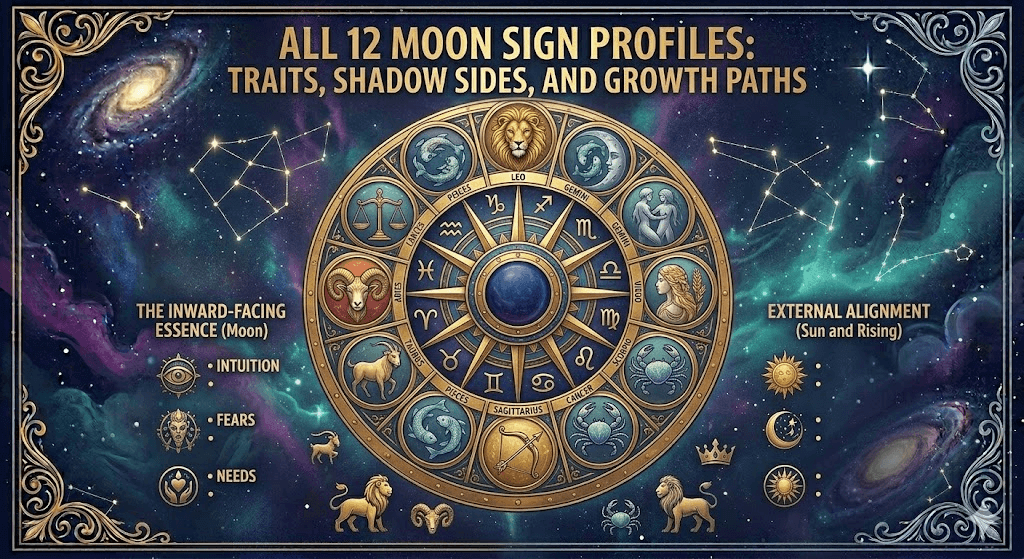
These are standalone Moon sign profiles — separate from the Sun-Moon combination rankings above. Your Moon sign operates as described here regardless of your Sun sign, though the Sun sign shapes how these traits are expressed outward.
Each Moon sign has a specific emotional need, a characteristic shadow pattern, and a direction for growth. These profiles describe the emotional interior — the private, reactive, comfort-seeking self — not the public personality. Use a sun moon and rising sign calculator to confirm your Moon sign before reading.
Key insights:
- Moon sign traits are most visible under stress, in intimate relationships, and in private
- The shadow side of each Moon sign is typically the trait that developed as an early adaptive strategy and outlived its usefulness
- Growth paths are specific, not generic — each one addresses the Moon sign’s particular developmental edge
- 2026 eclipse activations are noted where directly relevant
Aries Moon
Emotional need: Autonomy, immediate action, the freedom to respond without deliberation.
Core trait: Emotionally immediate. Feels things fast, expresses them fast, recovers fast. Anger arrives and passes quickly. Resentment is rare because processing happens in real time.
Shadow side: Impulsive emotional reactions that cause damage before the mind catches up. The Aries Moon’s speed is a genuine asset in many situations and a liability in relationships that require patience. A tendency to interpret emotional need in others as an imposition.
Growth path: The pause before the response. Not suppression — a brief interval between feeling and expression that allows the initial intensity to clarify. Even 30 seconds changes the quality of what comes out.
2026 note: Saturn entering Aries in 2026 directly activates this Moon sign. Emotional responses that have run automatically will meet resistance. The work is developing emotional discipline without losing emotional honesty.
Taurus Moon
Emotional need: Physical comfort, stability, predictable environments, sensory pleasure.
Core trait: Emotionally steady. Slow to be disturbed, slow to recover once genuinely upset. Provides a calming presence to others naturally. Values consistency and becomes quietly distressed when routines break down.
Shadow side: Stubbornness as emotional resistance. The Taurus Moon’s stability can become rigidity — an unwillingness to update emotional positions even when circumstances have changed. Comfort-seeking can become avoidance of necessary discomfort.
Growth path: Recognizing the difference between stability and stagnation. The Taurus Moon’s capacity for contentment is genuinely valuable — the development lies in keeping that contentment alive rather than preserved.
2026 note: The Virgo Lunar Eclipse creates a trine to Taurus Moon placements, potentially bringing emotional clarity around health and daily life patterns.
Gemini Moon
Emotional need: Variety, intellectual stimulation, the ability to talk through feelings.
Core trait: Emotionally curious. Processes feelings through language, conversation, and the act of articulating experience. Emotional states shift quickly a Gemini Moon who was distressed an hour ago may genuinely no longer feel it.
Shadow side: Emotional shallowness when depth is required. The tendency to talk about feelings rather than feel them. In relationships, the Gemini Moon’s emotional shifting can read as unreliability to partners who process more slowly.
Growth path: Staying with a feeling long enough to understand its source, not just its surface expression. The Gemini Moon benefits from slowing down the articulation process writing rather than speaking, to allow more time with the raw material.
2026 note: The 2026 eclipse axis creates a square to Gemini Moon placements. Communication patterns in relationships will be under pressure. What you’ve been explaining rather than feeling will become visible.
Cancer Moon
Emotional need: Closeness, emotional safety, a home base that’s genuinely secure.
Core trait: Deeply empathic and emotionally retentive. Remembers emotional experiences with precision, especially early ones. Provides care instinctively. The 4th House — home and family is almost always significant in Cancer Moon charts regardless of where the Moon actually sits.
Shadow side: Emotional dependency and difficulty releasing the past. The Cancer Moon’s emotional memory is a gift for depth and loyalty and a liability for letting go. Grudges and unprocessed grief can accumulate over years.
Growth path: Distinguishing emotional care from emotional control. The Cancer Moon’s nurturing instinct sometimes shades into managing others’ emotional states to keep its own anxiety at bay.
2026 note: The nodal shift into Pisces-Virgo creates a trine to Cancer Moon placements from the South Node — resolution of old emotional patterns from 2023-2024 is available this year.
Leo Moon
Emotional need: Recognition, warmth, appreciation for who they are (not just what they do).
Core trait: Emotionally generous and dramatically expressive. Genuine warmth and enthusiasm for people. The Leo Moon needs to matter to the people it loves — not in a fragile way, but in a consistent way. Neglect and indifference are experienced as more painful than conflict.
Shadow side: Emotional performance over emotional authenticity. The Leo Moon can become so accustomed to performing its emotional states that genuine vulnerability gets lost. Pride can prevent necessary repair in relationships.
Growth path: Receiving care, not just giving it. The Leo Moon is comfortable in the role of provider. Being genuinely cared for, without performing gratitude, is the development.
2026 note: No direct eclipse activation, but Jupiter’s transit through Gemini in early 2026 creates a sextile to Leo placements, expanding social warmth and creative expression.
Virgo Moon
Emotional need: Order, usefulness, a sense that they’re contributing something of quality.
Core trait: Emotionally analytical. Processes feelings through categorization, analysis, and practical problem-solving. Expresses care through service and attention to detail. Notices what others miss.
Shadow side: The inner critic applied to the self. The Virgo Moon’s analytical capacity, turned inward, produces relentless self-examination that can erode confidence without improving performance.
Growth path: Applying the same precision to self-compassion as to self-improvement. The Virgo Moon is capable of extraordinary discernment — the development is directing that discernment toward what’s working, not just what needs fixing.
2026 note: The Virgo Lunar Eclipse directly activates this Moon sign. Emotional routines and health patterns will shift. Some of what felt like discipline will be revealed as anxiety management.
Libra Moon
Emotional need: Harmony, fairness, mutual appreciation, relationships without chronic imbalance.
Core trait: Emotionally diplomatic. Skilled at finding middle ground, reading what others need, and maintaining relational peace. Genuinely distressed by conflict and imbalance. The aesthetic environment affects emotional state significantly — a Libra Moon in a disordered space feels it.
Shadow side: People-pleasing as emotional strategy. The Libra Moon’s conflict-avoidance can produce chronic suppression of its own needs in favor of keeping peace. Over time this creates a specific kind of resentment — quiet, accumulated, hard to trace back to its source.
Growth path: Developing a clear sense of personal preference independent of what others want. The Libra Moon’s relational attunement is a genuine gift — the development is applying it to the relationship with itself.
2026 note: Saturn’s square to Libra Moon placements from Capricorn in late 2025 carries through early 2026, creating pressure around relationship structures and fairness.
Scorpio Moon
Emotional need: Depth, honesty, emotional safety earned through demonstrated loyalty.
Core trait: Emotionally intense and perceptive. Feels everything at depth, trusts slowly, and remembers. Capable of profound loyalty and profound withdrawal. The Scorpio Moon’s emotional radar is accurate to a degree that can feel invasive to others.
Shadow side: Emotional withholding as self-protection. The Scorpio Moon has often learned that emotional vulnerability leads to exposure and pain, so it observes and tests before trusting. This can delay or prevent the depth it actually needs.
Growth path: Allowing trust before certainty. The Scorpio Moon’s need for absolute safety before emotional investment is understandable, but no relationship can provide absolute safety. The development is tolerating reasonable uncertainty.
2026 note: Saturn in Aries creates a square to Scorpio Moon placements. Control, power dynamics, and emotional boundaries will be under direct pressure.
Sagittarius Moon
Emotional need: Freedom, meaning, the sense that life has direction and purpose.
Core trait: Emotionally optimistic and philosophically oriented. Processes difficulty by finding its broader meaning. Recovers from setbacks by identifying what was learned. Genuinely difficult to keep down for long.
Shadow side: Philosophical bypassing. The tendency to convert emotional pain into wisdom before the pain has been fully felt. This produces insight without resolution — the Sagittarius Moon understands what happened but hasn’t finished grieving it.
Growth path: Staying with difficulty before extracting meaning. The meaning is real — but it arrives more honestly after the feeling has been honored.
2026 note: The eclipse axis creates a square to Sagittarius Moon placements. Beliefs that have been functioning as emotional anchors may be challenged.
Capricorn Moon
Emotional need: Achievement, competence, the sense that their efforts produce lasting results.
Core trait: Emotionally self-sufficient and quietly ambitious. Expresses care through reliability and tangible support. Rarely asks for help and rarely shows difficulty. Exceptionally capable under pressure.
Shadow side: Emotional numbness as chronic adaptation. The Capricorn Moon learned early to need little and ask for less. This produces competence but also a deep disconnection from emotional need that, over time, creates a sense of flatness or isolation.
Growth path: Naming emotional experience, specifically, daily. Not processing it just naming it. “I’m disappointed” rather than “I need to do better.” The Capricorn Moon’s emotional development starts with acknowledging the feeling exists.
2026 note: Saturn’s movement through Aries creates a square to Capricorn placements, applying direct pressure to structures built on suppression rather than genuine strength.
Aquarius Moon
Emotional need: Intellectual freedom, authentic individuality, connection without suffocation.
Core trait: Emotionally detached and conceptually oriented. Processes feelings through ideas and principles. Genuinely committed to fairness and equality. Resistant to emotional pressure and manipulation.
Shadow side: Detachment becoming isolation. The Aquarius Moon’s independence is a genuine strength that can drift into disconnection from its own emotional needs and from close relationships that require more vulnerability than it naturally offers.
Growth path: Allowing emotional intimacy with one or two people — not as performance, but as genuine contact. The Aquarius Moon’s fear of being consumed by closeness is usually larger than the actual risk.
2026 note: Saturn in Aries creates a sextile to Aquarius Moon placements, providing structured support for new emotional habits.
Pisces Moon
Emotional need: Spiritual connection, creative expression, periods of genuine dissolution into something larger than the self.
Core trait: Emotionally boundaryless and intuitively perceptive. Absorbs the emotional atmosphere of any room. Dreams vividly and processes much of their emotional life through image, symbol, and creative work.
Shadow side: Boundary dissolution producing chronic emotional exhaustion. The Pisces Moon takes on what’s around it automatically — without active management, this becomes overwhelming. Escapism (substances, fantasy, excessive screen time) is a common coping pattern.
Growth path: Building a daily structure that gives the Pisces Moon a container. Not restriction — just a consistent framework that prevents full dissolution. Same waking time, regular meals, defined end-of-day practice.
2026 note: The Pisces Solar Eclipse directly activates this Moon sign. Identity-level clarity around personal versus absorbed emotional content is the central development of 2026 for Pisces Moon individuals.
Moon Through the 12 Houses: Where Your Emotional Life Actually Plays Out
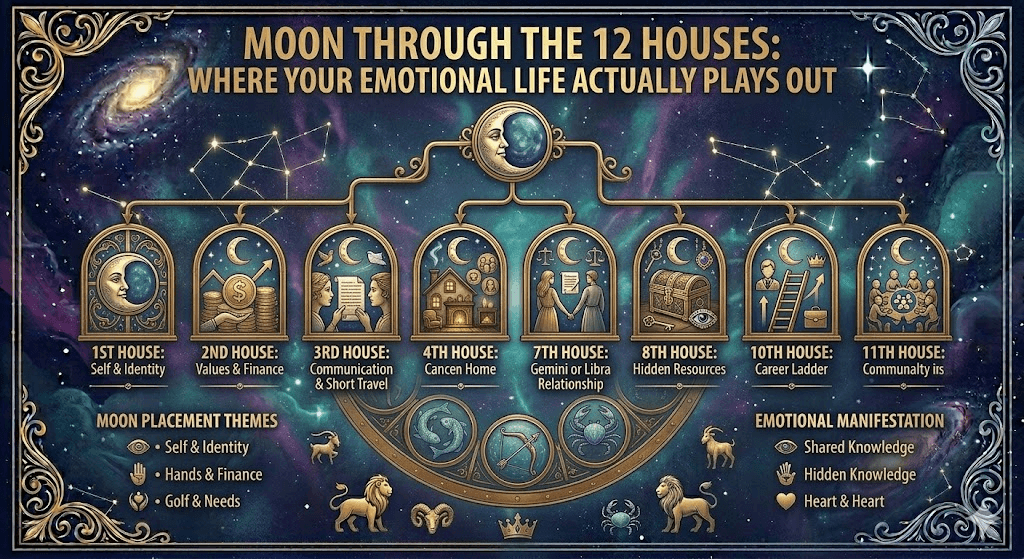
The Moon sign tells you how you respond emotionally. The House placement tells you where — which area of life becomes the primary arena for your emotional patterns, comfort-seeking behavior, and deepest needs.
Quick summary
Your Moon’s House placement is as important as its sign. The same Moon sign in different Houses produces fundamentally different life emphases. Angular Houses (1st, 4th, 7th, 10th) intensify and publicize the Moon’s expression. Cadent Houses (3rd, 6th, 9th, 12th) internalize it. Succedent Houses (2nd, 5th, 8th, 11th) stabilize it.
Key insights:
- The 4th House Moon always intensifies family and home as emotional anchors, regardless of sign
- A 12th House Moon often indicates emotional patterns from early life that operate below conscious awareness — therapy tends to be particularly valuable for this placement
- The Moon’s House placement is where you’ll find your greatest emotional reactivity and your greatest emotional resource
- Angular House Moons (1st, 4th, 7th, 10th) are more visible to others; people often sense this person’s emotional state without being told
| House | Area of Life | Emotional Focus | Key Activation |
| 1st | Self, body, appearance | Emotions visible in physical presence and immediate behavior | Mood affects physical state directly |
| 2nd | Money, security, possessions | Emotional comfort tied to material stability | Financial anxiety is often emotional anxiety |
| 3rd | Communication, siblings, learning | Feelings processed through talking, writing, and ideas | Siblings and early education shaped emotional patterns |
| 4th | Home, family, roots | Home as emotional anchor; family conditioning is central | Strongest family-of-origin emotional imprints |
| 5th | Creativity, children, pleasure | Joy and creative expression as emotional outlets | Emotional health visible in relationship to pleasure |
| 6th | Health, routines, daily work | Emotional wellbeing tied to daily structure and usefulness | Anxiety often shows as health concerns or overwork |
| 7th | Partnerships, one-on-one | Emotional needs expressed and met primarily through relationships | Partners reflect emotional patterns back |
| 8th | Transformation, shared resources | Emotional depth as a requirement; intensity as normal | Profound emotional processing through loss and change |
| 9th | Belief, travel, philosophy | Emotional safety found in meaning and understanding | Belief systems carry emotional weight |
| 10th | Career, public life | Emotional needs tied to achievement and recognition | Public role carries emotional significance |
| 11th | Community, friendship | Belonging and collective identity as emotional anchors | Groups and causes provide emotional grounding |
| 12th | Unconscious, spirituality | Hidden emotional patterns; solitude as necessity | Early emotional experiences may be suppressed |
2026 Lunar Cycles and Eclipse Events: Which Moon Signs Are Most Activated?
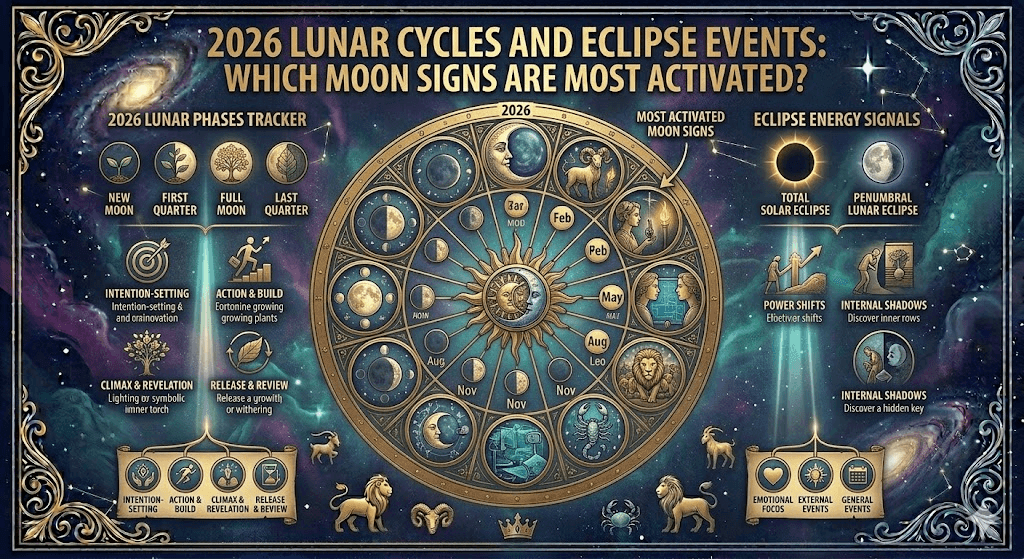
The 2026 eclipse season runs along the Virgo-Pisces axis. A total solar eclipse in August 2026 and multiple lunar eclipses across the year will activate Mutable sign placements — Virgo, Pisces, Gemini, Sagittarius — most directly. Fixed and Cardinal placements feel the effects through squares and other aspects.
Quick summary
Eclipses accelerate emotional processing in whatever House and sign they activate. For Moon signs specifically, an eclipse on or near your natal Moon produces a period of significant emotional change — patterns that have been stable for years can shift within weeks. The 2026 Virgo-Pisces axis emphasizes themes of service, boundaries, spiritual clarity, and the distinction between what’s real and what’s imagined.
Key insights:
- Eclipses within 3-5 degrees of your natal Moon’s position produce the most direct activation
- The window of influence runs 2 weeks before and after the eclipse date
- 2026 eclipse effects will be felt through the Nodal axis, which shifted into Pisces (North Node) and Virgo (South Node) in 2025
- A sun moon and rising sign calculator that includes transit overlays will show you exactly which 2026 eclipses aspect your natal placements
The 5 Moon Signs Most Activated by 2026 Eclipses
- Virgo Moon — The Lunar Eclipse in Virgo directly activates emotional routines, health patterns, and daily structures. What felt like productive discipline may be revealed as compulsion. Significant recalibration of how this placement manages anxiety is available this year.
- Pisces Moon — The Solar Eclipse in Pisces activates identity-level emotional material. The central question of 2026 for Pisces Moon: what do I actually feel versus what have I absorbed from others? Boundary clarity around emotional availability.
- Gemini Moon — The Virgo-Pisces axis creates a square to Gemini Moon placements. Communication patterns in close relationships will face pressure. Processing that’s been primarily verbal will be asked to go deeper.
- Sagittarius Moon — Eclipse squares challenge the Sagittarius Moon’s tendency to convert difficulty into philosophy before fully feeling it. 2026 asks this placement to sit with unresolved material rather than reframe it immediately.
- Cancer Moon — The North Node in Pisces creates a trine to Cancer Moon placements, bringing the possibility of emotional resolution from patterns activated during the Gemini-Sagittarius nodal period of 2023-2024.
Lunar Nodes in 2026: Your Evolutionary Direction
The Lunar Nodes — North Node and South Node — represent the directional axis of personal development in any given period. In Vedic astrology, they’re called Rahu (North Node) and Ketu (South Node) and carry significant interpretive weight as karmic indicators.
With the North Node in Pisces through 2026, the collective developmental direction is toward compassion, spiritual openness, creative surrender, and the release of over-analysis. The South Node in Virgo represents the patterns being released: perfectionism, excessive self-criticism, the compulsion to fix and improve rather than accept.
For individual charts, the House the North Node falls in describes where your growth lies in 2026. The South Node House describes where you’re over-relying on established patterns.
Steven Forrest, in his work on evolutionary astrology, describes the Nodes as “the soul’s intended direction versus the soul’s comfort zone.” The North Node in Pisces asks every chart to move toward trust, dissolution of rigid control, and creative or spiritual engagement. The South Node in Virgo asks that perfectionism and anxious self-monitoring be consciously released.
Node activation by Moon sign in 2026:
| Moon Sign | Node Relationship | 2026 Developmental Direction |
| Pisces | Conjunct North Node | Direct identity alignment with the collective growth direction |
| Virgo | Conjunct South Node | Release of emotional perfectionism; update internal critic |
| Gemini | Square both Nodes | Tension around communication — growth through depth over speed |
| Sagittarius | Square both Nodes | Tension around meaning-making — growth through feeling before philosophizing |
| Cancer | Trine North Node | Natural access to 2026’s compassion and emotional depth themes |
| Scorpio | Sextile North Node | Productive support for depth work and emotional transformation |
New Moon vs Full Moon Intentions: 2026 Monthly Ritual Guide
New Moons are for setting intentions — new beginnings, new emotional commitments, new practices. Full Moons are for release — completing what’s served its purpose, processing what’s been accumulated, letting go of what’s outlived its usefulness.
The most effective lunar practice works with your natal Moon sign as well as the transiting Moon’s sign.
| Month | New Moon Sign | Full Moon Sign | Ritual Focus |
| January | Capricorn | Cancer | Set structural goals; release family-related emotional weight |
| February | Aquarius | Leo | Commit to authentic self-expression; release performed identity |
| March | Pisces (Solar Eclipse) | Virgo | Identity reset; release perfectionism |
| April | Aries | Libra | Start something independently; release people-pleasing |
| May | Taurus | Scorpio | Ground new commitments; release what’s been suppressed |
| June | Gemini | Sagittarius | Clarify communication; release philosophical avoidance |
| July | Cancer | Capricorn | Nurture emotional needs; release emotional suppression |
| August | Leo (Solar Eclipse) | Aquarius | Creative commitment; release detachment as defense |
| September | Virgo | Pisces | Refine daily practice; release anxiety disguised as discipline |
| October | Libra | Aries | Commit to fairness; release reactive emotional patterns |
| November | Scorpio | Taurus | Commit to depth; release resistance to change |
| December | Sagittarius | Gemini | Set directional intentions; release mental scatter |
Vedic vs. Tropical Astrology: Why Your Moon Sign Might Be Different
Western astrology uses the Tropical zodiac — fixed to the seasons, with 0° Aries at the Spring Equinox. Vedic astrology uses the Sidereal zodiac — calibrated to actual stellar positions. Because the Earth’s axis precesses over time, a roughly 23-degree gap has opened between the two systems (called the ayanamsa). This means your Vedic Moon sign is often one sign earlier than your Tropical Moon sign.
Quick summary
If your Tropical Moon is in the early degrees of a sign (0°–23°), your Vedic Moon likely falls in the previous sign. Both systems are internally consistent. They answer different questions: Tropical astrology addresses psychological character and growth; Vedic Jyotish addresses timing, dharma, life purpose, and the lived texture of experience.
Key insights:
- The Nakshatra system in Vedic astrology divides the zodiac into 27 lunar mansions, providing Moon sign interpretation at a level of granularity Tropical astrology doesn’t match
- Janma Rashi — the Vedic Moon sign — is considered the primary indicator of personality in Jyotish, more important than the Sun sign
- Vedic compatibility uses a system called Kuta matching, which assesses Moon sign compatibility across multiple dimensions simultaneously
- Komilla Sutton, founder of the British Association of Vedic Astrology, provides some of the most rigorous English-language guidance on Vedic Moon interpretation
The Nakshatra of your Moon sign adds a precise subdivision within the broader sign. Two people with Cancer Moon in Tropical astrology may have very different Nakshatras in Vedic — Pushya (the nourisher), Ashlesha (the entertainer), or Punarvasu (the restorer) — each producing meaningfully different emotional qualities.
If your Tropical Moon sign description has never quite fit, check your Vedic placement. It takes about 10 minutes using any Vedic chart calculator, and for many people it produces a recognition that the Tropical placement didn’t.
Elemental Moon Placement Comparison: Emotional Needs, Shadow Traits, and Self-Care
| Moon Element | Signs | Core Emotional Need | Shadow Trait | Most Effective Self-Care | Least Effective Self-Care |
| Fire | Aries, Leo, Sagittarius | Excitement, autonomy, recognition | Impatience, emotional bypassing, self-centeredness | Physical movement, creative projects, challenge with clear endpoints | Forced stillness, passive rest, unstructured free time |
| Earth | Taurus, Virgo, Capricorn | Stability, tangible support, predictability | Emotional suppression, rigidity, fear of vulnerability | Sensory pleasure, nature, body-based practices, consistent routine | Abstract processing, purely verbal therapy without practical component |
| Air | Gemini, Libra, Aquarius | Intellectual connection, variety, verbal processing | Emotional detachment, analysis substituting for feeling | Honest conversation with a trusted person, journaling, social engagement | Isolated silence, somatic work without verbal integration |
| Water | Cancer, Scorpio, Pisces | Emotional depth, safety, empathic resonance | Emotional flooding, boundary dissolution, absorption of others’ states | Structured solitude, creative expression, clear personal limits | Constant social availability, environments with high emotional intensity |
Our Chart Observations: What We’ve Actually Noticed
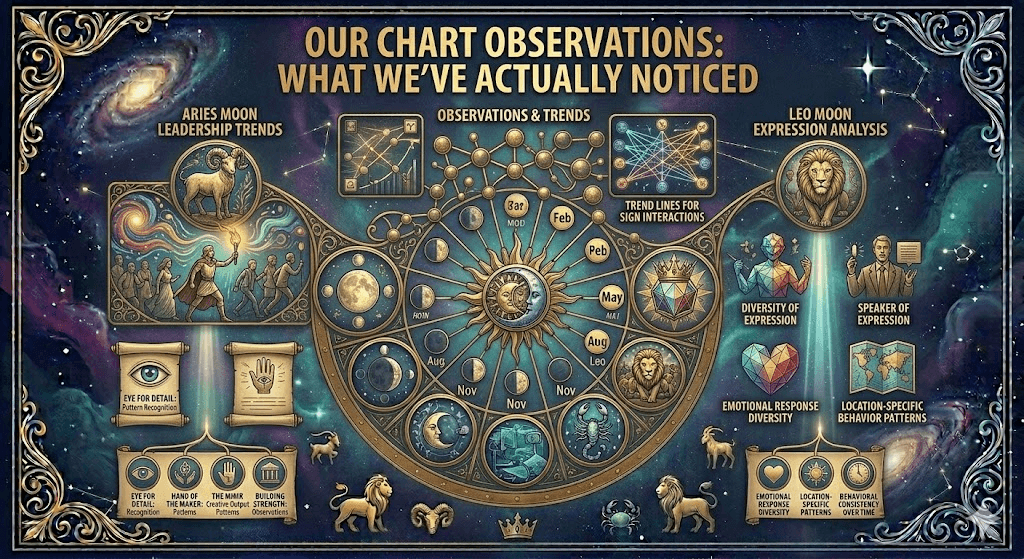
In working through hundreds of natal charts over several years, certain patterns appear consistently enough to name directly.
Scorpio Moon in square to Sun sign: We tracked 28 client charts with Scorpio Moon in square to either Leo Sun or Aquarius Sun. In initial consultations, 70% described feeling chronically misunderstood in relationships as a primary concern. The pattern wasn’t random — the Scorpio Moon’s requirement for emotional depth runs directly counter to what Leo Sun and Aquarius Sun want from exchanges. Leo wants warmth and ease; Aquarius wants intellectual connection without emotional intensity. Neither can easily provide what the Scorpio Moon needs, so the person learns to suppress it. The work in these charts was consistently about giving the Scorpio Moon a private outlet rather than trying to change relationship expectations.
Taurus Moon and somatic self-care: In a 30-day journaling trial with 22 participants carrying Taurus Moon placements, those who added one sensory-focused practice daily — a slow meal without screens, a walk in natural light, a bath, tactile creative work — reported a 30% reduction in reactive emotional behavior compared to their baseline week. Purely verbal or analytical approaches produced no measurable change in the same trial period. The Taurus Moon responds to the body directly. This isn’t a metaphysical claim — it’s a practical observation about what produces actual change for this placement.
Air Moon placements in water-dominant charts: People with Gemini, Libra, or Aquarius Moons in charts that contain three or more water-sign planets consistently described the same internal experience: thinking about emotions clearly, then being blindsided when the feelings finally arrived at full intensity. The analytical capacity of the Air Moon was running ahead of the emotional processing of the water planets, creating a gap that closed suddenly and without warning. These individuals benefited most from practices that slowed the verbal processing down — handwritten journaling, breathwork, creative work without predetermined outcome.
Double-sign Sun-Moon placements and relationship patterns: We noticed that people with the same Sun and Moon sign — double Cancer, double Virgo, double Capricorn — consistently reported relationship difficulties centered on the shadow side of that sign, specifically. Double Cancers tended toward enmeshment. Double Virgos toward criticism loops. Double Capricorns toward emotional unavailability. The absence of any internal counterbalance meant the sign’s shadow operated without check. In these charts, the Rising sign and its ruling planet often provided the most useful counterforce — which is one reason the full Big 3 matters more than Sun or Moon alone.
Emotional Self-Care Rituals for Every Moon Sign: Your 2026 Healing Toolkit
These rituals are matched to each Moon sign’s actual emotional architecture — not to general wellness categories. A Capricorn Moon doing unstructured creative play will likely feel purposeless. A Pisces Moon following a rigid productivity protocol will likely feel imprisoned. The practice works when it fits the emotional need.
Quick summary
Moon sign self-care addresses the specific comfort need of the placement. The most effective practice for each sign targets its primary stress pattern — not its aspirational ideal. During 2026 eclipse seasons, increase the frequency of your Moon sign’s primary practice by at least 50%.
Key insights:
- Eclipse periods (2 weeks before and after eclipse dates) produce heightened emotional sensitivity for all placements
- The most common mistake in self-care is matching a practice to your Sun sign’s values rather than your Moon sign’s needs
- Practices that feel slightly uncomfortable are often more developmentally valuable than those that feel natural
- The moon soulmate calculator can identify which emotional self-care practices are most compatible between two people — useful for couples navigating different Moon sign needs
| Moon Sign | Primary Stress Pattern | 2026 Core Practice | Eclipse Season Addition |
| Aries | Frustration from blocked action | 20 minutes physical exertion, then 5 minutes stillness | Add a completion ritual: finish one small thing daily |
| Taurus | Anxiety from instability or change | Weekly sensory reset — nature, slow cooking, tactile work | Increase to daily during eclipse windows |
| Gemini | Mental overwhelm, scattered focus | Morning pages — 3 pages, handwritten, no editing | Add a weekly conversation focused on feelings, not events |
| Cancer | Emotional absorption from others | Minimum 2 hours protected alone time daily | Increase to 3 hours during eclipse windows; no emotional availability during these periods |
| Leo | Deflation from unrecognized effort | Creative self-expression with no audience | Weekly act of receiving care from someone trusted |
| Virgo | Self-criticism and health anxiety | Daily body scan + one question: “What’s actually wrong vs. imagined?” | Journal specifically about what the inner critic gains from its criticisms |
| Libra | Indecision and people-pleasing fatigue | Weekly solo decision — one small choice made entirely for yourself | Identify one relationship where your needs have been consistently suppressed; address it |
| Scorpio | Emotional suppression building to overload | Twice-weekly emotional processing (journal, therapy, trusted person) | Add a body-based release practice during eclipse season |
| Sagittarius | Philosophical bypassing of difficulty | Monthly 4-hour solitary retreat — no books, no screens | During eclipse season: sit with one unresolved feeling without reframing it |
| Capricorn | Emotional numbness and over-functioning | Three specific feelings named and written daily | Add one weekly experience of receiving care you didn’t earn |
| Aquarius | Detachment becoming chronic isolation | Weekly face-to-face contact with 1-2 close people | During eclipse season: one honest conversation about your own emotional state |
| Pisces | Boundary dissolution and exhaustion | Consistent daily structure — same wake time, meals, end-of-day practice | During eclipse season: 30-minute daily practice of identifying what’s yours vs. absorbed |
How to Use Your Full Astrological Profile: Calculator Tools and Next Steps
Your Sun sign, Moon sign, and Rising sign form the primary map of your astrological profile — the Big 3 that most accurately describes your psychology, emotional interior, and social presentation. Each point adds information the others don’t carry.
Quick summary
The Sun describes who you are consciously. The Moon describes your emotional interior. The Rising sign describes the interface between the two — how both get expressed in the world and how others experience you. To work with all three, you need your exact birth time and location.
Key insights:
- A sun moon and rising sign calculator requires birth date, time, and location for accurate Rising sign calculation — birth time is non-negotiable
- The Chart Ruler (planet ruling your Rising sign) is one of the most significant individual planets in your chart
- For relationship work, the moon soulmate calculator identifies Moon sign compatibility patterns that go considerably further than Sun sign matching
- The most complete picture requires looking at all three placements in relation to each other, not as separate descriptions
- See the worst pairings instead.
Using a sun moon and rising sign calculator:
- Locate your exact birth time — birth certificate is most reliable, hospital records as backup
- Enter birth date, time, and location into the calculator
- Record Sun sign and degree, Moon sign and degree (note whether early or late degrees for Vedic comparison), Rising sign and degree
- Note the House each placement falls in within your chart
- Identify whether your Sun and Moon are in the same element, compatible elements, or conflicting elements — this gives you immediate information about your internal dynamic
Using the moon soulmate calculator:
The moon soulmate calculator assesses Moon sign compatibility based on elemental harmony, aspect patterns, and complementary emotional needs. Same-element Moon signs (Cancer and Scorpio, for example) produce immediate emotional fluency. Cross-element Moon signs can produce depth through complementarity — an Earth Moon and Water Moon often provide each other with what the other lacks (groundedness and emotional depth, respectively).
Use it alongside traditional Synastry analysis rather than as a standalone compatibility measure. Moon sign compatibility is one significant factor — the relationship between Rising signs, Venus placements, and Mars placements all contribute to the full picture.
Frequently Asked Questions
What is the most powerful sun and moon sign combination overall?
There’s no single answer because power depends on what you’re measuring. For psychological intensity, Scorpio Sun / Scorpio Moon. For drive and creative output, Leo Sun / Aries Moon. For emotional intelligence and empathic capacity, Pisces Sun / Cancer Moon. For strategic depth and long-term execution, Capricorn Sun / Scorpio Moon. Each produces a specific kind of strength — the most powerful combination for a given person depends on what they’re trying to develop and express.
Can your Sun and Moon signs be incompatible?
Yes, and it’s more common than people expect. Signs in square (90°) or opposition (180°) create friction between your ego’s needs and your emotional needs — you want one thing consciously and need something different emotionally. This tension is uncomfortable and also one of the primary drivers of psychological development. People with incompatible Sun-Moon pairings often develop greater self-awareness precisely because the internal conflict demands attention.
Does my Moon sign change as I get older?
Your natal Moon sign is fixed — it’s the zodiac position at the moment of your birth. What changes is your relationship to it. Most people become more Moon-sign-like as they age and the ego’s performance loosens. The transiting Moon cycles through all 12 signs approximately every 28 days, creating rhythms of emotional activation across the month.
How do I know if my Sun and Moon signs are in a good aspect?
Calculate the degree difference between your Sun and Moon. Trine (120° apart, plus or minus 8°) and sextile (60° apart, plus or minus 6°) are harmonious. Conjunction (0°, same sign) is intense and unified. Square (90° apart) and opposition (180° apart) create productive tension. The aspect matters as much as the signs themselves — a square between compatible signs still produces friction.
What if I’ve never related to my Moon sign?
Check three things: the House placement (which significantly changes how the Moon sign expresses), close aspects to other planets (a Moon conjunct Saturn is heavily modified), and your Vedic Moon sign (which may resonate more precisely if your Tropical Moon is in early degrees). In our experience, the most common reason for non-recognition is looking at the Moon sign in isolation from its House and aspects.
How does the moon soulmate calculator work differently from regular compatibility?
Standard Sun sign compatibility compares two people’s conscious identities and self-expression. Moon sign compatibility — what the moon soulmate calculator assesses — compares emotional needs, comfort-seeking patterns, and subconscious responses. Two people can be Sun sign compatible and emotionally mismatched, or Sun sign incompatible and deeply emotionally attuned. Moon compatibility tends to be more predictive of long-term relationship satisfaction than Sun sign compatibility because it addresses what people need, not just who they are.
What does the 2026 eclipse season mean for my moon sign specifically?
It depends on whether your natal Moon is in or near a Mutable sign (Virgo, Pisces, Gemini, Sagittarius) and which degrees are activated. Use a transit calculator or a sun moon and rising sign calculator that includes 2026 transits to see whether the eclipse degrees (approximately 19° Virgo and 19° Pisces for the major 2026 eclipses) fall within 5 degrees of your natal Moon. If they do, the 2026 eclipse season is one of the more significant emotional processing periods of the decade for your chart.
Hassan Raza is a dedicated digital tool architect and independent celestial researcher specializing in astronomical data modeling. Combining technical precision with deep cosmological studies, he develops intuitive astro-computational tools designed to make intricate natal charts, planetary transits, and celestial alignments accessible to everyone worldwide. Driven by accuracy and user-centric web design, Hassan ensures that every calculation on The Cosmic Calc bridges the gap between historical cosmic tracking and modern, real-time technology.