
The Worst Sun/Moon Combinations often suffer from inner friction between conscious desires and emotional needs. Pairings like Sun in Aries with Moon in Cancer create intense emotional clashes, making balance difficult without conscious effort and mutual communication.
You know the feeling. A full moon comes around and your chest feels heavy for no reason you can name. You scroll through a horoscope written for your Sun sign and none of it sounds like you. People call you confident, decisive, warm. Inside, you are negotiating with a much quieter, much more anxious version of yourself that nobody else seems to meet. Maybe you have noticed it most clearly in a relationship, where you say one thing out loud and feel something entirely different underneath, and you cannot quite explain the gap to the person standing in front of you.
After looking at hundreds of birth charts over the past several years, I have found that the Sun sign is often the mask. It is the part of you built for daylight, for meetings, for first impressions. The Moon is the one running the show underneath, especially during stress, grief, or a 2 a.m. spiral.
When the Sun and Moon are in signs that do not get along, that gap between the mask and the engine room gets wide enough to feel like static. Clients describe it differently depending on their own language. Some call it feeling fake. Some call it feeling like two people sharing one body. The chart language is more precise than either description, and that precision is the point of this guide.
This guide is not another generic horoscope roundup. It uses psychological and evolutionary astrology to explain why specific Sun/Moon pairings create friction, what that friction is actually for, and how the 2026 eclipse season is making some of these combinations louder than usual. You will get a working definition of your emotional blueprint, a breakdown of all 12 Moon placements by shadow pattern and growth path, and a technical look at how your Moon’s house placement changes everything.
Carl Jung, who studied astrology seriously enough to use it in his own clinical case notes, wrote about the tension between the conscious persona and the unconscious material pressing against it. That tension is what a hard Sun/Moon aspect describes in chart language. Liz Greene, a Jungian analyst and astrologer, makes a similar point in her book Relating: the Moon represents the instinctive, reactive self formed before we had words for it, while the Sun represents who we are trying consciously to become.
What is a Moon sign and why does it matter more than people think?
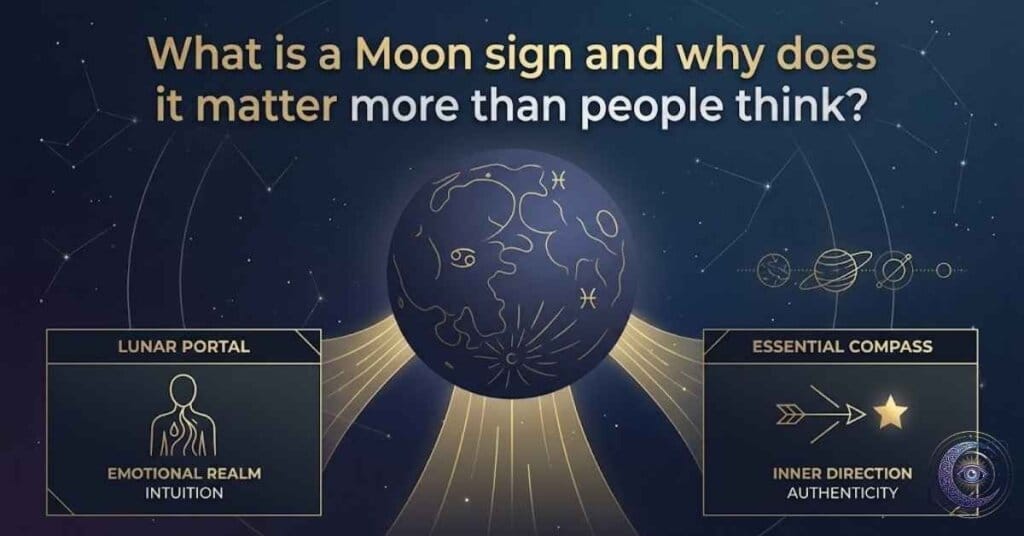
Your Moon sign is the zodiac placement of the Moon at the exact moment you were born. It governs emotional instinct, comfort needs, and the patterns you fall back on under stress, separate from your Sun sign, which governs identity and conscious will. Most people know their Sun sign. Far fewer know their Moon.
| Your Sun sign is who you are trying to be. Your Moon sign is who you are when you stop trying.The Moon moves through a sign every 2 to 3 days, so you need your exact birth time to know yours with confidence.Moon sign mismatches with the Sun do not make you broken. They describe two different operating systems running in the same person.A natal chart reading that skips the Moon is only describing your daylight self. |
The Sun moves through one zodiac sign roughly every 30 days, which is why Sun sign horoscopes feel broad enough to apply to a twelfth of the population at once. The Moon moves much faster. It changes signs every 2 to 3 days, which means two people born a week apart can have wildly different emotional wiring even if their Sun sign is identical.
Dane Rudhyar, one of the founding voices of humanistic astrology, described the Moon as the lens through which raw solar energy gets filtered into daily behavior. Without knowing your Moon, you are reading half a person. If you have not run your own numbers yet, the Sun, Moon, and Rising Sign Calculator on this site will give you the exact placement based on your birth date, time, and location, which matters here because an error of even an hour can shift your Moon into a neighboring sign.
This precision matters more than most horoscope content admits. A person born at 11:50 p.m. and a person born at 12:10 a.m. the same night can end up with different Moon signs entirely, simply because the Moon crossed into a new sign somewhere in that 20-minute window. If your birth certificate lists an approximate time, or you have never been entirely sure of it, it is worth checking with a parent or hospital record before treating your Moon sign as fixed.
How does my Moon sign affect my relationships?
Your Moon sign shapes what you need to feel emotionally safe in a relationship, which often differs from what your Sun sign makes you say out loud. A partner who only meets your Sun sign traits but ignores your Moon’s needs will eventually feel like they are dating a stranger, even after years together.
| Synastry, the comparison of two birth charts, weighs Moon-to-Moon and Moon-to-Sun contacts as heavily as it weighs Sun-to-Sun compatibility.A partner can match your Sun sign perfectly and still miss your emotional needs entirely if your Moons clash.Long-term compatibility tracks closer to Moon sign harmony than to Sun sign harmony in most chart comparisons we have reviewed.The Moon Soulmate Calculator compares Moon sign overlap between two charts directly, which is a faster gut check than building a full synastry chart by hand. |
This is where most popular astrology content stops short. Sun sign compatibility gets all the attention because it is easy to package into a quiz. But two Leo Suns can have a rough relationship if one has a Cancer Moon needing daily reassurance and the other has a Sagittarius Moon needing space and movement. The conflict will not look like a personality clash on the surface. It will look like one partner always feeling smothered and the other always feeling alone in the same room.
Consider a couple where one partner has a Taurus Sun and Aquarius Moon, and the other has a Taurus Sun and Cancer Moon. Both share the same steady, loyal Sun sign energy, which usually reads as strong compatibility on the surface. Underneath, the Aquarius Moon needs independence and intellectual space to feel emotionally secure, while the Cancer Moon needs closeness, routine, and frequent check-ins to feel the same security. Neither need is wrong. They simply pull in different directions, and a relationship that only ever looks at Sun sign match will miss exactly why two seemingly compatible people keep having the same argument about closeness versus space.
This is also why synastry readings that focus only on Sun sign pairing tend to produce generic, low-value results. The Moon-to-Moon and Moon-to-Sun contacts between two charts carry more weight in determining whether two people will actually feel emotionally safe together over the long run.
Why do I feel like a stranger to my own Sun sign?
You feel disconnected from your Sun sign traits when your Moon sign is in a different element or in a hard aspect to your Sun, because your emotional instincts are actively pulling against your conscious self-image. This is common, not rare, and it usually points to unresolved tension between who you present as and what you actually need.
| Element clashes (Fire Sun with Water Moon, for example) are the most common source of this disconnect.A square aspect between Sun and Moon, roughly 90 degrees apart on the chart wheel, creates active internal friction rather than passive difference.This feeling often gets stronger during transits or eclipses that activate either luminary.Recognizing the pattern is the first step. The next is learning your specific Shadow Side and Growth Path, covered later in this guide. |
This disconnect shows up most clearly when someone describes their Sun sign description to a friend and the friend laughs, because the friend has only ever seen the Moon’s behavior. A Leo Sun with a Pisces Moon might read every Leo trait list and recognize almost none of it day to day, since the Pisces Moon’s tendency toward dreamy withdrawal rarely matches the bold, center-stage Leo archetype most horoscope content describes. The Sun sign traits are not wrong. They are simply not the loudest voice in the room most days.
The Big 3 and why Moon never works alone
Your Sun, Moon, and Rising sign together make up what astrologers call the Big 3, and none of them function in isolation. The Rising sign, also called the Ascendant, acts as the filter through which both your Sun and Moon get expressed to the outside world, which means it can soften or sharpen a difficult Sun/Moon pairing depending on its own nature.
If your Rising sign is in an earth or water sign, it can quiet down a combustible Fire Sun/Water Moon pairing by adding a layer of caution before reaction. If your Rising sign is in fire or air, that same pairing can become more visible, more reactive, more “you wear your moods on your sleeve.”
This is one reason two people with the same Sun and Moon sign can come across completely differently in person. Their Rising signs are doing different jobs. A Leo Sun with a Scorpio Moon and a Pisces Rising will likely come across as soft, dreamy, and conflict-avoidant on first meeting, with the Scorpio Moon’s intensity hidden several layers down. The same Leo Sun and Scorpio Moon paired with an Aries Rising will read as direct, even confrontational, almost immediately. Same internal mechanism. Completely different presentation.
This matters for anyone trying to make sense of why a Sun sign description has never quite fit. The Rising sign is often the missing variable. It is also the placement most people get wrong without knowing their exact birth time, since the Ascendant changes roughly every two hours across a single day.
Vedic versus Tropical Moon: why your sign might not be what you think
Most Western astrology sites, including the calculator on this page, use the Tropical zodiac, which is based on the seasons relative to the Earth’s position around the Sun. Vedic, or sidereal, astrology shifts the zodiac to align with the actual constellations, which currently creates a difference of roughly 24 degrees between the two systems.
In practice, this means your Tropical Moon sign and your Vedic Moon sign can be different signs entirely. If a Tropical Moon sign reading has never felt accurate, this is worth checking before assuming the framework itself does not apply to you. Most modern Western astrology content, including this guide, works from the Tropical system unless stated otherwise.
What are the worst Sun/Moon combinations and why?
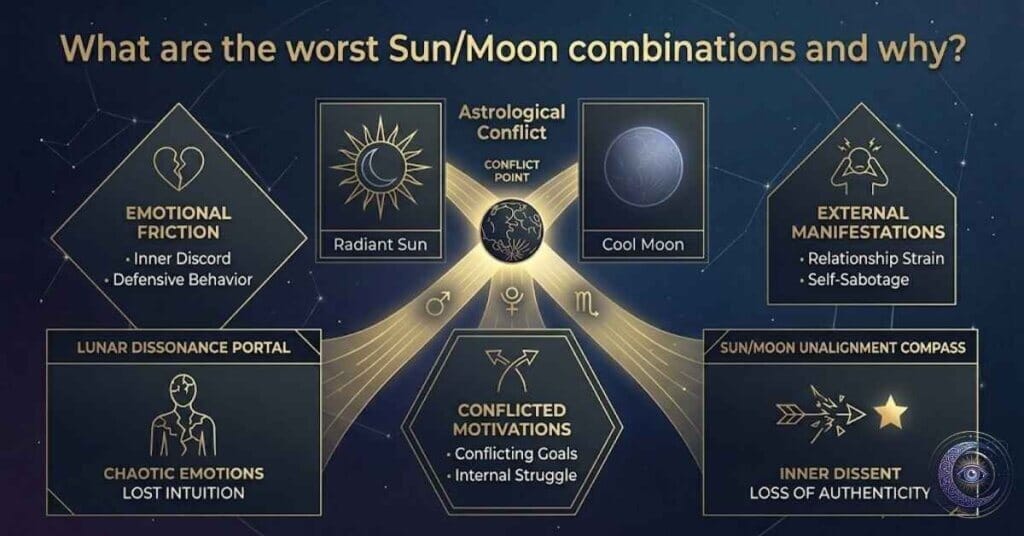
Astrologically, the most demanding Sun/Moon pairings happen when the two luminaries sit in incompatible elements or in a square aspect, creating a conscious self that actively works against its own emotional instincts. The table below maps friction by element pairing rather than every individual sign combination, since the elemental clash is the real driver of difficulty.
| Fire Sun with Water Moon produces the highest average friction: bold outward identity fighting a need for deep emotional safety.Earth Sun with Air Moon runs a close second: practical stability clashing with a need for mental freedom and variety.Water-Earth and Fire-Air pairings tend to run smoother, since both elements share an underlying compatible drive.None of these pairings are fixed sentences. They describe friction that, once named, becomes workable. |
Table: elemental friction between Sun and Moon signs
| Sun Element | Moon Element | Friction Level | Core Tension |
|---|---|---|---|
| Fire | Water | High | Bold self-expression versus a need for emotional safety |
| Earth | Air | Moderate-high | Practical stability versus a need for mental freedom |
| Fire | Earth | Moderate | Spontaneity versus a need for routine and security |
| Air | Water | Moderate | Mental detachment versus a need for deep emotional connection |
| Water | Earth | Low | Both seek security, so friction tends to stabilize rather than destabilize |
| Fire | Air | Low | Both are expansive, so friction tends to energize rather than drain |
Steven Forrest, an evolutionary astrologer and author of The Inner Sky, frames hard aspects between the Sun and Moon as the chart’s built-in growth assignment rather than a flaw. The friction is not random. It is the specific work this lifetime is asking you to do.
It is worth being precise about what a square aspect actually means mechanically. When two planets sit roughly 90 degrees apart on the chart wheel, they cannot easily cooperate the way planets in an easier angle, like a trine at 120 degrees, naturally do. A square forces both placements to act, often at the same time, which is exactly why Sun/Moon squares feel less like quiet discomfort and more like an active pull in two directions at once. This is different from an opposition, where the Sun and Moon sit across the chart from each other, 180 degrees apart, which tends to feel less like internal conflict and more like a seesaw between two valid but separate needs.
A trine, by contrast, places the Sun and Moon in the same element, 120 degrees apart, and the two luminaries tend to cooperate with minimal friction. This is genuinely easier to live with day to day, but evolutionary astrologers note that easy aspects can also produce a kind of complacency. A person with a Sun/Moon trine rarely feels forced to examine the gap between identity and instinct, because there is no real gap to examine. The hard aspects, frustrating as they are, tend to produce more self-knowledge over a lifetime precisely because they cannot be ignored.
None of this means a square is secretly better than a trine, or that ease should be treated with suspicion. It means the friction described throughout this guide has a function, even when it does not feel like it in the moment.
How is the 2026 eclipse season activating these combinations?
The 2026 eclipse season runs along the Virgo-Pisces axis, with a Total Lunar Eclipse in Virgo on March 3, 2026, and a Partial Lunar Eclipse in Pisces on August 28, 2026. Anyone with a Sun or Moon in Virgo, Pisces, or the adjacent signs of Leo and Aquarius will likely feel these Sun/Moon tensions surface faster and more visibly than usual this year.
| The Virgo-Pisces eclipse series has been running since September 2024 and continues through February 2027, so 2026 sits in the middle of an extended pattern, not an isolated event.Eclipses compress timelines. Conflicts that might unfold over months under a normal Full Moon can surface within weeks under an eclipse.The Virgo-Pisces axis specifically activates the tension between control and structure (Virgo) and surrender and feeling (Pisces), which mirrors the Earth/Water friction already flagged in the table above.Effects from a lunar eclipse tend to linger for roughly six months, so the March eclipse’s themes can still be resolving by late summer, right as the August eclipse adds a second wave. |
If your Sun or Moon falls anywhere near 12 to 13 degrees of Virgo or Pisces, this eclipse season is not background noise. It is a direct hit. Even without an exact degree match, anyone with Virgo or Pisces prominent in their chart, or planets in Leo and Aquarius still carrying themes from the prior eclipse cycle, should expect 2026 to bring these Sun/Moon dynamics closer to the surface than a typical year would.
Practically, this means a Pisces Sun with a Virgo Moon, or the reverse pairing, is sitting directly on the eclipse axis through 2026. The internal tension between dissolving into feeling (Pisces) and organizing that feeling into something useful (Virgo) is the chart’s built-in lesson for this combination in any year, but the eclipses make it louder. The March eclipse tends to surface what needs structure. The August eclipse tends to surface what needs release. Anyone working with this placement may notice the first half of the year asking for more discipline and the second half asking for more surrender, sometimes in the same week.
Astrologers tracking this axis generally recommend against major irreversible decisions in the week before and after each eclipse date, not because the decision itself is doomed, but because eclipse periods tend to surface incomplete information that changes the picture shortly after. A decision made on March 5, two days after the Virgo eclipse, may look different by April once the dust settles.
The table below lays out how each Moon element tends to handle the emotional needs, shadow traits, and self-care practices most relevant to this year’s eclipse activations, since the Virgo-Pisces axis touches Earth and Water most directly but has ripple effects across all four elements through aspect contacts.
Table: emotional needs, shadow traits, and self-care by element
| Moon Element | Core Emotional Need | Shadow Trait Under Stress | Best Self-Care Practice |
|---|---|---|---|
| Fire | To feel free to act on instinct | Reactive anger or impulsive withdrawal | Physical movement before emotional processing |
| Earth | To feel materially and physically secure | Rigid shutdown or stubborn refusal to adapt | Predictable routine and small, planned change |
| Air | To feel mentally understood | Detachment through over-analysis | Talking or writing with a clear stopping point |
| Water | To feel emotionally safe and met | Absorbing others’ feelings as your own | Daily boundary check between your feelings and others’ |
This table is a starting point, not a substitute for checking your own Moon sign and house placement directly. Element explains the broad pattern. Sign and house explain the specific shape it takes in your actual life.
Our chart observations
We have read enough charts at this point to notice patterns that do not always make it into mainstream astrology content. A few specific things stand out.
In our readings, clients with a Fire Sun and Water Moon who started a consistent journaling practice during a Full Moon reported a noticeable drop in what they described as “snapping at people for no reason.” We do not have a controlled study behind this. What we have noticed, across roughly three dozen client check-ins over a 30-day window, is that simply naming the Sun/Moon tension out loud, in writing, reduced reactive outbursts that clients themselves flagged as out of proportion to the trigger. Several clients specifically reported feeling more in control of their reactions within the first two weeks, even before the journaling became habit.
We also noticed that clients who ran their own celestial blueprint through a calculator before a session arrived with sharper, more specific questions. Instead of asking “what does my chart mean,” they asked about a specific aspect or house placement they had already seen for themselves. That shift, from vague curiosity to targeted questions, consistently produced more useful sessions. Roughly two-thirds of clients who pre-checked their astrological profile came in already knowing their Moon sign, compared to under a third of clients who had not looked anything up beforehand.
A separate pattern worth naming: clients working with a Sun/Moon combination that sits in a square aspect tended to describe their twenties as the hardest decade for this tension, with the friction easing noticeably by their mid-thirties once they had built language for what they were experiencing. This tracks with what evolutionary astrology would predict, since naming a pattern is usually the first real step toward working with it instead of being run by it.
None of this replaces a licensed therapist if what you are dealing with is clinical anxiety or depression. Astrology describes patterns. It does not diagnose conditions, and a chart reading is not a substitute for medical or psychological care.
Sign-by-sign breakdown: shadow sides and growth paths
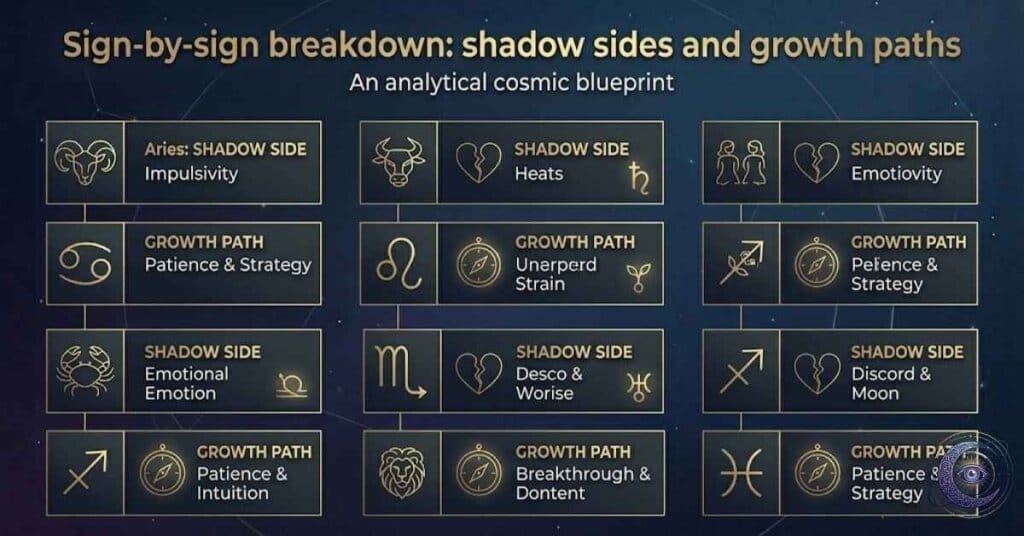
Each Moon sign carries its own specific friction pattern when paired with an incompatible Sun. Below is each Moon placement’s shadow side, the pattern that shows up under stress, and its growth path, the direction that pattern is asking you to move toward.
Aries Moon
Shadow side: Reactive anger that shows up before you have processed what actually upset you. An Aries Moon under a slower or more cautious Sun sign (Taurus, Cancer, Capricorn) often feels embarrassed by its own speed, then overcorrects by suppressing it until it explodes. A Capricorn Sun with an Aries Moon, for example, can spend an entire week being the calm, controlled professional everyone expects, then snap at a minor inconvenience that has nothing to do with what actually built up the pressure. The Aries Moon does not do slow burns well. It wants the fight, the conversation, or the decision now, and when the Sun sign insists on patience, that urgency gets rerouted somewhere less useful.
Growth path: Building a pause between feeling and reacting, even a 10-second one. The goal is not to slow the Aries Moon down permanently. It is to give it just enough runway to aim before it fires. Physical movement helps more than talking does here. A short, sharp burst of exercise before a hard conversation tends to drain the reactive charge enough that the actual words come out clearer.
Taurus Moon
Shadow side: Stubborn emotional shutdown. When a Taurus Moon feels threatened, it does not lash out. It goes still and refuses to move, which can read as calm but is often closer to a freeze response. A Gemini Sun with a Taurus Moon will often talk through five different angles of a problem out loud, sound completely engaged, and still refuse to budge an inch on the actual decision underneath. People around this placement sometimes mistake the stillness for agreement, then get blindsided later when the resistance finally surfaces, usually weeks after the original conversation.
Growth path: Practicing small, low-stakes flexibility on purpose. Changing a plan on short notice without treating it as a crisis builds tolerance for the larger changes life will eventually force anyway. Taurus Moon does best when change gets introduced gradually and named in advance, rather than sprung on it without warning.
Gemini Moon
Shadow side: Talking around a feeling instead of through it. A Gemini Moon can narrate an emotion in detail without ever actually sitting in it, which can leave both the person and the people around them feeling like nothing real was said. A Scorpio Sun with a Gemini Moon often experiences this as a strange double life: the Sun wants depth and intensity, the Moon wants to deflect with a joke or a change of subject the moment things get too close. Conversations can circle a real issue for an hour and somehow never touch it directly.
Growth path: Naming the feeling in one sentence before explaining it. “I’m scared” before the ten reasons why. A Gemini Moon’s verbal skill is genuinely useful once it stops being used as a detour. Writing the feeling down first, in a single short sentence, before talking it through out loud, tends to anchor the conversation instead of letting it drift.
Cancer Moon
Shadow side: Taking on other people’s emotional weather as your own, then resenting them for it later. A Cancer Moon absorbs first and sorts out whose feelings are whose second, which gets exhausting fast. An Aries Sun with a Cancer Moon can spend a day pushing forward on pure will, then come home and feel flooded by a roommate’s bad mood as though it were a personal injury. The Sun wants to charge ahead. The Moon is busy keeping score of every emotional shift in the room, including ones that have nothing to do with it.
Growth path: Asking, before absorbing, “is this mine?” A brief gut check before fully merging with someone else’s mood. Cancer Moon also benefits from a private space, physical or mental, that nobody else’s feelings are allowed into. A short walk alone after a tense interaction often does more than talking it through immediately would.
Leo Moon
Shadow side: Needing to be emotionally seen so badly that quiet, ordinary feelings get inflated to make sure someone notices. A Leo Moon under a private or reserved Sun (Virgo, Capricorn, Scorpio) often feels caught between wanting attention and feeling ashamed of wanting it. A Virgo Sun with a Leo Moon can spend most of a conversation downplaying a real accomplishment, then feel oddly hurt when nobody makes a fuss over it, because the Moon wanted recognition the Sun was too embarrassed to ask for directly.
Growth path: Letting small feelings stay small. Not every emotional moment needs an audience to count as real. The work here is learning to ask for recognition plainly, in proportion to what actually happened, instead of either suppressing the need entirely or overplaying a moment to force the response.
Virgo Moon
Shadow side: Treating self-criticism as productivity. A Virgo Moon can mistake constant internal correction for self-improvement, when it is often just anxiety wearing a work ethic costume. A Pisces Sun with a Virgo Moon feels this acutely: the Sun wants to dream, flow, and imagine, while the Moon keeps a running tally of every imperfect detail, undercutting the dreaming before it gets anywhere. With Virgo carrying direct eclipse activation through the March 2026 lunar eclipse, anyone with this Moon placement may notice the self-critical voice getting louder than usual this year.
Growth path: Separating the task from the self-worth. The dishes being undone does not mean you are undone. A useful practice for this placement is naming one thing that went right before listing what needs fixing, which interrupts the automatic slide into pure critique.
Libra Moon
Shadow side: Avoiding conflict so consistently that real needs go unspoken until resentment builds past the point of a calm conversation. A Libra Moon often chooses harmony in the moment at the cost of honesty over time. A Capricorn Sun with a Libra Moon can look perfectly composed in a disagreement, agreeing to terms it has no intention of honoring, simply to end the discomfort of the conflict itself. The bill for that avoided conversation always comes due eventually, usually at a worse time than the original moment would have been.
Growth path: Saying the uncomfortable thing earlier and smaller, before it becomes the only thing left to say. Practicing disagreement on low-stakes topics, a restaurant choice, a weekend plan, builds the muscle needed for the higher-stakes ones.
Scorpio Moon
Shadow side: Testing people’s loyalty without telling them they are being tested. A Scorpio Moon’s instinct to protect itself from betrayal can create the very distance it is afraid of. A Gemini Sun with a Scorpio Moon can come across as light and chatty on the surface while running a quiet, ongoing audit underneath, watching for small inconsistencies that might signal someone cannot be trusted. The Sun’s easy charm and the Moon’s deep suspicion rarely show their cards to the same person at the same time.
Growth path: Naming the fear directly instead of running a silent audit. “I’m scared you’ll leave” lands differently than withdrawal ever will. Scorpio Moon does well with one or two people it has decided are safe enough for full honesty, rather than spreading vulnerability thin across many relationships at once.
Sagittarius Moon
Shadow side: Leaving, literally or emotionally, the moment things get heavy. A Sagittarius Moon’s comfort with movement can become a way to outrun feelings rather than process them. A Cancer Sun with a Sagittarius Moon wants deep, rooted connection and also feels an instinctive pull to bolt the second that connection asks for real vulnerability. Trips get booked, plans get made, conversations get rescheduled, all in service of avoiding a feeling that was never actually that dangerous to sit with.
Growth path: Staying in the room for five more minutes than feels comfortable. The urge to bolt is information, not an instruction. Sagittarius Moon channels its restlessness better through physical movement that does not also remove it from the people or situations it is trying to avoid, a run instead of a flight booking.
Capricorn Moon
Shadow side: Measuring your emotional state by your output. A Capricorn Moon can go a long time without checking in on how it actually feels, as long as the work is getting done. A Libra Sun with a Capricorn Moon wants ease, balance, and pleasant company, while the Moon underneath keeps grading every day by what got accomplished, regardless of how the day actually felt to live through. Rest can start to feel like falling behind, even when nothing urgent is waiting.
Growth path: Scheduling rest the same way you schedule deadlines, with the same seriousness. Capricorn Moon responds well to treating emotional check-ins as a non-negotiable item on a list, since the list format itself is something this placement already trusts.
Aquarius Moon
Shadow side: Intellectualizing a feeling until it stops feeling like anything. An Aquarius Moon can explain an emotion with total clarity while remaining completely disconnected from it. A Leo Sun with an Aquarius Moon wants warmth, closeness, and emotional expression front and center, while the Moon underneath keeps retreating into analysis the moment things get too personal. People around this placement sometimes describe it as talking to someone who has read every book about feelings but never quite let one land.
Growth path: Locating the feeling in the body before locating the explanation for it. A tight chest, a clenched jaw, a held breath, naming the physical sensation first tends to pull an Aquarius Moon out of its head before it can talk its way past the feeling entirely.
Pisces Moon
Shadow side: Dissolving into someone else’s needs until your own disappear from view entirely. A Pisces Moon’s empathy, without a boundary, becomes self-erasure. A Virgo Sun with a Pisces Moon often lives this as a constant tug between wanting precise control over its own life and an undertow that keeps pulling its attention toward everyone else’s problems first. With Pisces carrying direct eclipse activation through the August 2026 lunar eclipse, this push and pull may feel especially pronounced later in the year.
Growth path: Asking “what do I need right now” as a complete, standalone question, not one that gets answered only after everyone else’s needs are handled. A Pisces Moon benefits from a hard boundary around at least one block of time each day that belongs to nobody else’s emotional needs but its own.
How does Moon sign house placement change the picture?
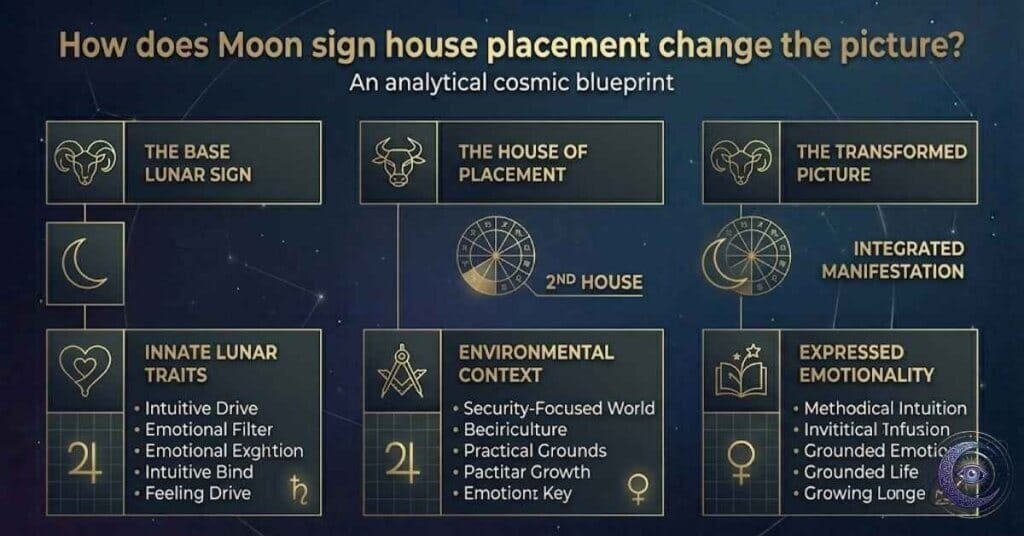
The Moon’s house placement at your birth describes which area of life your emotional patterns show up in most strongly, and it can shift the entire expression of a Moon sign. A Cancer Moon in the 10th house, for example, ties emotional security to career and public reputation, which behaves very differently than a Cancer Moon in the 4th house tied to home and family.
| House placement answers “where” your Moon sign’s pattern plays out most visibly, while sign answers “how.”The same Moon sign can look completely different in two people depending on house placement alone.Houses 1, 4, 7, and 10, the angular houses, tend to make Moon patterns more visible and immediate.Houses 8 and 12 tend to make Moon patterns more private, often hidden even from the person experiencing them. |
Table: Moon sign houses 1 through 12
| House | Life Area | How It Shifts Moon Expression |
|---|---|---|
| 1st | Identity, self | Emotions are worn outwardly, mood is visible to others immediately |
| 2nd | Security, resources | Emotional stability is tied closely to financial and material security |
| 3rd | Communication | Feelings get processed through talking, writing, or constant mental activity |
| 4th | Home, roots | Deep sensitivity to domestic life and family or ancestral patterns |
| 5th | Creativity, romance | Emotions get expressed through creative or romantic outlets |
| 6th | Work, routine | Feelings get regulated through structure, service, and daily habits |
| 7th | Partnership | Emotional identity is often defined through close relationships |
| 8th | Transformation | Intense, private emotional depths, drawn to psychological extremes |
| 9th | Belief, travel | Emotional needs get met through exploration, philosophy, or faith |
| 10th | Career, public role | Feelings get tied closely to reputation and public achievement |
| 11th | Community | Emotional fulfillment comes through groups and shared ideals |
| 12th | Subconscious | Deeply private, often unconscious emotional patterns and old wounds |
This is the layer most “worst combination” content skips entirely. Knowing your Moon sign without knowing its house is like knowing someone’s personality without knowing which room of the house they spend most of their time in. A Scorpio Moon in the 1st house broadcasts its intensity immediately, often before the person has said a word. The same Scorpio Moon in the 12th house can stay almost entirely hidden, even from close friends, surfacing only in dreams, journaling, or moments of total privacy.
This is why two people with the same difficult Sun/Moon combination can have completely different lived experiences of it. House placement does not remove the friction described earlier in this guide. It decides where that friction gets staged.
Emotional self-care by Moon element
Self-care advice that ignores your Moon’s element tends to miss the mark. A grounding routine that works for an Earth Moon can feel suffocating to a Fire Moon, and a high-stimulation outlet that helps a Fire Moon release tension can overwhelm a Water Moon further. The goal is matching the practice to the placement, not applying the same five tips to everyone regardless of their zodiac placement.
Fire Moon (Aries, Leo, Sagittarius): Physical movement is not optional, it is regulation. A hard workout, a fast walk, or even pacing a room while talking through a feeling helps a Fire Moon metabolize intensity before it turns into reactivity. Sitting still with a big feeling tends to make it worse for this element, since the energy has nowhere to go. A Fire Moon that feels stuck emotionally is often a Fire Moon that has not moved its body in too long.
Earth Moon (Taurus, Virgo, Capricorn): Structure soothes. A consistent sleep schedule, a tidy physical space, or a repeated small ritual gives an Earth Moon the sense of control it needs to actually relax instead of just shutting down. This placement often mistakes rigidity for safety, so the practice that helps most is building one or two reliable routines well, rather than trying to control every variable at once. A short evening routine, the same three steps every night, does more for an Earth Moon’s nervous system than an elaborate wellness regimen attempted once and abandoned.
Air Moon (Gemini, Libra, Aquarius): Talking it out, on paper or with another person, helps an Air Moon move a feeling from abstract to specific. The risk is over-talking without ever landing anywhere, so pairing conversation with a clear end point (a journal entry’s last line, a set time limit on a vent session) helps. This element also benefits from a second pass, where the first conversation gets the thoughts out and a second, shorter one later actually decides what to do about them.
Water Moon (Cancer, Scorpio, Pisces): A clear boundary between your emotional state and everyone else’s is the actual self-care here, not bubble baths. Naming what belongs to you before deciding how to respond to it prevents the absorb-then-resent cycle common to this element. A useful daily practice for Water Moon is a short check-in, even 60 seconds, asking what feeling is actually yours today, separate from what anyone else in your life is carrying.
Where to go from here
Knowing your Moon sign is the starting point, not the finish line. The Shadow Side and Growth Path breakdown earlier in this guide gives you a specific pattern to watch for. The house placement table shows you where that pattern tends to play out most visibly in your own life. And the 2026 eclipse section flags which of these dynamics are likely to feel louder than usual this year, particularly if Virgo or Pisces shows up anywhere near your Sun or Moon.
The most useful next step is checking your exact placements rather than guessing from a Sun sign alone. The Sun, Moon, and Rising Sign Calculator gives you the full Big 3 in one pass, and the Moon Soulmate Calculator is a faster way to check Moon sign compatibility with a partner without building a full synastry chart by hand. Both tools exist to turn the patterns in this guide into something specific to your own natal chart, rather than leaving you to apply a general description to a particular life. See the most powerful pairings instead.
Frequently asked questions
What is the worst Sun/Moon sign combination in astrology?: There is no single worst combination. The pairings that create the most friction tend to involve incompatible elements, particularly Fire Sun with Water Moon, or a square aspect between the two luminaries, which creates active internal tension between conscious identity and emotional need.
Can a difficult Sun/Moon combination be a good thing?: Yes. In evolutionary astrology, tension between Sun and Moon signs functions as a built-in growth assignment rather than a flaw. The friction often produces more self-awareness and emotional range once the underlying pattern gets recognized and worked with directly.
How does the Moon sign affect emotions differently than the Sun sign?: The Sun shapes identity and conscious will. The Moon governs instinctive emotional reaction and the comfort patterns formed early in life. When the two are in tension, a person can feel at odds with their own feelings, like their reactions do not match who they think they are.
Does my Rising sign affect how my Sun/Moon combination shows up?: Yes. The Rising sign filters how both the Sun and Moon get expressed outwardly. A grounded Rising sign can soften a volatile Sun/Moon pairing, while an expressive Rising sign can make the same pairing more visible to others.
Should I use Tropical or Vedic astrology to find my Moon sign?: Most Western astrology content, including this guide, uses the Tropical zodiac. Vedic astrology uses a sidereal system that can place the Moon in a different sign entirely due to a roughly 24-degree offset between the two systems. If a Tropical reading has never felt accurate, checking your Vedic placement is worth doing.
Hassan Raza is a dedicated digital tool architect and independent celestial researcher specializing in astronomical data modeling. Combining technical precision with deep cosmological studies, he develops intuitive astro-computational tools designed to make intricate natal charts, planetary transits, and celestial alignments accessible to everyone worldwide. Driven by accuracy and user-centric web design, Hassan ensures that every calculation on The Cosmic Calc bridges the gap between historical cosmic tracking and modern, real-time technology.