
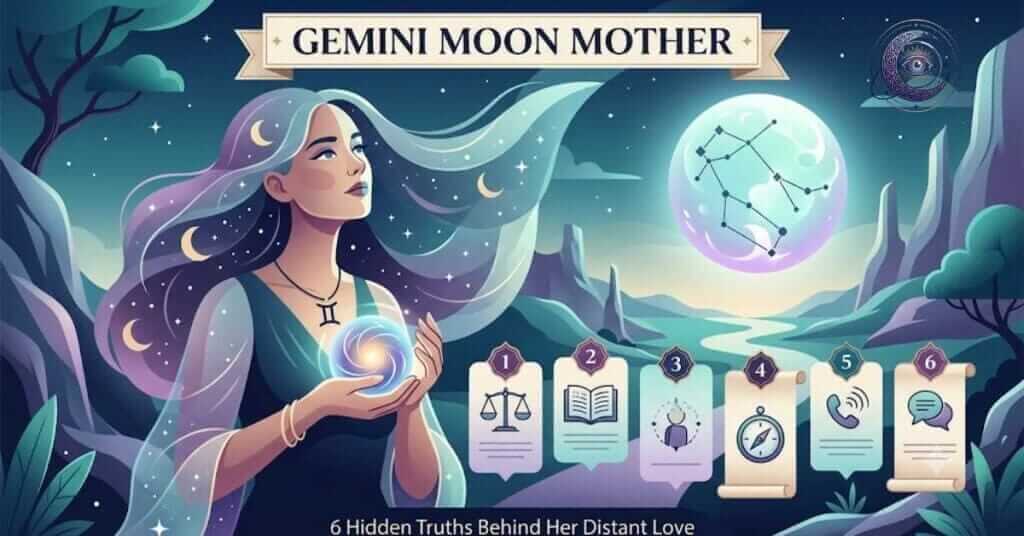
If you had a Gemini Moon mother, you probably remember the sound of her voice more than the feel of her hug. You can probably recall exactly how she explained things, how she turned an argument into a debate, or how she filled silence with questions before you even sat down to talk. What’s harder to name is a quieter ache: the sense that she loved you, but the love came wrapped in words instead of warmth you could hold.
After going through hundreds of birth charts for readers of TheCosmicCalc.com, one pattern shows up again and again with Gemini Moon mothers. The Sun sign gets remembered first. It’s the loud one, the friendly one, the parent people describe at parties. The Moon sign works quietly underneath it. It decided how she comforted you, how she argued with you, and how close you felt to her on an ordinary Tuesday.
This guide goes past the usual one-line horoscope description of a talkative, curious mother. It covers what a Gemini Moon actually needs to feel safe, how the placement changes depending on which House it sits in, what the 2026 lunar eclipses mean for this bond, and what to actually do with all of it, whether you’re the child or the mother in this story.
What does it mean if your mother has a Gemini Moon?
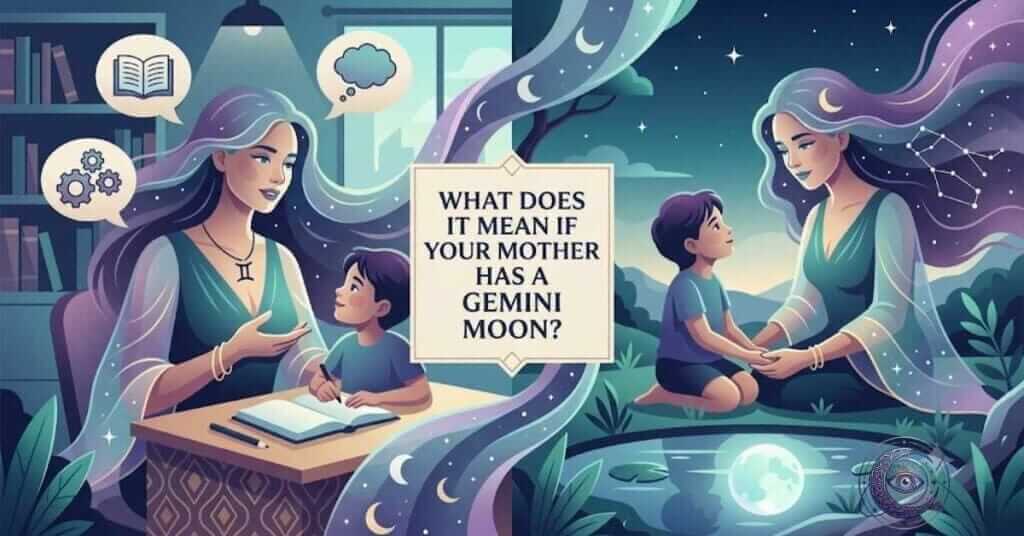
A Gemini Moon mother processes feelings by talking, not by sitting quietly with them. She’s usually quick, curious, and more comfortable in conversation than in silence. Her love often shows up as questions, jokes, and shared ideas instead of steady physical affection, and that pattern usually starts early.
Your natal chart is a map of where every planet sat at the exact moment you were born. Among all those points, the Sun and Moon carry the most personal weight. Astrologers call them the Luminaries, because they light up the rest of the chart. The Sun is who you’re becoming. The Moon is who you already are when nobody’s watching.
Gemini rules communication, so a Gemini Moon translates emotion into language. Fear becomes a joke. Sadness becomes a story. Frustration becomes a sharp comment that lands before there’s been time to think it through. That’s simply how a mutable air sign processes anything that feels too big to sit with quietly. Mutable signs shift and adjust by nature, and air signs tend to process the world through thought before feeling, so she often needs to talk something out before she can actually feel it.
Steven Forrest, in his book The Moon Through the Twelve Signs, describes the Gemini Moon as needing a steady supply of new conversation, new ideas, and change to feel nourished. When she had that stimulation growing up, she likely showed up curious and playful. When she didn’t, the same placement could turn restless or scattered.
One more thing worth checking before you settle on a Moon sign: there are two different systems for calculating it. Western astrology, the version most calculators default to, uses the Tropical zodiac, which lines up with the seasons. Vedic astrology uses the Sidereal zodiac, which lines up with the actual position of the constellations and runs about 24 days behind Tropical placements. Someone calculated as a Gemini Moon in the Tropical system can come out as a Taurus Moon in the Vedic system. Neither one is wrong, they’re just two different maps of the same sky, so it helps to know which system a reading is using before comparing notes with someone else.
How does the Big 3 change what a Gemini Moon mother looks like?
Your mother’s Sun sign and Rising sign shape how her Gemini Moon actually comes across day to day. A grounded Sun sign can soften her restlessness. A private Rising sign can hide it almost completely. The Moon still runs her emotional world underneath, but the Sun and Rising decide what you actually see on the surface.
Astrologers sometimes call the Sun, Moon, and Rising sign the Big 3, because together they explain most of what a birth chart is doing. The Sun is identity. The Rising sign, also called the Ascendant, is the first impression a person gives. The Moon is the emotional engine running behind both of them.
A Taurus Sun with this Moon often looks steady and patient on the outside, while the Gemini Moon keeps her mentally active and quick to change subjects in private. A Cancer Sun with this Moon can seem nurturing and home-focused, but conversation, not cuddling, is still how she bonds. A Capricorn Sun with this Moon often reads as serious and career-focused, while the Moon underneath still needs regular mental stimulation to feel emotionally settled.
None of these combinations cancel out the Gemini Moon. They just change how it’s expressed.
It’s worth separating a Gemini Moon from a Gemini Rising here, since people mix them up often. Rising sign is about first impressions, how someone comes across in the first five minutes of meeting them. Moon sign is about what actually happens once the door is closed and the audience is gone. A mother can have a completely different Rising sign and still run on the same Gemini Moon underneath, which is why two people’s memories of the same mother can sound like they’re describing two different people.
What do the 2026 lunar eclipses mean for a Gemini Moon mother?
Two lunar eclipses land in 2026: a total lunar eclipse in Virgo on March 3, and a partial lunar eclipse in Pisces on August 27 and 28. Both sit on the mutable axis that includes Gemini, which means they tend to surface old communication patterns between a Gemini Moon mother and her child.
Eclipses tend to speed things up. They don’t create new issues so much as they push existing ones into the open faster than usual.
The March 3 total lunar eclipse in Virgo asks her to slow down and get specific instead of talking in circles. Virgo is detail-focused and grounded, the opposite instinct of scattered Gemini energy. Conversations around this date may feel more direct, sometimes uncomfortably so, but they tend to clear the air rather than add more noise to it.
The August 27 and 28 partial lunar eclipse in Pisces works differently. Pisces is emotional and nonverbal, unfamiliar territory for a mother whose Moon runs on words. Around this eclipse, she and her child may find that some things finally get felt instead of explained. That can feel strange at first, since talking has always been the safety net, but it often turns into the more honest exchange of the two.
How does a Gemini Moon mother’s parenting land on each child’s own Moon sign?
A Gemini Moon mother’s parenting style lands differently depending on her child’s own Moon sign. A Cancer Moon child may crave more physical comfort than she naturally gives. A Capricorn Moon child may bond with her intellectually with ease. The fit comes down to matching emotional languages between mother and child.
Cancer Moon child. This child needs steady physical comfort and a predictable emotional rhythm. Her quick pace and constant talking can feel unsettling here. The relationship often improves once she learns that sitting quietly next to her child, without narrating the moment, is its own kind of love.
Scorpio Moon child. This child wants depth and privacy, and can find her constant questions intrusive. The bond tends to work best when she asks fewer questions and simply stays present, letting her child come to her instead of chasing the conversation.
Capricorn Moon child. This pairing often works well early on, since both value logic and clear communication. Her ability to explain things clearly suits a Capricorn Moon child’s need for structure, though the child may eventually want more warmth than words alone can carry.
Taurus Moon child. This child wants routine and physical steadiness, which sits at odds with the Gemini Moon’s need for variety. She can build in a few small, unchanging rituals, like a set bedtime chat, to give this child the stability the placement doesn’t offer by default.
Aries Moon child. This child wants fast, direct answers and gets impatient with a long, winding explanation. The pairing usually works well since both move quickly, though the child may need her to slow down every so often and just say the short version first.
Pisces Moon child. This child feels first and explains later, which is nearly the reverse order of how she processes things. The relationship tends to grow once she learns to let a feeling sit unexplained for a while instead of naming it too fast for her child’s comfort.
What’s the shadow side of a Gemini Moon mother, and what’s the growth path?
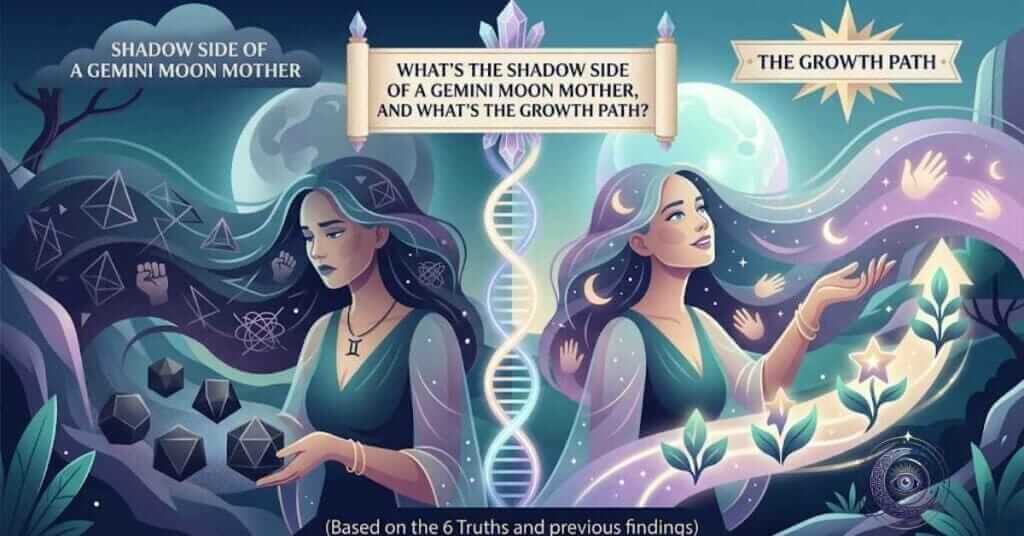
The Gemini Moon’s shadow side shows up as emotional avoidance disguised as being reasonable. She might explain away a feeling instead of sitting with it, both her own and her child’s. The growth path involves naming the feeling first, in one word, before trying to explain or fix it.
Steven Forrest puts it plainly. He writes that when this placement turns unhealthy, “the Gemini Moon degenerates into shallowness and running around in circles.” That’s the shadow in one sentence: motion without landing anywhere.
Liz Greene, in Astrology for Lovers, names a related pattern she calls the “irresponsible-child syndrome,” where the sign avoids emotional weight by staying light and moving on before things get too real.
For a Gemini Moon mother, the shadow rarely looks dramatic from the outside. It looks like changing the subject. It looks like turning a hard conversation into a joke. It looks like being so quick with an explanation that nobody, including her, gets a chance to actually feel the thing underneath it.
The growth path starts small. Developmental psychologist John Bowlby’s attachment theory describes how children build internal expectations about relationships based on how consistently a caregiver responds to their emotional needs, not just their words. That means practicing a pause: naming the feeling in one word, sad, scared, angry, before explaining it away. For her child, growth often means learning to ask directly for depth: “I don’t need you to fix this, I just need you to sit here with me for a minute.”
A simple daily habit helps here. Each evening, ask one word first: how did today feel, not what happened today. The second question invites a story. The first one forces a feeling to the front before the explaining starts. Over a few weeks, that small change in order tends to shift the entire conversation, since the feeling finally gets named instead of getting talked around.
How does House placement change a Gemini Moon mother’s parenting?
The House a Moon sits in shows where its emotional pattern plays out most strongly. A Gemini Moon in the 4th House puts that need for conversation right into the home itself. The same Moon in the 10th House puts it into her career and public identity instead, changing how the pattern reaches her child.
Houses in a chart represent the areas of life a planet’s energy shows up in, such as home, career, or relationships. A Gemini Moon in the 4th House turns the home into a place full of books, media, and conversation, sometimes at the cost of quiet or stillness. A Gemini Moon in the 10th House pulls that same need for stimulation into work and public life, so she may talk about her career or ideas with her child more than she talks about feelings directly. A Gemini Moon in the 3rd or 7th House tends to treat siblings, or a co-parent, almost like teammates in raising the child, with decisions made through discussion rather than authority.
House placement isn’t the only layer worth checking. Aspects, the angles planets form to each other in a chart, can tighten or loosen a placement’s default pattern. A Gemini Moon in easy aspect to Mercury tends to communicate with less friction. A Gemini Moon in a tense aspect to Saturn can turn the same talkativeness into anxious overthinking instead of playful curiosity. This is also where synastry, the comparison between two people’s charts, becomes useful. Running a mother’s chart against her child’s shows exactly where their Moons support each other and where they’re likely to talk past one another.
The table below breaks down six common placements and what each one tends to look like in practice.
| House | Mothering style | Child’s likely experience |
|---|---|---|
| 1st | Identity expressed through constant self-narration | Learns to talk before learning to sit with feeling |
| 3rd | Sibling-like, treats child as an intellectual equal early | Feels like a friend more than a parent growing up |
| 4th | Home full of ideas, media, and movement | Craves a stability the household doesn’t naturally offer |
| 6th | Mothering through shared routines and problem-solving | Feels loved through tasks more than through touch |
| 7th | Parents in partnership, values dialogue over hierarchy | Learns negotiation early, sometimes over-negotiates feelings |
| 10th | Public-facing, career-identified, words shape ambition | May link her love to achievement and shared goals |
How does a Gemini Moon compare with mothers who have Moon in other elements?
Moon signs group into four elements: fire, earth, air, and water, and each one meets emotional needs differently. Air Moons, including Gemini, need mental connection and conversation. Earth Moons need routine and physical steadiness. Water Moons need emotional depth. Fire Moons need excitement and recognition. Knowing the element clarifies the pattern fast.
This is where an astrological profile built on element, not just sign, becomes useful. Two air Moons, like Gemini and Libra, share a similar emotional need even though the signs look different on paper. The table below compares all four elements side by side.
| Element | Emotional needs | Shadow trait | Best self-care practice |
|---|---|---|---|
| Fire (Aries, Leo, Sagittarius) | Excitement, recognition, room to act | Impatience, burning out fast | Physical movement before big decisions |
| Earth (Taurus, Virgo, Capricorn) | Routine, physical comfort, security | Rigidity, resistance to change | Slow, sensory rituals like cooking or walking |
| Air (Gemini, Libra, Aquarius) | Conversation, mental stimulation, variety | Detachment, avoidance through logic | Naming feelings out loud before explaining them |
| Water (Cancer, Scorpio, Pisces) | Emotional depth, privacy, closeness | Absorbing other people’s moods | Journaling alone before discussing feelings |
How do you find your own or your mother’s Moon sign?
Your Moon sign depends on your exact birth date, time, and location, not your Sun sign alone, since the Moon changes signs roughly every two and a half days. The fastest way to find it is to enter those birth details into a free calculator built for this exact purpose.
Sun, Moon, and Rising Sign Calculator pulls your full Big 3 from your birth details in a few seconds, so there’s no need to calculate it by hand. If you want to see how your own Moon sign lines up with a parent’s, partner’s, or friend’s, the Moon Soulmate Calculator compares two charts directly and shows where the emotional patterns match or clash.
Is a Gemini Moon a good placement for a mother?
Yes, with a specific strength and a specific tradeoff. Gemini Moon mothers tend to raise curious, verbally confident children and adjust easily as each child’s needs change. The tradeoff is consistency, since steady physical comfort and emotional routine can feel less natural to her than intellectual connection does.
There’s no placement that gets everything right. Her strength is adaptability. She reads a room fast, adjusts her approach as her child grows, and keeps the household mentally stimulating. Where she has to work harder is in the slow, repetitive, physical side of comfort, the kind that doesn’t need words at all.
Our chart observations
When we look at Gemini Moon charts in readings, a few patterns keep showing up, though these come from pattern-noticing across many charts, not from measured data. Readers with this placement often describe feeling closer to their mother during shared projects or long conversations than during quiet, unstructured time together.
We’ve noticed that readers who grew up with this kind of mother often say the relationship got easier once they stopped expecting physical comfort to look a certain way. Several have mentioned that a regular phone call or text conversation, even a short one, did more for the relationship than a planned visit that stayed mostly quiet.
We’ve also noticed that mothers with this placement who raise a water Moon child, Cancer, Scorpio, or Pisces, tend to ask us the most questions about how to slow down and sit with feeling instead of explaining it. That tracks with the shadow pattern Forrest and Greene both describe: motion instead of stillness, when stillness is what’s actually needed.
On the calculator side, we’ve also noticed that people are often surprised their Moon sign doesn’t match their Sun sign’s general reputation at all. A reader with a warm, quiet Cancer Sun and a Gemini Moon has told us more than once that the Gemini Moon description, not the Cancer one, was what actually explained how they related to their own mother.
A simple ritual for a Gemini Moon mother and her child
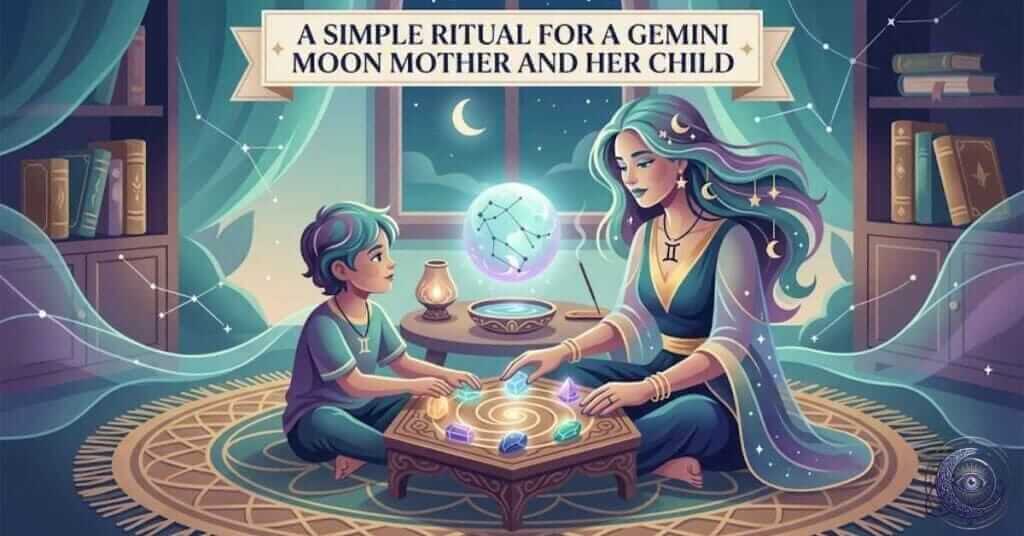
A weekly, no-agenda conversation works well for this placement, since it gives the Gemini Moon exactly what it needs, words and connection, without turning into small talk or conflict. Fifteen minutes, no phones, one open question each, is often enough to keep the bond feeling close instead of surface-level.
Pick one evening a week. Sit down for 15 minutes with no phones nearby. Each person asks the other one open question, something with no yes-or-no answer, like “what’s something you’ve been thinking about lately.” Let the answer run as long as it needs to.
This works because it gives a Gemini Moon exactly what it needs to feel close: real conversation, without pressure to solve anything or perform for an audience. Over a few months, it tends to turn talking, the thing this mother already does best, into the thing that actually closes distance instead of filling it.
FAQs
1. Can a Gemini Moon mother be emotionally close to her child, even if she’s not physically affectionate?
Yes. Closeness for this placement usually looks like inside jokes, long talks, and shared curiosity rather than hugs or quiet time together. The bond is real, it just runs through conversation instead of touch. Naming that difference out loud often helps both sides stop measuring love by the wrong signal.
2. Why does my Gemini Moon mother seem to avoid deep conversations about feelings?
She likely turns feelings into words fast, sometimes before she has actually felt them. This can look like changing the subject, joking, or over-explaining instead of sitting with the emotion. It is not usually avoidance on purpose, it is how a Gemini Moon processes anything that feels too heavy to hold quietly.
3. Does a Gemini Moon mother’s relationship with her child change as the child gets older?
Often yes. Gemini Moon mothers tend to connect more easily once a child is old enough to hold a real conversation, so the bond can actually deepen in the teen and adult years. Early childhood, when a baby needs steady physical comfort, is usually the harder stretch for this placement.
4. What’s the difference between a Gemini Moon mother and a Gemini Sun mother?
The Sun sign shapes identity and how someone presents to the world. The Moon sign shapes emotional habits, the ones that show up at home when nobody’s performing. A Gemini Sun mother might seem social and witty in public. A Gemini Moon mother processes her private emotional world the same restless, talkative way, regardless of her Sun sign.
5. Can two Gemini Moon people, like a mother and daughter, get along easily?
Usually, yes, since they share the same emotional language and both process feelings through talking. The risk is that neither one naturally slows down to sit with a feeling before explaining it, so unresolved emotions can pile up quietly under all the conversation. A regular check-in that skips small talk helps.
Hassan Raza is a dedicated digital tool architect and independent celestial researcher specializing in astronomical data modeling. Combining technical precision with deep cosmological studies, he develops intuitive astro-computational tools designed to make intricate natal charts, planetary transits, and celestial alignments accessible to everyone worldwide. Driven by accuracy and user-centric web design, Hassan ensures that every calculation on The Cosmic Calc bridges the gap between historical cosmic tracking and modern, real-time technology.