Venus square Mars synastry is the aspect behind one of the most confusing feelings two people can have about each other: wanting someone and being irritated by them, sometimes in the same hour.
I’ve looked at this aspect across a lot of charts over the years, and one pattern shows up almost every time. The couple doesn’t fight about the big things first. They fight about timing. One person moves toward affection or desire faster than the other can receive it, and the gap between those two speeds is where the friction lives.
This guide walks through what the aspect actually means, how your Sun, Moon, and Rising change how it feels day to day, what’s happening astrologically in 2026 that makes it more active, and a full sign-by-sign and house-by-house breakdown so you can find your own pairing instead of reading a generic description.
What is Venus square Mars in synastry?
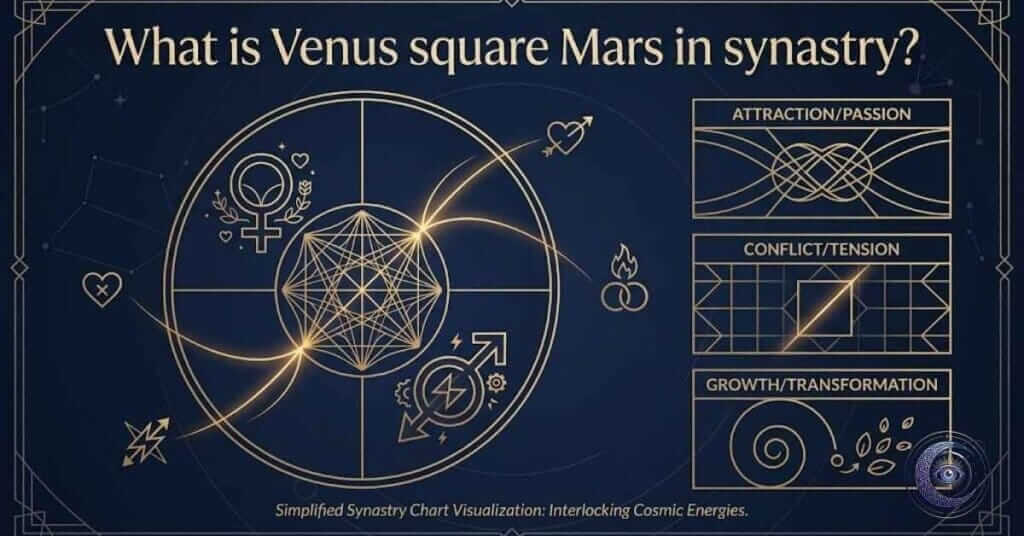
Venus square Mars in synastry means one person’s Venus sits at a 90 degree angle to the other person’s Mars. Venus rules love, affection, and what feels good to receive. Mars rules desire, drive, and how a person goes after what they want. A square between them creates real chemistry and real friction over pacing, at the same time.
The difference between a natal square and a synastry square
A natal square is a tension inside one person’s own chart, between their own Venus and their own Mars. A synastry square is between two different people’s charts. That distinction matters because a synastry square isn’t something either person can fix alone. It’s a dynamic that only shows up when the two charts are placed next to each other, which is why the same person can feel completely different tension levels with different partners.
Why square doesn’t mean doomed
Astrologers who work in the evolutionary astrology tradition, a school of thought developed by writer and teacher Steven Forrest, generally treat hard aspects like squares as pressure that pushes a person toward growth, not as a sentence of incompatibility. The tension itself isn’t the problem. What a couple does with it is.
A square is a hard aspect, meaning the two planets are 90 degrees apart. That’s a geometric fact about the angle, not a verdict on the relationship. Plenty of long, close, passionate partnerships have this square between them. The friction tends to fuel the attraction almost as much as it fuels the arguments, as long as both people learn to talk about the mismatch instead of just reacting to it.
Orb, applying, and separating: the mechanics that decide how strong it feels
Not every Venus square Mars hits the same way, and this is the part most articles skip. The orb is how many degrees apart the two planets are from an exact 90 degree angle. A tight orb, inside about 2 to 3 degrees, tends to register strongly and constantly. A wider orb, out to 6 or 8 degrees, is felt more like background weather than a daily event.
An applying aspect is one where the faster planet is still moving toward the exact angle. That tends to feel like building tension, the kind that hasn’t peaked yet. A separating aspect means the angle has already passed exact and the planets are moving apart, which usually feels more like an old pattern being worked through than a fresh spark.
If the two Venus and Mars signs happen to be in mutual reception, meaning each planet sits in the sign ruled by the other, the friction softens. Each person has a natural, almost instinctive respect for the other’s style, even when the angle between them is technically hard.
Beyond the aspect: how your Sun, Moon, and Rising change the experience
A Venus square Mars between two people plays out differently depending on the modality of the signs involved, meaning whether they’re cardinal, fixed, or mutable, and on how the Moon and Rising signs support or strain that dynamic.
Cardinal squares: fast ignition, fast blowout
Aries, Cancer, Libra, and Capricorn are the cardinal signs. When the square falls between two of these, arguments start fast and end fast. Neither person tends to sit on frustration for long. The risk is that the same fight repeats because it gets resolved on the surface before the real issue gets named.
Fixed squares: slow burn power struggles
Taurus, Leo, Scorpio, and Aquarius are the fixed signs. A square here builds slowly and lasts. Both people tend to dig in, and the friction becomes less about a single disagreement and more about who bends first. These pairings often need a third party, like a counselor, to interrupt the standoff.
Mutable squares: avoidance instead of confrontation
Gemini, Virgo, Sagittarius, and Pisces are the mutable signs. Here the friction rarely turns into open conflict. Instead, one or both people quietly avoid the topic, change the subject, or intellectualize the tension instead of feeling it. The work is usually about staying present in the conversation instead of talking around it.
How Moon and Rising shift the picture
The Venus square Mars is only one piece of the synastry overlay, the full comparison of two birth charts placed side by side. A Moon that trines the other person’s Sun, for example, can soften a rough Venus-Mars square considerably, because the emotional baseline between the two people is already comfortable. A tense Rising-to-Rising connection can make the same square feel sharper, because the first impression each person gives off keeps rubbing the other the wrong way.
The 2026 Venus retrograde and what it stirs up for this aspect
In 2026, Venus turns retrograde on October 3, moving backward from Scorpio into Libra, and stations direct on November 13 to 14. For anyone carrying a Venus square Mars with a partner, this six week window tends to pull old, unresolved friction back to the surface. It’s a better stretch for honest repair conversations than for starting something brand new.
The Scorpio phase of the retrograde, roughly October 3 through 25, tends to bring up questions about intimacy, jealousy, and who wants more from the relationship. That lines up directly with the shadow side of this square for fixed and water sign pairings especially.
When Venus moves back into Libra for the second half of the retrograde, the theme shifts toward fairness and rebalancing. This is often when couples try to smooth things over. The risk in that phase is settling for a surface peace instead of actually resolving what the Scorpio phase brought up.
Mars doesn’t retrograde again until 2027, so through the rest of 2026 Mars keeps moving forward without a pause. That steady forward motion means the pressure in a Venus square Mars pairing during this retrograde comes almost entirely from Venus reviewing old ground, not from Mars adding new complications.
Sign-by-sign: shadow side and growth path
Here’s a working table for finding the pattern that matches an actual pairing. Find the Venus sign on the left, then look at which Mars signs create the square.
| Venus sign | Squares Mars in | Shadow side | Growth path |
|---|---|---|---|
| Aries | Cancer or Capricorn | Impatience gets read as rejection. Desire feels demanding before it feels loving. | Ask for what you want directly instead of testing your partner to see if they notice. |
| Taurus | Leo or Aquarius | Affection gets withheld as a form of control. | Trade certainty for small, low-stakes spontaneity. |
| Gemini | Virgo or Pisces | Words deflect instead of connect. | Say the plain feeling before the clever line. |
| Cancer | Aries or Libra | Moodiness becomes a quiet punishment. | Name the hurt instead of retreating into silence. |
| Leo | Taurus or Scorpio | Pride blocks repair after a fight. | Let being understood matter more than being right. |
| Virgo | Gemini or Sagittarius | Criticism replaces vulnerability. | Offer one honest appreciation before any critique. |
| Libra | Cancer or Capricorn | People-pleasing hides resentment. | Practice stating a preference without an apology attached. |
| Scorpio | Leo or Aquarius | The relationship turns into a contest over who wants more. | Trade control for disclosed vulnerability. |
| Sagittarius | Virgo or Pisces | The need for freedom looks like avoidance. | Commit to finishing one hard conversation, start to end. |
| Capricorn | Aries or Libra | Emotional withholding disguises itself as discipline. | Let desire be allowed to look messy sometimes. |
| Aquarius | Taurus or Scorpio | Detachment becomes a way to dodge intimacy. | Stay in the room during the uncomfortable part. |
| Pisces | Gemini or Sagittarius | The partner gets idealized, then resented for not matching the fantasy. | Separate the fantasy of the person from the person in front of you. |
How to read this table for your specific pairing
Look up the Venus person’s sign, confirm the Mars person’s sign matches one of the two square options, then read both columns together. The shadow side is what tends to happen automatically, without effort. The growth path is the deliberate choice that interrupts it.
When both people share the same modality
If both partners have their Sun, Moon, or Rising in the same modality, cardinal, fixed, or mutable, the pattern in that modality’s row above tends to intensify rather than balance out. Two fixed-sign-heavy charts with this square, for example, usually need more outside support to break a standoff than two charts with mixed modalities.
House overlay: where the square actually lands
The house overlay shows which area of life gets the most friction. Find the house where the Mars person’s Venus falls in the other person’s chart, or vice versa, and read across.
| House | Theme | Friction point | Integration path |
|---|---|---|---|
| 1st | Identity, first impressions | Attraction feels destabilizing to self-image. | Let the relationship reshape identity slowly, not all at once. |
| 2nd | Money, self-worth, values | Fights over resources or worth. | Align on values before you argue about logistics. |
| 3rd | Communication, daily rhythm | Constant small friction, sibling-style bickering. | Slow down before you respond. |
| 4th | Home, family, security | Domestic power struggles. | Set house routines out loud, together. |
| 5th | Romance, creativity, ego | Competitive flirtation, jealousy. | Put the rivalry into a shared creative project. |
| 6th | Routine, health, service | Nitpicking over habits. | Trade criticism for one practical fix at a time. |
| 7th | Partnership itself | The square colors the whole relationship identity. | This house needs the most conscious repair work. |
| 8th | Intimacy, merging, control | Power and vulnerability get tangled together. | Practice being open without using it as leverage later. |
| 9th | Beliefs, growth, travel | Clashing worldviews or life direction. | Treat differences as information, not a threat. |
| 10th | Career, public image | Ambition competes with connection. | Keep professional identity separate from partnership identity. |
| 11th | Friendship, community, ideals | Tension shows up in the shared friend group. | Build a few small shared social rituals. |
| 12th | Subconscious, endings, solitude | Hidden resentment, avoidance. | Say the pattern out loud instead of letting it stay unspoken. |
Reading the overlay both directions
Synastry always runs two ways. Check both where person A’s Venus falls in person B’s houses, and where person B’s Venus falls in person A’s houses. Most couples carry two separate house themes at once, not just one.
What the composite chart adds
A composite chart is a third chart built from the midpoints between two people’s planets. It represents the relationship as its own entity, separate from either individual chart. Checking which house the composite Venus square Mars falls in adds a layer on top of the overlay: it shows which area the relationship itself, as a unit, tends to struggle with, regardless of which partner is which.
Is Venus square Mars good or bad?
Neither. A hard aspect is a pressure point, not a verdict. The honest answer is that this square asks more of a couple than an easy aspect would, and what it asks for is direct communication about desire and affection instead of assuming the other person already knows what’s needed.
A growth square versus a depleting square
The difference isn’t in the aspect itself. It’s in what both people do with it. A growth square gets named out loud, discussed, and worked with over time, and the friction becomes part of what keeps the relationship alive. A depleting square gets avoided, denied, or used as ammunition in fights, and the same friction wears both people down instead.
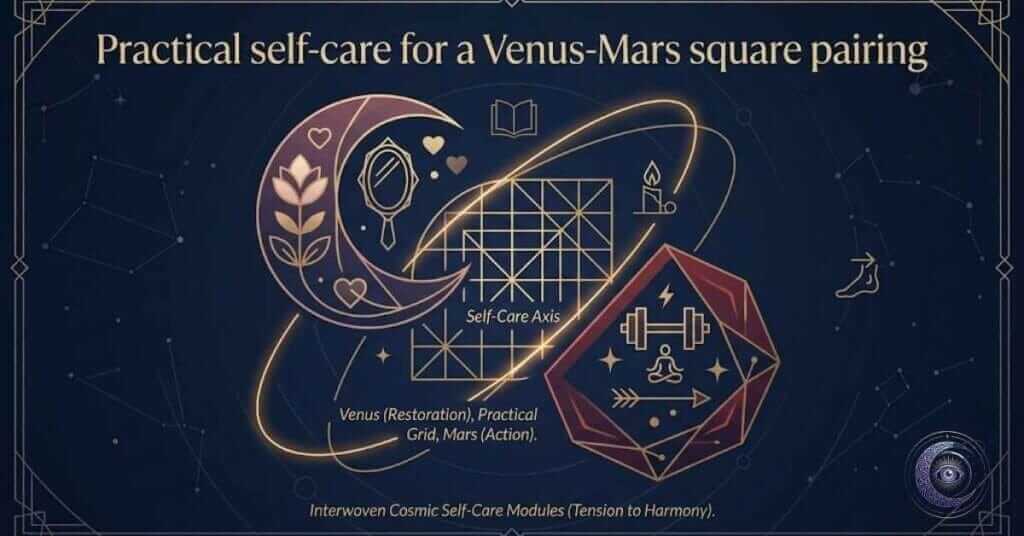
Practical self-care for a Venus-Mars square pairing
A grounding practice before a hard conversation
Before bringing up a pacing mismatch, take a few minutes alone first. Slow, longer exhales calm the nervous system faster than trying to think your way into staying calm. The goal is to enter the conversation regulated, not to suppress what you’re feeling.
How to name desire without triggering defensiveness
Start with what you want, not with what your partner is doing wrong. “I want more closeness before we get physical” lands very differently than “you never slow down.” The first is a request. The second is an accusation, and accusations trigger Mars, not Venus.
When to bring in outside support
If the same fight repeats for months without either person’s approach changing, that’s usually a sign the pattern needs a third party. A couples counselor, ideally one who’s comfortable with clients who use astrology as part of how they understand themselves, can help name the pattern faster than either partner working it out alone.
Our chart observations
A note on how we use the word observation here: this is a pattern noticed across readings, not a controlled study, and it should be read that way.
In the pairings we’ve looked at with a tight orb Venus square Mars, under 3 degrees, the couples who did best were the ones who talked about the pacing mismatch directly in the first few months, rather than waiting for it to become a recurring fight. The ones who struggled most tended to be pairings where one partner assumed the friction would resolve itself with time.
We also noticed that pairings where the square fell in the 7th house, meaning it colored the partnership house directly, needed to have the conversation about pacing earlier and more often than pairings where the square landed in a less central house, like the 6th or 11th.
If you want to check your own chart before reading further into any of this, a synastry calculator or a full birth chart tool can show you exactly where your Venus and Mars fall against a partner’s chart, and which house each one lands in.
Frequently asked questions
Is Venus square Mars a bad aspect in synastry?
Not inherently. It’s a hard aspect, not a doomed one. It creates friction because desire and affection styles are out of sync, not because the relationship lacks love. Many long, passionate partnerships carry this square, and the tension often fuels attraction as much as conflict.
How do you work with Venus square Mars synastry tension?
You don’t eliminate it. You learn to name it. Say the pacing mismatch out loud, watch for the pattern of one partner withdrawing while the other pursues, and use the house overlay to find exactly which area of life the friction keeps showing up in.
How do I know if I have this aspect with my partner?
Generate both birth charts and overlay them. Most free synastry calculators do this automatically. Then check for a 90 degree angle between one person’s Venus and the other’s Mars, ideally within about a 6 to 8 degree orb for it to register strongly.
Hassan Raza is a dedicated digital tool architect and independent celestial researcher specializing in astronomical data modeling. Combining technical precision with deep cosmological studies, he develops intuitive astro-computational tools designed to make intricate natal charts, planetary transits, and celestial alignments accessible to everyone worldwide. Driven by accuracy and user-centric web design, Hassan ensures that every calculation on The Cosmic Calc bridges the gap between historical cosmic tracking and modern, real-time technology.