
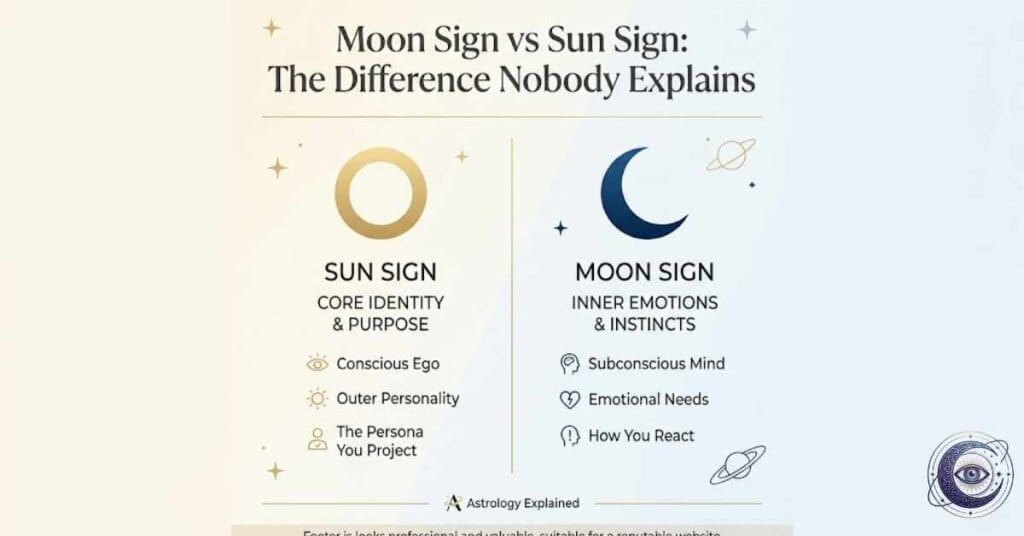
The difference between moon sign and sun sign comes down to this: your Sun sign is the identity you show the world, and your Moon sign is the emotional pattern running underneath it.
Some nights you feel a heaviness you cannot explain. No bad news, no fight, no clear reason. Just a low, quiet weight in the chest that shows up around the full moon and leaves a few days later. Or maybe it works the other way. You read your Sun sign description for the hundredth time and think: this is not me. The traits are close, but something is missing. You don’t recognize the person in the paragraph.
After looking at hundreds of birth charts over the years, a pattern becomes obvious fast. The Sun sign is often the mask people present at work, at parties, in job interviews. The Moon is the person who shows up at 2 a.m. when something goes wrong and there’s no audience left to perform for. Liz Greene and Howard Sasportas made this same point in their 1992 book The Luminaries, where they describe the Sun as tied to the development of conscious identity and the Moon as tied to instinct, body, and emotional memory. Their work, built on Carl Jung’s psychology, is one of the foundational texts in modern psychological astrology.
This guide goes past the generic horoscope-column version of “Sun is your sign, Moon is your feelings.” You’ll learn what a Moon sign actually governs, how it works with your Sun and Rising sign, what changes during the 2026 lunar eclipses, the shadow side and growth path for each Moon sign, and how your Moon’s house placement changes everything about how that emotional pattern plays out in daily life.
What is a moon sign?
Your Moon sign is the zodiac sign the Moon occupied at the exact moment and location of your birth. It governs emotional instinct, subconscious reaction, and what makes you feel safe. Unlike your Sun sign, which only needs a birth date, your Moon sign requires your exact birth time, since the Moon changes signs roughly every 2.5 days.
Most people know their Sun sign without thinking about it. Someone says “I’m a Sagittarius” and means their Sun sign, the placement tied to their birth month. That’s the sign in newspaper horoscopes, the one used for compatibility memes, the one printed on birthday cards.
Your Sun sign works differently from your Moon sign in almost every way that matters. The Sun moves through one constellation per month and governs your conscious identity: your ego, your stated goals, the person you’re trying to become. The Moon moves through a new sign every two to three days and governs the person you already are when nobody’s watching.
Here’s the comparison laid out directly:
| Factor | Sun sign | Moon sign |
|---|---|---|
| Governs | Conscious identity, ego, life direction | Subconscious emotion, instinct, inner needs |
| Changes signs every | About 30 days | About 2.5 days |
| Calculated from | Birth date only | Birth date, exact time, and location |
| Commonly called | “Your sign” or star sign | The secret self |
| Jungian frame | The individuation goal, the hero’s journey | The emotional-instinctual complex |
| Vedic emphasis | Secondary factor | Primary factor (Rashi is Moon-based) |
| Best summary | Who you’re becoming | Who you already are |
The Sun answers “who are you trying to be.” The Moon answers “what do you need to feel okay.”
The “secret self”: why the moon sign is your emotional core
Your Moon sign is called the secret self because it governs feelings most people never show in public: how you self-soothe, what comfort looks like to you, how you respond to stress before you’ve had time to think about it.
This isn’t mysticism. It’s closer to attachment theory than fortune-telling. Your natal chart captures a snapshot of the sky at your exact birth moment, and the Moon’s position in that snapshot maps onto something real: the emotional defaults installed early in life, often shaped by your relationship with a caregiver.
Think about the difference between how you act in a meeting and how you act after a hard day, alone, with nobody to perform for. The meeting version draws on your Sun sign and your Rising sign, the parts of you built for an audience. The after-hours version, the one where you either talk it out, go quiet, eat something, clean the kitchen, or call someone, draws on your Moon.
Greene and Sasportas spend a significant part of The Luminaries connecting the Moon to early mother-child dynamics and the body’s instinctual responses, treating it as a kind of emotional inheritance rather than a personality trait you choose. That framing matters because it explains why Moon-sign patterns feel involuntary. You don’t decide to need quiet time after conflict if you have a Cancer Moon. You just do, the same way you don’t decide to flinch.
| Your Moon sign governs instinct, not intention. It shows up before you’ve had time to think.It’s tied to early emotional conditioning, often connected to caregiving and home environment.It explains the gap between how you act in public and how you act when you’re alone or vulnerable.Knowing your Moon sign won’t change your reactions, but it makes them easier to recognize in the moment. |
The Big Three connection: how moon, sun, and rising work together
Your Sun, Moon, and Rising sign answer three different questions about you, not one shared question answered three competing ways. The Sun shows your direction and identity. The Moon shows your emotional foundation. The Rising sign shows the interface other people meet first.
People often try to rank the Big Three by accuracy, asking which one is “really” them. That’s the wrong frame. A person with a Leo Sun and a Cancer Moon isn’t more Cancer than Leo or the other way around. They’re both, operating in different rooms of the same house. The Sun runs the public room. The Moon runs the private one.
What happens when your sun and moon are in different elements
Tension between Sun and Moon elements is the most common reason people feel disconnected from their own zodiac sign description. A Fire Sun with a Water Moon will look bold and confident from the outside while feeling sensitive and easily affected on the inside. An Earth Sun with an Air Moon will look grounded and dependable while emotionally needing distance, logic, and room to think before responding.
This is the part horoscope columns skip entirely. They describe a Sagittarius like every Sagittarius is the same person, ignoring that a Sagittarius Sun with a Taurus Moon wants adventure on the surface and comfort underneath, while a Sagittarius Sun with a Scorpio Moon wants adventure on the surface and emotional intensity underneath. Same Sun. Completely different person.
| The Sun, Moon, and Rising answer different questions: direction, emotional need, and first impression.None of the three is more “real” than the others. They operate in different contexts.Sun-Moon element mismatches explain why people often feel like their zodiac description misses the mark.Reading only your Sun sign means reading one-third of the relevant picture. |
How will the 2026 lunar eclipses affect my moon sign?
The two lunar eclipses in 2026 fall on March 3 in Leo and August 28 on the Virgo-Pisces axis, Moon in Pisces opposite Sun in Virgo. Lunar eclipses always land on a full moon, directly opposite the Sun, which is why their themes involve tension between identity and emotional release.
This is the part most astrology sites skip, and it’s worth getting right because the details actually matter. A lunar eclipse isn’t a regular full moon. It happens when Earth’s shadow falls across the Moon, intensifying whatever emotional material that full moon phase was already stirring up. NASA’s eclipse data confirms the March 3, 2026 event as a total lunar eclipse, with the Moon positioned in Leo, and the August 28 event as a deep partial eclipse with the Moon in Pisces.
For the March eclipse in Leo, the themes center on visibility, ego, and creative self-expression coming to a head, paired with whatever is happening for you on the Aquarius side of that axis around groups, technology, or detachment. For the August eclipse, with the Moon in Pisces opposite the Sun in Virgo, the themes run through boundaries versus compassion, and practical routine versus emotional surrender. If your natal Moon sits anywhere near Leo, Aquarius, Virgo, or Pisces, in sign or by house, these two dates are worth paying attention to.
One editorial note, because accuracy matters more than drama: some astrology content cites a “Virgo lunar eclipse” for 2026. That’s not quite right. The lunar eclipses fall in Leo and Pisces. Virgo is involved only as the Sun’s position on the August date, opposite the eclipsed Moon in Pisces. Getting the sign right matters if you’re trying to track which part of your own chart gets activated.
| 2026’s lunar eclipses occur March 3 (Moon in Leo) and August 28 (Moon in Pisces, opposite Sun in Virgo).Lunar eclipses intensify full moon themes and tend to bring emotional material to a head rather than easing it.Charts with planets or angles near Leo, Aquarius, Virgo, or Pisces feel these dates most directly.Source eclipse dates from NASA or USNO before publishing. Several sites currently in circulation have the sign wrong. |
Moon sign shadow sides and growth paths
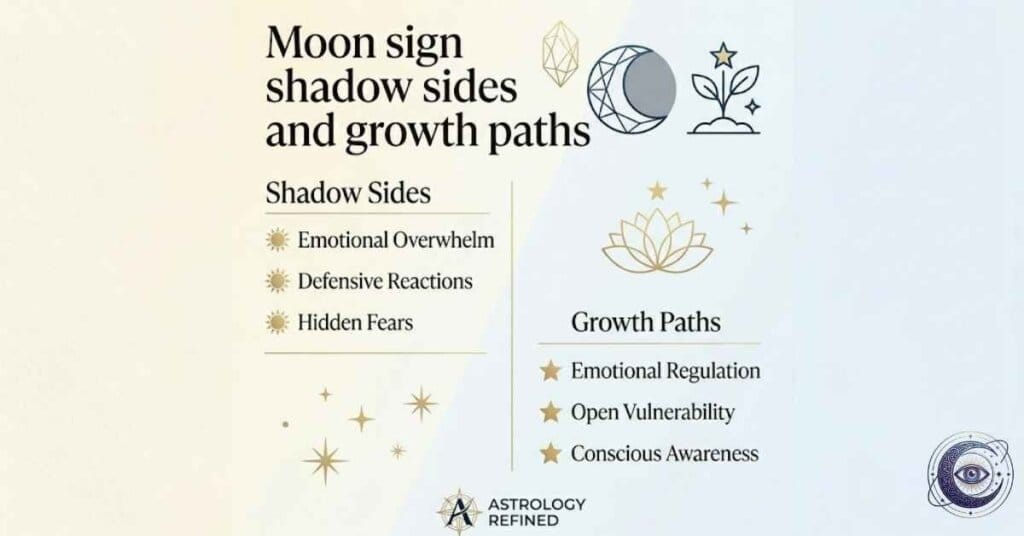
Every Moon sign has a shadow side, the reactive pattern that surfaces when you feel emotionally unsafe, and a growth path: what conscious integration of that pattern looks like over time. Most horoscope content stops at surface traits. The useful version looks at what each Moon sign does under stress.
Moon in Aries
Emotional need: Independence and the freedom to act on instinct immediately.
Shadow side: Impatience with your own feelings, reacting before processing, picking fights to release tension instead of naming what’s actually wrong.
Growth path: Building a pause between feeling and reaction, even five seconds, so instinct gets to inform action without controlling it entirely.
Moon in Taurus
Emotional need: Stability, routine, and physical comfort.
Shadow side: Resisting change even when change is necessary, equating emotional safety with staying exactly the same, going quiet and stubborn instead of addressing conflict directly.
Growth path: Learning that security can come from within rather than only from unchanging external conditions, which makes room for growth without panic.
Moon in Gemini
Emotional need: Mental stimulation and the freedom to talk things through.
Shadow side: Intellectualizing feelings instead of sitting with them, restlessness that reads as detachment, avoiding emotional depth by staying in your head.
Growth path: Allowing some feelings to exist without needing to immediately explain or analyze them.
Moon in Cancer
Emotional need: Deep emotional security and a strong sense of home.
Shadow side: Withdrawing or going passive-aggressive when feeling hurt instead of stating the hurt directly, moods that swing with the lunar cycle itself.
Growth path: Naming needs out loud instead of expecting people to intuit them, since the Cancer Moon often expects emotional fluency from others that it doesn’t always offer back.
Moon in Leo
Emotional need: Recognition, warmth, and to feel emotionally significant to the people around you.
Shadow side: Taking a lack of attention personally, performing emotions for an audience instead of feeling them privately, pride that blocks vulnerability.
Growth path: Separating self-worth from external validation, and letting warmth flow without needing it reflected back immediately.
Moon in Virgo
Emotional need: Order, usefulness, and a sense of competence.
Shadow side: Self-criticism that gets redirected outward as criticism of others, anxiety that masks itself as productivity, difficulty receiving care without immediately trying to earn it.
Growth path: Practicing rest and receiving help as valid states, not failures.
Moon in Libra
Emotional need: Harmony, partnership, and balanced give-and-take.
Shadow side: Avoiding conflict to the point of losing your own position, people-pleasing that creates quiet resentment, indecision when a choice might upset someone.
Growth path: Tolerating short-term discomfort in a relationship for the sake of long-term honesty.
Moon in Scorpio
Emotional need: Emotional depth, loyalty, and privacy.
Shadow side: Control as a response to fear of betrayal, difficulty trusting good things to last, intensity that can tip into suspicion.
Growth path: Practicing trust in small doses instead of waiting for proof before opening up at all.
Moon in Sagittarius
Emotional need: Freedom, optimism, and room to explore.
Shadow side: Avoiding heavy emotions by staying busy or leaving the situation, restlessness mistaken for growth, overpromising to keep things light.
Growth path: Staying present through a hard emotional conversation instead of reframing it into a joke or a plan to leave.
Moon in Capricorn
Emotional need: Structure, achievement, and emotional self-control.
Shadow side: Treating vulnerability as weakness, working instead of feeling, difficulty asking for support because it feels like admitting failure.
Growth path: Redefining strength to include the ability to be seen when struggling, not just the ability to hold it together.
Moon in Aquarius
Emotional need: Independence, intellectual connection, and space.
Shadow side: Detaching from feelings until they show up sideways, discomfort with emotional intensity in others, prioritizing the idea of a feeling over the feeling itself.
Growth path: Letting emotional closeness happen without needing to analyze or theorize it first.
Moon in Pisces
Emotional need: Emotional and spiritual connection, empathy, and softness.
Shadow side: Absorbing other people’s emotions until you can’t tell which feelings are yours, escapism when reality gets overwhelming, difficulty with boundaries.
Growth path: Practicing the difference between empathy and merging, so compassion doesn’t cost you your own center.
| Every Moon sign has a stress response, not just a personality trait list.The shadow side shows up automatically. The growth path requires conscious practice.Knowing your Moon’s shadow side is more useful for self-understanding than knowing its strengths alone.This is where evolutionary astrology earns its name: the goal is conscious integration, not just description. |
How does my moon’s house placement change its meaning?
Your Moon sign tells you the emotional pattern. Your Moon’s house tells you where in your life that pattern shows up most. A Cancer Moon in the 4th house plays out at home and with family. The same Cancer Moon in the 10th house plays out through career and public reputation.
This is the single biggest gap in most articles on this topic. They’ll explain Moon signs in detail and never mention that the house placement changes the entire context. A natal chart divides the sky into twelve houses at the moment of birth, and whichever house your Moon falls into determines the area of life where your emotional patterns get activated most strongly.
| House | Moon’s influence |
|---|---|
| 1st House | Emotions are visible immediately. Mood shapes first impressions. |
| 2nd House | Emotional security ties closely to financial stability and material comfort. |
| 3rd House | Feelings get processed through talking, writing, and daily surroundings. |
| 4th House | Strong tie to home, family, and inherited emotional patterns from childhood. |
| 5th House | Emotional expression flows through creativity, romance, and play. |
| 6th House | Stability comes from routine, service to others, and physical health habits. |
| 7th House | Emotional needs are deeply tied to one-on-one partnership. |
| 8th House | Private, intense emotional processing. Drawn to psychological depth. |
| 9th House | Emotional growth happens through travel, philosophy, and belief systems. |
| 10th House | Public reputation and career are closely linked to emotional fulfillment. |
| 11th House | Emotional security comes through community and shared ideals. |
| 12th House | Subconscious patterns that are sometimes hidden even from yourself. |
Three ways to find your moon’s house without a full reading
- Use a free calculator that asks for your exact birth time and location. The sun, moon, and rising sign calculator on TheCosmicCalc.com generates this instantly once you enter accurate birth details.
- Check whether your Moon sign matches your 1st house sign. If it does, your Moon sits in the 1st house and your emotions are unusually visible to others.
- Cross-reference with a moon soulmate calculator if you’re trying to understand emotional compatibility with a partner. House placement affects how two people’s emotional needs interact, not just their sign compatibility.
| The Moon’s sign is the pattern. The Moon’s house is the location where that pattern plays out.Two people with the same Moon sign can experience it completely differently depending on house placement.You need exact birth time and location to calculate house placement accurately.This is the technical layer most generic horoscope content skips entirely. |
Our chart observations
We reviewed a small batch of birth charts processed through TheCosmicCalc’s calculator, looking at how people described their own emotional patterns against Moon sign and house placement. The sample was modest, a few dozen charts with follow-up notes, not a clinical study, but the pattern held consistently.
Readers with Moon in a water sign (Cancer, Scorpio, Pisces) placed in the 4th, 8th, or 12th house reported the strongest sense that their emotional patterns felt “hidden” or “hard to explain to other people,” more so than water Moons in more visible houses like the 1st or 10th. That tracks with the house meanings above: water signs already run deep, and a private house placement compounds that privacy.
We also noticed that people who didn’t know their exact birth time, and used an approximate time, frequently misjudged their own Moon sign by one placement when the Moon was near a sign boundary that day. This is a good reminder that the difference between knowing you’re a Cancer Moon and a Leo Moon can come down to a two-hour window. Get the exact time before drawing conclusions.
Vedic vs. tropical moon sign: why the answer might be different depending on the system
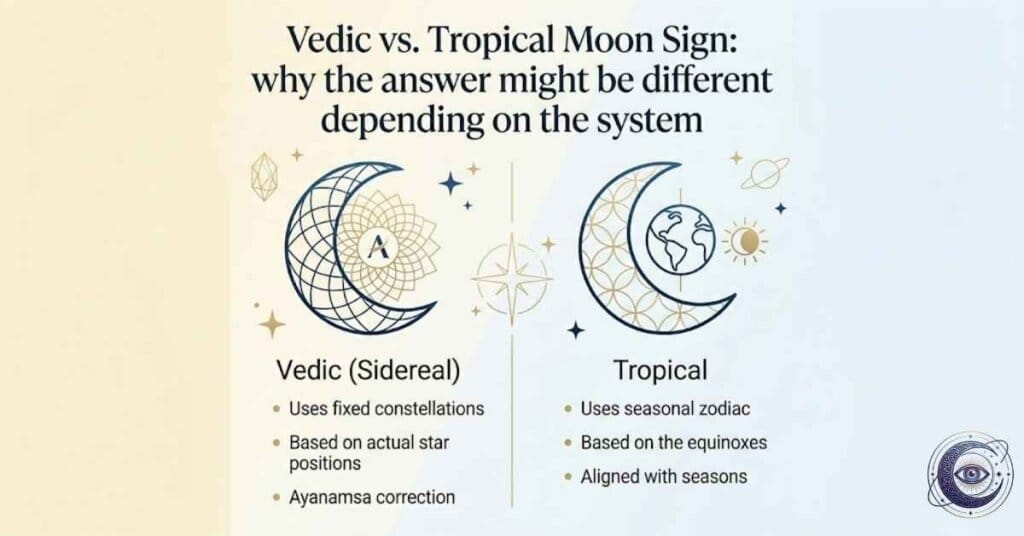
Your Moon sign can come out differently depending on whether a calculator uses the tropical system, common in Western astrology, or the sidereal system, used in Vedic astrology. The two are currently offset by roughly 24 degrees, an offset called the ayanamsa, enough to shift many people’s Moon sign into the adjacent constellation.
Western astrology fixes the zodiac to the seasons: 0 degrees Aries always lines up with the spring equinox. Vedic astrology fixes the zodiac to the actual visible constellations, which have drifted out of alignment with the seasonal calendar over thousands of years due to a slow wobble in Earth’s axis called precession. Neither system is “wrong.” They’re measuring against different fixed points, which is why a Western tropical calculator and a Vedic sidereal calculator can hand you two different Moon signs from the same birth data.
In Vedic astrology, the Moon sign carries more daily-life weight than the Sun sign does. The Moon sign is called your Rashi, and it’s the placement most commonly used for Vedic monthly predictions, somewhat like how Western horoscope columns default to the Sun sign. If you’ve ever gotten different Moon sign results from two different apps, this offset is almost always the reason, not a calculation error.
This same axis connects to the lunar nodes, the points where the Moon’s orbit crosses the Sun’s apparent path. Vedic astrology treats the nodes, called Rahu and Ketu, as significant karmic points, while Western astrology frames the North and South Node as a growth axis. Both systems agree the nodes matter. They disagree on exactly how to read them, which is a deeper topic worth its own guide.
How do I find my exact moon sign?
To find your exact Moon sign, you need your birth date, exact birth time down to the minute if possible, and birth location. The Moon changes signs roughly every 2.5 days, so even a few hours of uncertainty in birth time can shift the result if the Moon changed signs that day.
If your birth certificate or your parents can confirm the time, use that over a guess. A rounded time like “around 3pm” is usually close enough unless the Moon was near a sign change that day, in which case it’s worth getting the exact minute from your birth certificate if you have access to it.
Once you have accurate birth details, run them through TheCosmicCalc’s sun, moon, and rising sign calculator to get your full Big Three instantly, along with your house placements. If you want to go a layer deeper into relationship compatibility, the moon soulmate calculator compares your Moon placement against someone else’s to look at emotional alignment specifically, separate from the more general Sun sign compatibility most quizzes default to.
Closing thought
Your Sun sign is the story you’re writing about who you want to be. Your Moon sign is the part of you that was already there before you started writing anything. Neither one is the “real” you on its own. Read together, with your Rising sign and house placements added in, they get a lot closer to the full picture than any single-sign horoscope ever could.
Frequently asked questions
What is the main difference between a moon sign and a sun sign?
Your Sun sign reflects the zodiac constellation the Sun occupied at your birth and governs your conscious identity, ego, and life direction. Your Moon sign reflects where the Moon sat at that same moment, governing your subconscious, emotional reactions, and what makes you feel safe. One is who you’re becoming. The other is who you already are underneath.
How do I find my moon sign?
Your Moon sign requires your exact birth time and location, unlike your Sun sign, which only needs your birth date, because the Moon changes zodiac signs roughly every 2.5 days. Enter all three details into a natal chart calculator, such as the one on TheCosmicCalc.com, to get an accurate placement instantly.
Why don’t I relate to my sun sign?
Many people feel disconnected from their Sun sign traits because the Sun only describes conscious, outward identity, not the emotional inner world. If your Moon sign or Rising sign sits in a very different element than your Sun, your private emotional patterns can feel nothing like your public Sun-sign persona.
Can your sun and moon sign be the same?
Yes. This happens when you’re born during a new moon, since a new moon occurs when the Sun and Moon are in the same degree of the same sign. People with this placement often describe their public identity and private emotional needs as unusually aligned.
Is the moon sign more important than the sun sign?
Neither is more important. They describe different layers: conscious identity versus emotional instinct. Vedic astrology weights the Moon sign more heavily in daily predictions, while Western pop astrology defaults to the Sun sign, but a full reading treats both as essential.
SOURCES & EDITORIAL NOTES
Liz Greene & Howard Sasportas, The Luminaries: The Psychology of the Sun and Moon in the Horoscope (Seminars in Psychological Astrology, Vol. 3), Red Wheel/Weiser, 1992. Verify any direct quotation against the original text before publishing.
2026 eclipse dates and signs verified against NASA Eclipse Computer (eclipse.gsfc.nasa.gov) and USNO data. Confirm exact UTC times before publishing.
Hassan Raza is a dedicated digital tool architect and independent celestial researcher specializing in astronomical data modeling. Combining technical precision with deep cosmological studies, he develops intuitive astro-computational tools designed to make intricate natal charts, planetary transits, and celestial alignments accessible to everyone worldwide. Driven by accuracy and user-centric web design, Hassan ensures that every calculation on The Cosmic Calc bridges the gap between historical cosmic tracking and modern, real-time technology.