
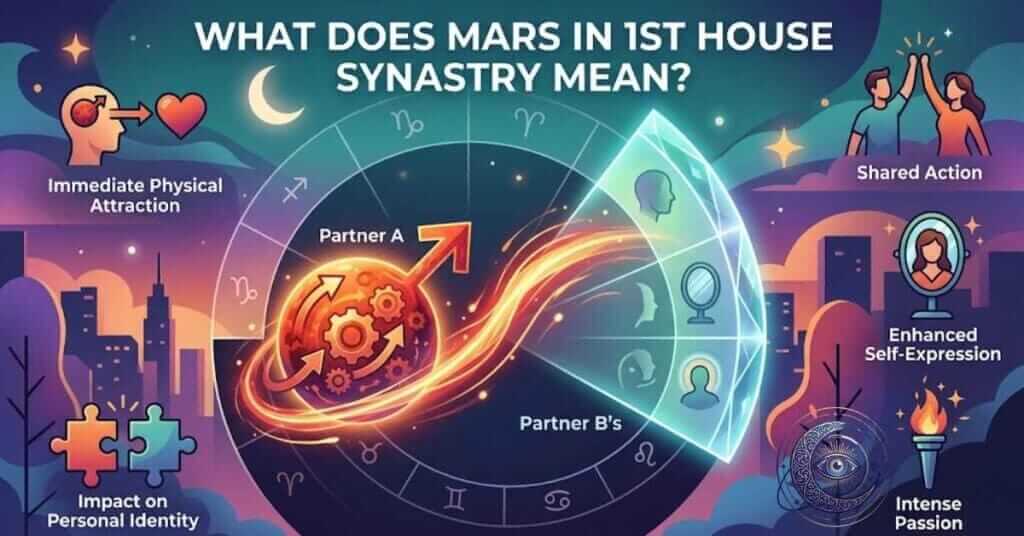
Mars in 1st house synastry shows up in real life before you ever open a chart. You meet someone and your body reacts before your mind catches up. Your pulse picks up. You stand a little straighter. You feel more competitive, more magnetic, or more on edge than the moment should call for.
After looking at hundreds of synastry overlays for readers, I have noticed one pattern again and again. When someone’s Mars lands in your first house, you do not just notice them. You notice yourself around them. Your instincts get louder. Your patience gets shorter. This is not random. It is a specific placement with its own mechanics, and it shows up the same way across very different couples.
This guide covers what mars in 1st house synastry actually means, how to check it in your own chart, why 2026 makes this placement feel sharper than usual, and what each Mars sign looks like once it lands on someone else’s Ascendant. You will also get a way to work with the growth side of this contact instead of just reacting to it.
What does Mars in 1st house synastry mean?
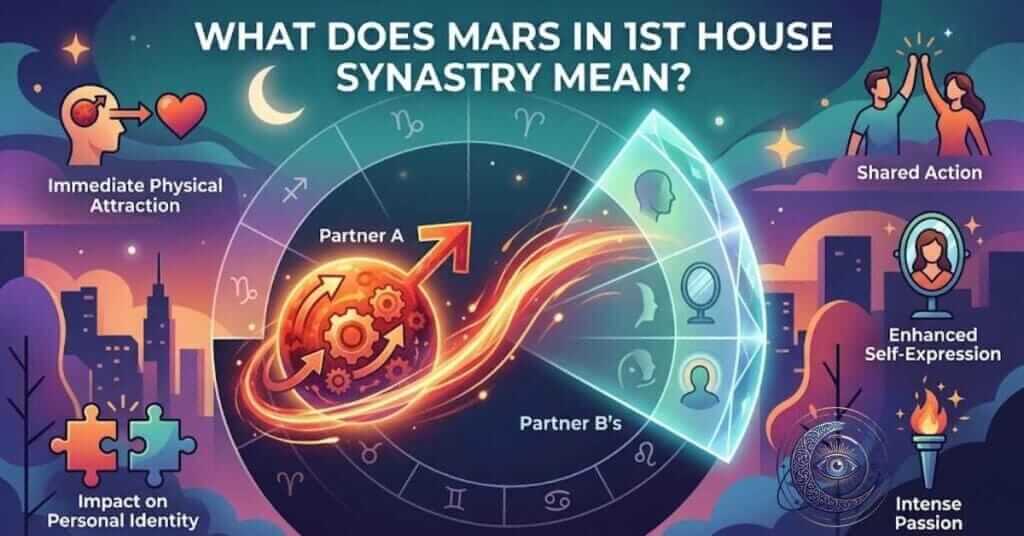
Mars in 1st house synastry happens when one person’s Mars falls into the other person’s first house, close to their Ascendant. This lights up the house person’s presence, instincts, and self assertion. The result usually feels like an immediate charge, read as attraction, competition, or friction depending on the rest of the chart.
Synastry is the practice of comparing two birth charts side by side to see how two people’s energies interact. Each person has a natal chart, the map of where every planet sat at the exact moment they were born. When you overlay two charts, you check where one person’s planets fall inside the other person’s houses, the twelve life areas that make up a chart.
The 1st house sits right on the Ascendant, the degree that was rising on the eastern horizon at the moment of birth. This house shapes how you show up, how people read you at first glance, and how you assert yourself without thinking about it.
When someone’s Mars lands in your 1st house, it does not stay quiet. Mars is the planet of drive, desire, and confrontation. It reaches straight into your instincts. You feel it before you understand it.
How do you check this placement in your own chart?
You need both people’s full birth data, including time of birth, and a tool that can build a synastry overlay. Enter each person’s details, generate the overlay chart, then look at where the Mars person’s Mars sits compared to the house person’s Ascendant degree.
Start with your own numbers first. Our Sun, Moon, and Rising Sign Calculator will confirm your exact Ascendant degree, which you need before comparing charts with anyone else.
Once you have that, plug both birth charts into a synastry tool. Look for the person whose Mars sits within a few degrees of the other person’s Ascendant. That is the person whose Mars is activating the 1st house.
Direction matters here. If person A’s Mars lands in person B’s 1st house, that is a different dynamic than person B’s Mars landing in person A’s 1st house. Check both directions separately. Most couples have at least one of these active, and some have both.
How does this Mars talk to your Sun, Moon, and Rising?
Mars conjunct the Ascendant is the strongest version of this contact, since it lands almost directly on the degree that defines the house person’s outward presence. The house person’s Sun, Moon, and Rising then filter how that charge gets expressed, whether as fuel, friction, or emotional overwhelm.
If the house person’s Sun sign is naturally assertive, like Aries or Leo, this Mars contact can feel like fuel. Two strong wills either clash hard or push each other forward.
If the house person’s Moon sign is more sensitive, like Cancer or Pisces, the same Mars energy can feel like too much too fast. The house person may need more time to feel safe with that intensity, even if part of them is drawn to it.
The Rising sign is already activated by definition, since the Ascendant sits at zero degrees of the 1st house. This is why mars in 1st house synastry tends to feel more personal and more immediate than a Mars contact to a private planet buried deeper in the chart.
Why does this placement feel stronger in 2026?
Mars stays in direct motion for all of 2026, with no retrograde period this year. That means Mars energy moves in a straight, steady line instead of turning inward and stalling, which lets contacts like this one play out clearly instead of getting stuck in delay or confusion.
Mars will not station retrograde in 2026. The next retrograde period begins in January 2027, in Virgo. For anyone carrying mars in 1st house synastry, this matters. Without a retrograde slowdown, the charge this placement creates has fewer natural pauses. Attraction, rivalry, or friction tends to move forward instead of circling back on itself.
Two lunar eclipses also fall in 2026: a total lunar eclipse in Virgo on March 3, and a partial lunar eclipse in Pisces on August 27 and 28. If either eclipse point lands close to your natal Ascendant, and you already carry this Mars contact with someone, expect that dynamic to feel more visible during those windows. Eclipses tend to bring things to the surface rather than create them from nothing.
Is Mars in the 1st house synastry a sign of attraction?
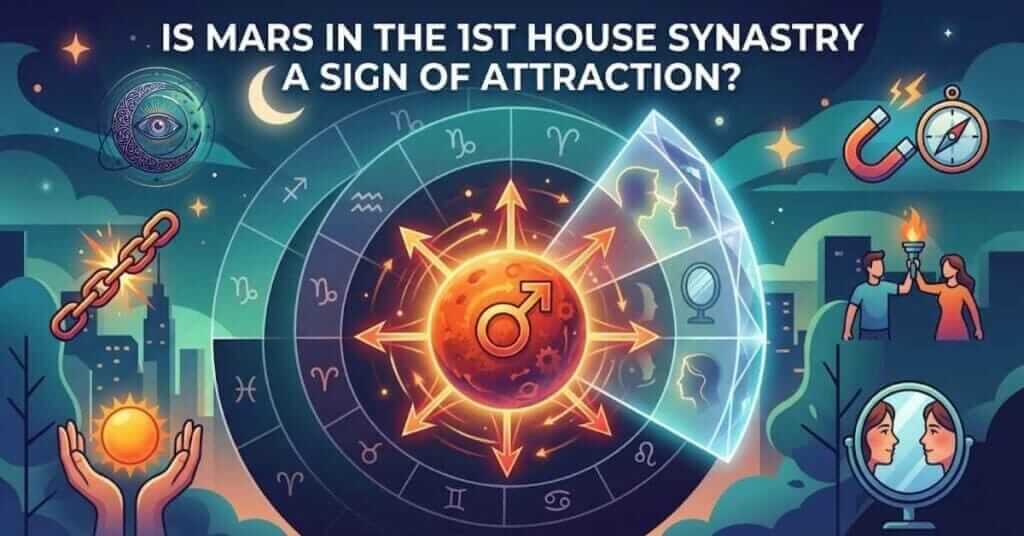
It often reads as attraction, but not automatically as romance. Mars rules drive and physical energy, so this contact usually raises awareness of the other person’s presence. Depending on the aspect and the rest of the chart, that awareness can show up as chemistry, competitiveness, or friction.
A conjunction tends to read as pull. A square tends to read as friction that keeps drawing you back in anyway. The chart cannot tell you which one you are feeling without more context, but it can tell you why the feeling is this strong in the first place.
Mars in the 1st house by sign: shadow side and growth path
Each Mars sign expresses this placement differently once it lands in someone else’s 1st house. The sign shapes whether the charge feels fast, slow, controlling, playful, or intense, and each version carries its own shadow pattern and its own way to grow past it.
Mars in Aries
When Aries Mars lands in your 1st house, the connection moves fast, with little patience for a slow build up. Shadow side: impatience turns into pressure, and the house person can feel rushed. Growth path: agreeing to slow down on purpose, especially early on, so momentum does not replace real decision making.
Mars in Taurus
This version is slower and more physical. The pull feels steady rather than sudden, almost stubborn in how consistent it is. Shadow side: possessiveness, or digging in during disagreements instead of moving through them. Growth path: trusting that steady does not mean stuck.
Mars in Gemini
Here the charge shows up as mental sparring. Wit, teasing, and fast talk replace physical intensity as the main draw. Shadow side: conflict through words instead of resolution, or restlessness that avoids real feelings. Growth path: using that same verbal skill to name what is actually happening.
Mars in Cancer
This Mars protects first and asserts second. The house person may feel cared for and provoked at the same time. Shadow side: moodiness, or using guilt instead of direct confrontation. Growth path: stating needs plainly instead of expecting the other person to read an undertone.
Mars in Leo
Big, warm, and hard to ignore, this placement often feels like being noticed in a way that flatters the house person. Shadow side: pride turns disagreements into performances, where being right matters more than being fair. Growth path: confidence that does not need an audience to hold steady.
Mars in Virgo
Precise and a little critical, this Mars shows care through correction and attention to detail. Shadow side: nitpicking, or turning affection into a checklist the house person keeps failing. Growth path: separating useful feedback from control, and choosing which battles are worth having.
Mars in Libra
This version wants harmony even while it is stirring things up. Direct confrontation feels uncomfortable, so tension shows up sideways instead. Shadow side: passive resistance, or avoiding a real disagreement until it builds into something bigger. Growth path: practicing direct, kind honesty instead of waiting to be asked.
Mars in Scorpio
Rarely casual, this contact often feels magnetic and intense from the first meeting, like the house person is being studied closely. Shadow side: control, jealousy, or using silence as leverage. Growth path: trading intensity for honesty, so the bond runs on depth instead of power plays.
Mars in Sagittarius
Blunt, playful, and freedom loving, this Mars asserts itself through honesty, sometimes more bluntly than the house person expects. Shadow side: carelessness with words, or restlessness that avoids commitment. Growth path: keeping the honesty, but pairing it with more care about timing.
Mars in Capricorn
Controlled and strategic, this placement shows up as steady pressure rather than sudden heat. Shadow side: coldness, or treating the relationship like something to manage rather than feel. Growth path: letting structure support the connection instead of replacing warmth with it.
Mars in Aquarius
Detached but curious, this Mars asserts itself through independence and unusual approaches to closeness. Shadow side: emotional distance, or picking fights over principle instead of the real issue. Growth path: staying engaged even when the instinct is to pull back and analyze from a distance.
Mars in Pisces
Soft and hard to pin down, this Mars asserts itself indirectly, often through mood or quiet withdrawal rather than confrontation. Shadow side: avoidance, or letting resentment build quietly instead of naming it. Growth path: naming what is actually wanted, even when vague feels safer.
The mechanics: aspects, orb, and house rulership
The exact aspect between Mars and the Ascendant changes how this placement feels. A conjunction is the most direct and physical version. A square adds friction. An opposition adds pull through contrast. Trines and sextiles ease the charge but can also make it easier to ignore.
Astrologers measure these connections using aspects, the angles between two points in a chart. The most common ones in synastry are the conjunction (0 degrees), the square (90 degrees), the opposition (180 degrees), the trine (120 degrees), and the sextile (60 degrees).
Each aspect has an orb, the allowed margin of error around the exact angle. A tighter orb, generally under 3 degrees, tends to feel stronger than a wide one.
| Aspect to Ascendant | Orb | Core dynamic | Shadow expression | Growth expression |
| Conjunction (0°) | 0-5° | Instant, undeniable charge | Impulsiveness, feeling overridden | Shared drive toward common goals |
| Square (90°) | 0-6° | Friction that builds momentum | Power struggles, provocation | Productive tension, mutual sharpening |
| Opposition (180°) | 0-6° | Magnetic pull through contrast | Projection onto the other person | Balanced assertion, each completes the other |
| Trine (120°) | 0-6° | Easy, confident chemistry | Complacency, under challenged | Effortless teamwork |
| Sextile (60°) | 0-4° | Supportive, opportunity driven spark | Stays surface level if unused | Active collaboration when engaged |
It also helps to check what Mars naturally rules in the house person’s own chart. If Mars rules a sign the house person has strong placements in, this contact carries extra weight, since it is not only activating the Ascendant but also connecting to a planet that already matters in that chart.
How does Mars element change this placement?
Mars expresses itself differently depending on its element. Fire signs push the charge outward fast. Earth signs ground it in the physical and the practical. Air signs turn it into conversation and mental push and pull. Water signs filter it through mood and instinct before it ever gets said out loud.
| Mars element | Emotional need | Shadow trait | Best self-care practice |
| Fire (Aries, Leo, Sagittarius) | Room to act without waiting for permission | Impatience, steamrolling the other person | Physical movement before big conversations |
| Earth (Taurus, Virgo, Capricorn) | Stability and follow through | Rigidity, digging in during conflict | Slow, grounding routines like walking or cooking |
| Air (Gemini, Libra, Aquarius) | Open, honest conversation | Avoidance through overthinking or detachment | Journaling or talking it out with a third party |
| Water (Cancer, Scorpio, Pisces) | Emotional safety before intensity | Withdrawal, guilt, or silent resentment | Naming the feeling out loud before it builds |
Our chart observations

In our own reading practice at TheCosmicCalc, we have looked at this placement across many synastry charts. When Mars sits close to the Ascendant, most readers describe meeting the other person and reacting fast, before they had time to think it through. When the aspect is a square instead of a conjunction, we notice more early disagreements, but also faster repair once both people name what is happening.
We have not run a formal study on this. These are patterns from real chart readings, not lab results, and we want to be upfront about that difference.
Steven Forrest writes about Mars as the planet of the warrior in his book The Inner Sky. In my own words, his core idea is that Mars is not about aggression for its own sake. It is about learning to point your will at something real. Liz Greene and Howard Sasportas explore a related idea in The Development of the Personality, where they treat Mars as the part of the psyche that has to learn to act instead of just react. Both point to the same lesson for mars in 1st house synastry: the placement works best once both people learn to use the charge on purpose instead of letting it run on autopilot.
What to do with this placement
Mars in 1st house synastry is one data point inside a much larger chart. It explains a charge, not a verdict on the relationship. Pay attention to which aspect is active, check what element carries it, and watch whether the intensity moves you toward each other or just toward friction.
If you want the fuller picture, run both of your details through our Sun, Moon, and Rising Sign Calculator and our Moon Soulmate Calculator to see how this Mars contact sits alongside your emotional compatibility, not just your physical charge.
Frequently Asked Questions
Does Mars in 1st house synastry mean physical attraction?
Often, yes, though not automatically romance. This contact raises physical awareness because Mars rules drive and energy. Whether that reads as romantic attraction, rivalry, or simple magnetism depends on the exact aspect and the rest of the synastry chart between both people.
Is Mars conjunct Ascendant synastry a good sign?
It is not good or bad on its own. A conjunction between Mars and the Ascendant creates intensity and immediate awareness. Whether that intensity feels supportive or draining depends on how both people handle assertion, conflict, and pace within the relationship.
What is the difference between Mars in 1st house and Mars in 7th house synastry?
Mars in the 1st house activates the house person’s identity and instincts directly. Mars in the 7th house activates the house person’s approach to partnership instead. The 1st house version feels personal and immediate. The 7th house version feels more about the relationship itself.
Can this placement cause arguments?
It can, especially with a square or opposition aspect. Mars brings assertion and sometimes confrontation. Two people with this contact often argue more than average, but many also report that the arguments resolve quickly once both people learn the pattern.
Hassan Raza is a dedicated digital tool architect and independent celestial researcher specializing in astronomical data modeling. Combining technical precision with deep cosmological studies, he develops intuitive astro-computational tools designed to make intricate natal charts, planetary transits, and celestial alignments accessible to everyone worldwide. Driven by accuracy and user-centric web design, Hassan ensures that every calculation on The Cosmic Calc bridges the gap between historical cosmic tracking and modern, real-time technology.