
Moon in the 5th house synastry is the placement behind that strange, specific feeling of meeting someone and suddenly wanting to laugh more, flirt more, and drop your guard without knowing why. Maybe it shows up as a heavy, warm feeling in your chest on a full moon, or the sense that you act like a different, softer version of yourself around one particular person. You catch yourself texting them at midnight about something small and silly, the kind of thing you would normally keep to yourself. You cannot explain it with logic. It just happens, and it happens fast.
After going through hundreds of birth charts and synastry overlays, I keep finding the same pattern. People rarely fall for someone’s Sun sign traits first. They fall for how safe their Moon feels around that person. The Sun is the mask we show the world. The Moon is the part of us that decides, in seconds, whether we feel free enough to be silly, open, or emotionally honest with someone new. Clients who come in confused about why one particular person feels so different from everyone else they have dated almost always have a strong Moon contact somewhere in the overlay, and the 5th house version is one of the most common ones I see.
This guide breaks down exactly what happens when this placement shows up in your chart comparison, why it feels the way it does, what it looks like sign by sign, and why 2026’s eclipses make it worth paying closer attention to right now. It is a grounded look at the psychology behind the spark, built on real house mechanics and named research rather than daily horoscope guesswork.
How does the moon in the 5th house synastry actually work?
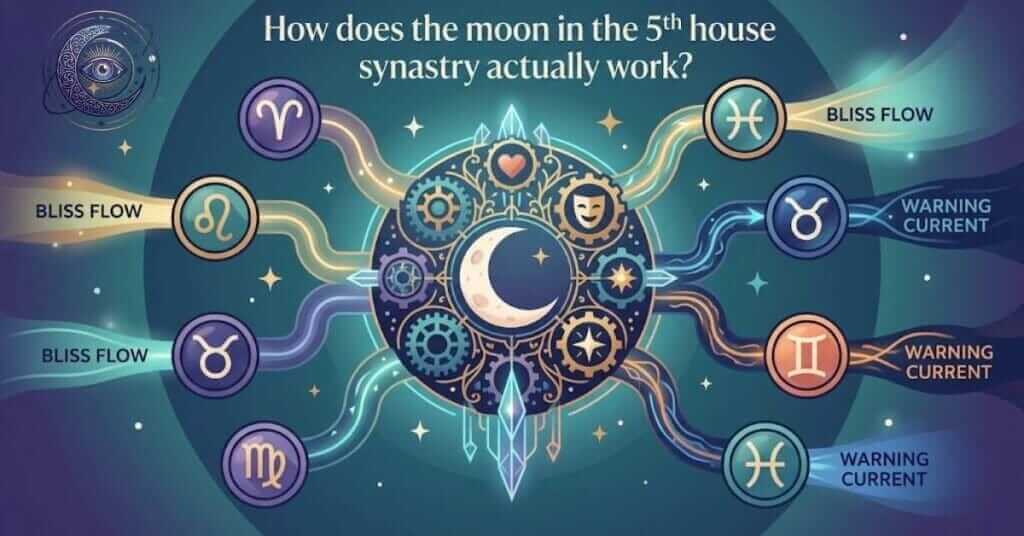
Moon in the 5th house synastry happens when one person’s Moon sign lands inside the other person’s 5th house of romance and creativity. The Moon person feels emotionally safe and playful around the 5th house person, often describing the connection as easy, warm, and instantly familiar.
In a synastry comparison, astrologers place one person’s planets onto the other person’s natal chart wheel to see which houses those planets fall into. The 5th house rules romance, self-expression, creativity, and joy. It is not the house of long-term commitment. That belongs to the 7th house, and it is not the house of deep merging either, that is the 8th house.
So when a Moon lands here, the feeling is lighter than obsession and warmer than friendship. Psychologist and astrologer Liz Greene has written extensively about the Moon as the part of the psyche shaped by early emotional conditioning, not conscious choice. Her work, most notably in her book Relating, argues that synastry contacts involving the Moon reveal where two people’s emotional habits either clash or fit with unusual ease. When the fit is easy, as it often is with a 5th house Moon overlay, people describe it simply: being around this person feels like play, not work.
What makes the Moon your secret emotional self?
Your Moon sign is the part of you that reacts before you think. It holds old emotional patterns, comfort habits, and the way you were cared for as a child. Astrologers call this the emotional blueprint, the private layer underneath your Sun sign personality.
Your Sun sign is who you are trying to become. Your Moon sign is who you already are underneath the trying. It governs your gut reactions, your comfort food, the way you cry, and the way you soothe yourself after a bad day. Author Donna Cunningham, in her book Moon Signs, describes the Moon as the “inner life” that most people never learn to read in themselves, the part that runs on autopilot long before the conscious mind catches up.
This is why a 5th house Moon overlay hits differently than a Sun-based connection. The 5th house person makes your nervous system relax. You feel free to be dramatic, silly, or emotionally loud without being judged for it. That is maternal energy at work, meaning the felt sense of being unconditionally delighted in, not a romantic dynamic.
If you are not sure what your own Moon sign is, a quick way to check is through a sun moon and rising sign calculator, which maps out your full emotional and identity blueprint in one pass rather than guessing from your birthday alone.
How do I know if this placement is actually in my chart?
You need two birth times, two birth places, and a synastry chart comparison. Enter both people’s exact birth data, generate the overlay, and check which house one person’s Moon falls into on the other person’s wheel. If it lands in the 5th, this placement is present.
Birth time matters more than most people expect. Houses shift roughly every two hours, so a Moon that lands in someone’s 4th house at 2 p.m. can shift into the 5th house if the real birth time was closer to 4 p.m. If you only know an approximate birth time, treat the house placement as a strong possibility rather than a locked fact, and look for the pattern in how the connection actually feels day to day. Chemistry, playfulness, and a sense of emotional ease around each other are the lived version of what the chart is describing on paper. A moon soulmate calculator can generate the overlay for you directly, so you are not stuck reading a raw chart wheel by hand.
How do the Sun, Moon, and Rising work together in this pairing?
The Moon shows what feels emotionally safe. The Sun shows what feels seen and celebrated. The Rising sign shapes the first spark of chemistry. When this Moon overlay lines up with Sun or Rising contacts too, the pull between two people gets stronger.
Your Ascendant, also called your Rising sign, is the mask you wear on first meeting someone. It is fast and instinctive. If the 5th house person’s Sun or Ascendant also touches the Moon person’s 1st or 5th house, the chemistry compounds. The connection then affirms both layers at once, the emotional safety of the Moon and the sense of being recognized for who you are.
| Big 3 layer | Role in this synastry pairing | Felt experience |
| Moon | Emotional core, subconscious comfort | “I feel safe being myself” |
| Sun | Conscious identity, ego expression | “I feel seen and celebrated” |
| Rising | First impression, initial chemistry | “I felt an instant spark” |
None of these layers work completely alone. A 5th house Moon link with no support from the Sun or Rising can still feel strong, but it will feel more like a summer fling than a full identity match. Add Sun or Rising contacts, and the same placement can carry real staying power.
Why is 2026 an important year for this placement?
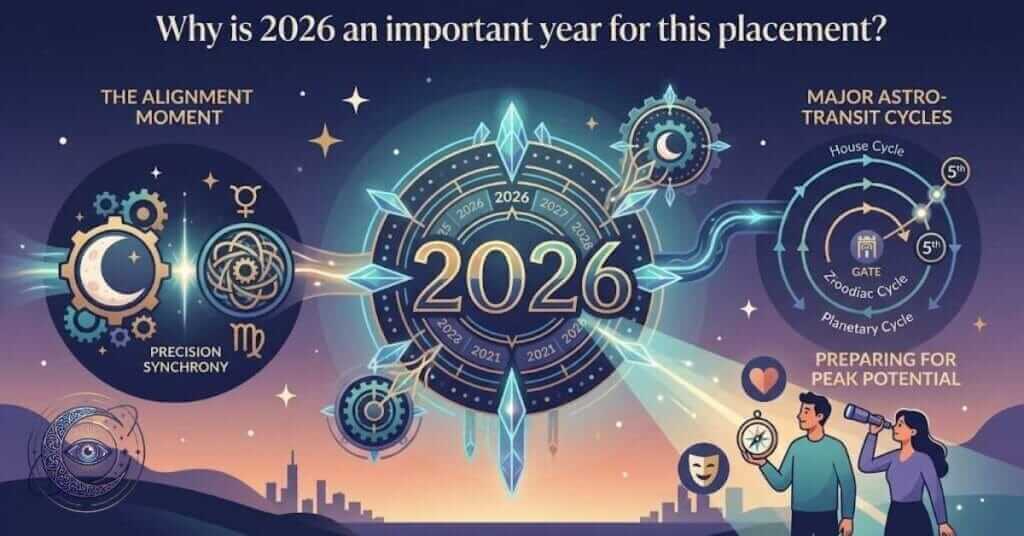
In 2026, two lunar eclipses fall along the Virgo-Pisces axis, on March 3 and August 27. For couples with this Moon overlay near those degrees, old questions about being loved for who you are can surface and ask to be answered honestly.
The March 3 eclipse lands near 12 to 13 degrees Virgo, a total lunar eclipse. The August 27 eclipse falls near 4 degrees Pisces, a partial lunar eclipse closing out a two-year eclipse cycle that began in September 2024. Eclipses do not create new dynamics out of nowhere. They speed up what is already quietly happening underneath a relationship.
For a 5th house Moon connection, that usually means the fun, easy chemistry gets tested. Does the warmth hold up when real emotional needs show up, not just the playful ones? Couples with natal planets near 4 to 13 degrees of Virgo or Pisces will feel this most directly during 2026, especially around the exact eclipse dates and the weeks on either side of them.
This does not mean the eclipses cause problems. They tend to work more like a spotlight than a wrecking ball. A couple who has been avoiding a real conversation about where the relationship is heading might find that conversation impossible to put off any longer during eclipse season. A couple who has been quietly building something solid underneath the fun often finds the eclipse confirms it, deepening the connection rather than shaking it.
How does the Moon in the 5th house synastry shift by zodiac sign?
Each Moon sign changes the flavor of a 5th house connection. A Leo Moon in the 5th house wants applause. A Cancer Moon in the 5th house wants devotion. The core theme stays the same, emotional warmth and creative spark, but each sign shows it, and struggles with it, differently.
Aries Moon in the 5th house. Surface chemistry moves fast, full of impulsive dates and quick decisions. Shadow side: emotional impatience, needing excitement to feel loved. Growth path: learning that steady affection can feel just as alive as a chase.
Taurus Moon in the 5th house. Surface chemistry is sensual, physical, and calm. Shadow side: possessiveness disguised as loyalty. Growth path: trusting a connection without needing to control its pace.
Gemini Moon in the 5th house. Surface chemistry is playful, talkative, endlessly curious. Shadow side: emotional restlessness, pulling away the moment things feel routine. Growth path: staying present in a conversation instead of chasing the next new topic.
Cancer Moon in the 5th house. Surface chemistry feels nurturing and devoted almost immediately. Shadow side: over-attachment, mistaking being needed for being loved. Growth path: offering care without keeping score of it.
Leo Moon in the 5th house. Surface chemistry is warm, generous, and radiant. Shadow side: needing constant admiration to feel emotionally secure. Growth path: learning that love does not require a performance.
Virgo Moon in the 5th house. Surface chemistry shows up as quiet, devoted attention to detail. Shadow side: criticism used as a stand-in for closeness. Growth path: offering praise as easily as feedback.
Libra Moon in the 5th house. Surface chemistry is romantic, harmonious, easy to fall into. Shadow side: avoiding conflict until resentment builds quietly. Growth path: saying the hard thing before it turns into distance.
Scorpio Moon in the 5th house. Surface chemistry is magnetic and intense from the first conversation. Shadow side: jealousy or emotional testing to check if the bond is real. Growth path: letting closeness build without needing proof of it.
Sagittarius Moon in the 5th house. Surface chemistry is adventurous, optimistic, and light. Shadow side: fear of routine, mistaking freedom for avoidance. Growth path: finding that commitment can still leave room to roam.
Capricorn Moon in the 5th house. Surface chemistry is quietly devoted, shown through actions more than words. Shadow side: withholding affection out of old fear of looking foolish. Growth path: letting playfulness in without needing to earn it first.
Aquarius Moon in the 5th house. Surface chemistry feels unconventional, easy, more like friendship than romance at first. Shadow side: emotional distance disguised as independence. Growth path: allowing closeness without pulling back the moment it feels too warm.
Pisces Moon in the 5th house. Surface chemistry is dreamy, imaginative, deeply devoted. Shadow side: idealizing the other person instead of seeing them clearly. Growth path: learning to love the person who is actually there.
How does the 5th house compare to other houses in synastry?
Synastry overlays work by placing one person’s planets into the other person’s houses. A Moon in the 5th house feels playful and romantic. The same Moon in someone’s 7th house feels closer to partnership, and in the 8th house it feels closer to deep, fated intimacy.
Astrologer Howard Sasportas wrote the definitive modern reference on this topic, The Twelve Houses, where he lays out each house as a different life arena the planets pass through. A Moon overlay is not fixed in meaning. It changes completely depending on which house it lands in, which is why two people can both feel “chemistry” with someone and mean two very different things by it.
Astrologer Steven Forrest, in his book Skymates, co-written with Jodie Forrest, makes a related point about synastry generally: no single contact between two charts decides a relationship’s fate on its own. A 5th house Moon overlay is one voice in a much larger conversation between two full charts, not the whole conversation.
The 1st house version of a Moon overlay changes someone’s sense of identity fast, often within the first real conversation. The 4th house version feels domestic quickly, the kind of connection where you feel folded into someone’s family life within a few months. The 11th house version stays closer to friendship, with romance as an option rather than the default. The 5th house sits in its own category: lighter than the 8th, warmer than the 11th, and less binding than the 7th.
| Moon overlay house | Core theme | Relationship flavor |
| 1st house | Identity, immediate impact | “You changed how I see myself” |
| 4th house | Home, emotional roots | “You feel like family” |
| 5th house | Romance, self-expression | “You make me feel alive and adored” |
| 7th house | Partnership, commitment | “You feel like a life partner” |
| 8th house | Intimacy, merging | “You feel like fate” |
| 11th house | Friendship, shared vision | “You feel like my best friend” |
The 5th house is expressive, but it is not automatically stabilizing. Without support from the 7th or 8th house, or a steady aspect between Saturn and the personal planets, this placement alone does not guarantee a relationship will last. It guarantees that it will feel good while it is happening, which is a real thing, just not the same thing as long-term structure.
Our chart observations
In the synastry readings I have worked through, this overlay shows up as one of the most immediately recognizable placements, even to people with no astrology background. We noticed that clients with this overlay almost always describe the same physical sensation before they know the chart term for it: a lightness in the chest, an urge to be more playful than usual, laughing more easily than they do with most people.
We also noticed a pattern worth naming honestly. This placement tends to feel strongest in the first six to twelve months of a connection. After that early window, couples who also have 7th or 8th house contacts tend to settle into something steadier. Couples who only have the 5th house Moon link, without other supporting contacts, more often describe the relationship cooling into a warm friendship rather than staying romantic. Neither outcome is a failure. It is simply what the placement, on its own, was built to do.
One more thing worth naming: this overlay shows up just as often in short-term flings and rebound connections as it does in long relationships. The warmth is real either way. It just does not, by itself, tell you which category a connection will end up in. That answer comes from the rest of the chart, not from this placement alone.
Emotional needs and self-care by element
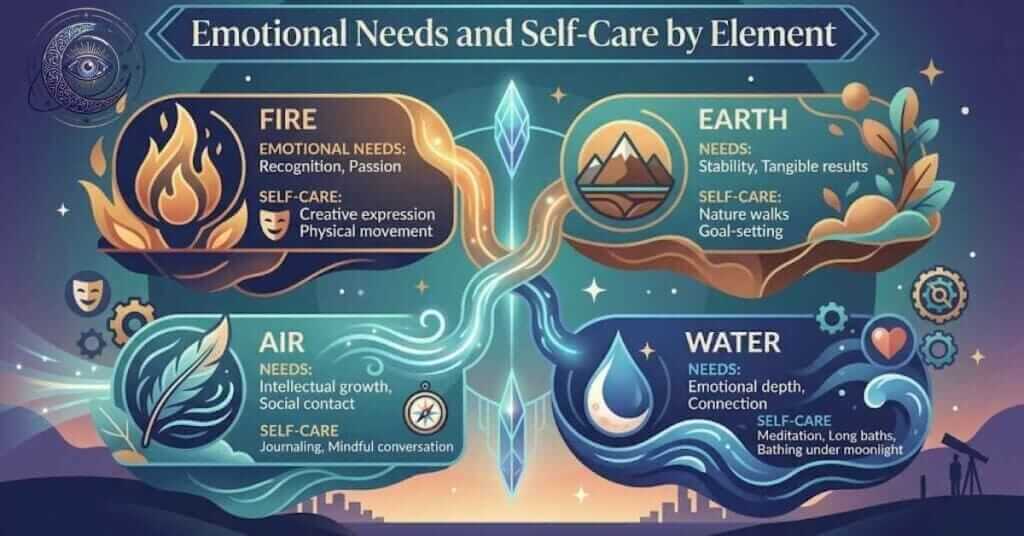
Every Moon sign belongs to one of four elements, and that element shapes how a person expresses the emotional warmth of a 5th house connection, and what throws it off balance.
| Element | Emotional need | Shadow trait | Best self-care practice |
| Fire (Aries, Leo, Sagittarius) | To feel exciting and admired | Impatience, needing constant stimulation | Physical movement before big emotional talks |
| Earth (Taurus, Virgo, Capricorn) | To feel secure and useful | Rigidity, withholding affection | Slow, sensory rituals like cooking or a long walk |
| Air (Gemini, Libra, Aquarius) | To feel understood and free | Emotional detachment, overthinking | Journaling before reacting out loud |
| Water (Cancer, Scorpio, Pisces) | To feel deeply seen | Over-attachment, absorbing others’ moods | Quiet alone time to reset after social contact |
If you want to see how your own Moon sign lines up with a partner’s chart, a moon soulmate calculator can map the overlay directly and show you which house your Moon lands in on their wheel, and theirs on yours.
The takeaway
Moon in the 5th house synastry is one clear, honest signal: this person makes your emotional guard come down. What you do with that information, whether you build something lasting or let it stay a bright, warm chapter, depends on everything else the two charts have to say.
If you want to see this placement mapped out in your own chart before drawing any conclusions, start with your own Moon sign through a sun moon and rising sign calculator, then run the full overlay through a moon soulmate calculator to see exactly which house your Moon lands in on someone else’s wheel, and theirs on yours. The chemistry is real. What you build from it is still up to you.
Frequently asked questions
Does Moon in the 5th house synastry mean we will fall in love?
Not automatically. This placement creates strong chemistry and creative rapport, but lasting romantic compatibility also depends on Venus and Mars contacts, 7th house overlays, and Saturn placements. Moon in the 5th house is a spark. It is not, on its own, proof of a lasting partnership.
Is this placement a one-way or mutual aspect?
It can be either. Most of the time it is one-directional, meaning only one person’s Moon falls into the other’s 5th house. When both people’s Moons fall into each other’s 5th houses, the chemistry tends to feel doubled, almost like both people are constantly cheering the other one on.
How is this different from a composite chart Moon in the 5th house?
Synastry compares two separate, individual charts against each other. A composite chart is a third chart built from the midpoints between two people’s planets, treated as a chart for the relationship itself, almost as its own entity. A Moon in the 5th house in a composite chart says the relationship as a whole runs on playfulness and creative energy, not just that one person feels that way about the other.
Hassan Raza is a dedicated digital tool architect and independent celestial researcher specializing in astronomical data modeling. Combining technical precision with deep cosmological studies, he develops intuitive astro-computational tools designed to make intricate natal charts, planetary transits, and celestial alignments accessible to everyone worldwide. Driven by accuracy and user-centric web design, Hassan ensures that every calculation on The Cosmic Calc bridges the gap between historical cosmic tracking and modern, real-time technology.