
Pluto trine Venus synastry is one of the few chart connections people notice before they ever look up what it means, because it feels like the ground shifted the moment two people met.
I’ve read through hundreds of synastry charts for readers over the years, and the ones with this aspect almost always describe the same thing. They say the relationship felt old on day one. Not comfortable in a boring way, but familiar in a way that made them want to know more, even the parts that scared them a little.
This guide breaks down what Pluto trine Venus actually means in synastry, how it differs from the composite and natal versions of the same aspect, why 2026 is reactivating it for a lot of couples, and where the shadow side shows up if nobody pays attention to it. This goes past the usual one line description you get from a horoscope app.
What is Pluto trine Venus in synastry?
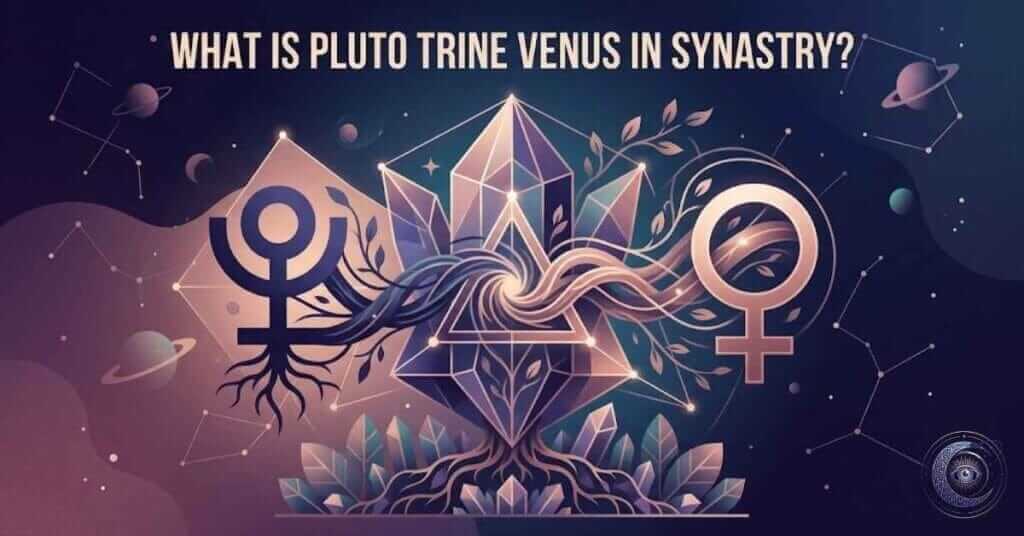
Pluto trine Venus in synastry means one partner’s Pluto forms a smooth 120 degree angle to the other partner’s Venus. This creates deep, transformative attraction without the friction of harder Pluto-Venus contacts. The bond feels magnetic and fated, and it tends to support loyalty and growth, though the intensity can still tip into possessiveness if nobody names it.
A trine is one of the oldest measurements in astrology. It means the two planets sit 120 degrees apart on the chart wheel, and because 120 degrees usually connects signs of the same element, the energy moves without much resistance. Fire trine fire. Water trine water. That shared element is why a trine feels supportive instead of tense.
Pluto is the planet tied to power, obsession, and psychological change. Venus is the planet of love, beauty, and what we value. When they meet in a synastry chart (the overlay of two separate birth charts on top of each other), the pairing usually brings intensity. A square or an opposition between the same two planets creates that intensity through conflict, arguments, or power struggles that repeat until someone breaks the pattern. A trine carries the same weight but the two planets cooperate instead of fight, so the depth shows up as attraction and staying power rather than tension.
Liz Greene, in her book Relating: An Astrological Guide to Living with Others, describes Pluto as the planet connected to psychological death and rebirth, the part of us that forces old patterns to end so something more honest can take their place. That framing matters here. A Pluto trine Venus contact doesn’t just add heat to a relationship. It tends to ask both people to grow, whether they were planning on it or not.
Why this aspect feels different from ordinary chemistry
Most people can tell the difference between a fling and this. A regular attraction fades once the newness wears off. Pluto trine Venus synastry tends to deepen instead, because Pluto doesn’t let anything stay surface level for long.
Readers describe a sense of recognition, like they’d met this person before in some other form. Astrologers who work with evolutionary astrology would call this a karmic bond or soul contract, meaning the relationship carries a sense of unfinished business from somewhere, even if neither person can point to where. You don’t need to take that literally to notice the pattern. Couples with this aspect report staying in each other’s lives long after the relationship changes shape, sometimes as friends, sometimes as people who just can’t fully let go.
Synastry vs composite vs natal: reading the aspect in three contexts
Pluto trine Venus shows up in three different ways depending on which chart you’re reading, and mixing them up is the fastest way to misread your own relationship. Synastry compares two separate birth charts. A composite chart builds a third chart from the relationship itself. A natal Pluto Venus trine belongs to one person alone, before they even meet anyone.
Most articles on this topic treat these three readings as one thing, which is exactly where readers get confused. Knowing which chart you’re actually looking at changes what the aspect is telling you.
Synastry overlay: two individual charts compared
A synastry chart takes two people’s birth charts and lays them on top of each other to see how the planets interact. If your Pluto sits at a trine to your partner’s Venus, direction matters. The person whose Pluto is involved usually feels like the one pulling the other person into deeper territory, sometimes without meaning to. The person whose Venus is involved often feels drawn in, sometimes unsettled by how strong the pull is, before they understand why.
This asymmetry is normal. It doesn’t mean one person has more power in the relationship. It means the two of you experience the same aspect from different seats.
The composite chart: the relationship’s own identity
A composite chart is built from the midpoints between two people’s planets, creating a chart for the relationship itself, almost like the partnership has its own birth chart. Robert Hand’s book Planets in Composite: Analyzing Human Relationships is one of the main references astrologers use for reading this kind of chart, and his work treats the composite as a separate entity with its own needs, separate from what either partner wants individually.
A composite Pluto trine Venus means the relationship, as its own thing, carries transformative pull built into its foundation. That’s different from the synastry version, which shows how each partner personally experiences the other.
Natal Pluto trine Venus: what one person brings in
Some people carry this trine in their own natal chart, meaning Pluto and Venus formed this angle at the moment they were born, with no partner involved yet. If that’s you, you likely walked into every relationship you’ve had with an appetite for depth that casual dating never satisfies. You get bored fast with anything shallow. This isn’t about your partner’s chart at all. It’s about the pattern you already carry, and it shapes who you’re drawn to before synastry even enters the picture.
Pluto in Aquarius 2026: how this year reactivates your trine
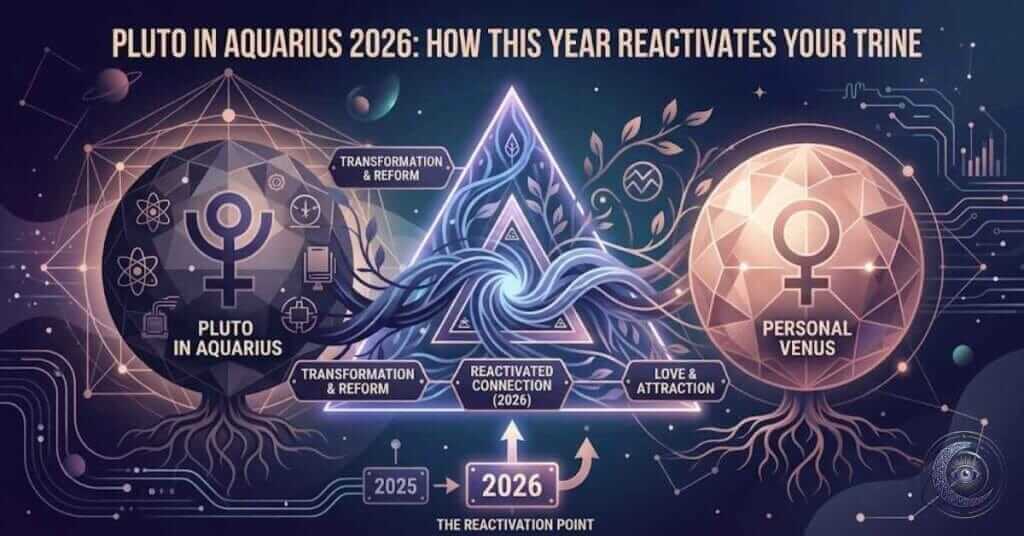
Pluto has been moving through Aquarius since November 2024, and 2026 keeps it there, including a retrograde stretch that runs from spring into fall. That retrograde period tends to pull attention inward, forcing people to sit with questions about power, independence, and control that they’d normally avoid.
If your Pluto trine Venus synastry involves planets in Aquarius, Leo, Taurus, or Scorpio, this year is likely to feel louder than usual. Pluto is making hard and soft aspects to Uranus, Jupiter, and Mars throughout 2026, and any planet connected to your natal or synastry Pluto gets pulled into that activity.
In practical terms, activation means the relationship asks for a renegotiation. Aquarius energy is about independence and space, so a couple with this trine might find themselves needing more room to be individuals even while the bond itself deepens. That combination, more autonomy and more closeness at the same time, is the theme of the year for anyone with this aspect.
Three ways Pluto in Aquarius 2026 is activating Venus-Pluto trines this year:
- It’s pushing couples to talk openly about independence instead of assuming they already agree on it.
- It’s bringing old power dynamics back to the surface so they can be renegotiated, not repeated.
- It’s rewarding partners who treat change as normal instead of something to fear.
Element by element: shadow sides and growth paths
Pluto trine Venus only forms between signs of the same element, since a 120 degree angle links fire to fire, earth to earth, air to air, and water to water. That’s why the honest way to break this down is by element, not by a single zodiac sign, and it’s also why most articles that list sign by sign combinations get the mechanics wrong.
Fire trine: Aries, Leo, Sagittarius pairings
Fire trine relationships run hot. The attraction feels adventurous and a little reckless, in a good way. Both partners tend to be direct about what they want, which keeps the connection honest even under pressure.
The shadow side shows up as competition over who leads. Two fire signs both want to be the one steering, and Pluto adds enough intensity that this can turn into a quiet power struggle neither person names out loud.
The growth path is shared purpose. When fire trine couples point their energy at something outside the relationship, a project, a goal, a cause, the competitive edge turns into teamwork instead of friction.
Earth trine: Taurus, Virgo, Capricorn pairings
Earth trine couples build something that lasts. The attraction is sensual and grounded, and both people usually value stability more than drama.
The shadow side is possessiveness dressed up as loyalty. Earth signs resist change by nature, and Pluto’s pull toward transformation can feel threatening rather than exciting, which sometimes shows up as one partner holding on too tight.
The growth path is allowing controlled change. Earth trine couples do best when they treat evolution as part of stability, not the opposite of it.
Air trine: Gemini, Libra, Aquarius pairings
Air trine relationships run on ideas. The attraction is intellectual first, physical second, and both partners tend to keep reinventing the relationship together instead of settling into routine.
The shadow side is detachment used as control. Air signs can retreat into logic when things get emotionally heavy, and Pluto adds a layer where that retreat starts to feel like punishment to the other person.
The growth path is pairing honesty with vulnerability. Air trine couples need to say the hard thing out loud instead of intellectualizing around it.
Water trine: Cancer, Scorpio, Pisces pairings
Water trine couples feel closer to each other than almost any other pairing. The emotional fusion runs deep, sometimes to the point where partners describe knowing what the other feels before they say it.
The shadow side is enmeshment. Two water signs can lose track of where one person ends and the other begins, and Pluto’s intensity makes that blur feel like closeness even when it’s actually a loss of identity.
The growth path is protecting individual boundaries while still allowing the depth. Water trine couples do best when closeness and separateness are both allowed to exist at once.
| Element pairing | Core expression | Shadow side | Growth path |
| Fire (Aries, Leo, Sagittarius) | Passionate, high heat attraction | Power struggles over leadership | Shared purpose over competition |
| Earth (Taurus, Virgo, Capricorn) | Sensual, built to last | Possessiveness disguised as loyalty | Allowing controlled change |
| Air (Gemini, Libra, Aquarius) | Intellectual magnetism | Detachment used as control | Vulnerability alongside honesty |
| Water (Cancer, Scorpio, Pisces) | Deep emotional fusion | Enmeshment, lost boundaries | Depth with protected individuality |
Pluto and Venus across the 12 houses
Where a partner’s Pluto lands in your chart’s houses tells you which part of life the trine transforms first. This is the piece most articles about Pluto trine Venus synastry skip, and it’s the part that gives the aspect real substance instead of vague talk about fate and magnetism.
Steven Forrest’s book Skymates: Love, Sex, and Evolutionary Astrology builds much of its house overlay method on the idea that a partner’s outer planet placement points to the exact area of life where the relationship does its deepest work, whether that’s identity, intimacy, or shared belief. That framework holds up well here.
| House where partner’s Pluto falls | What it transforms |
| 1st house | Sense of self and personal identity |
| 2nd house | Values, self worth, shared finances |
| 3rd house | Communication style, everyday connection |
| 4th house | Sense of home, family patterns, emotional roots |
| 5th house | Romance, creativity, how affection is expressed |
| 6th house | Daily routines, health habits shared |
| 7th house | The partnership itself, commitment, balance of power |
| 8th house | Intimacy, shared resources, psychological merging |
| 9th house | Beliefs, worldview, shared philosophy or travel |
| 10th house | Public image, ambitions, how the relationship is seen |
| 11th house | Friendships, shared community, long term goals |
| 12th house | Subconscious bonds, karmic or past life undertones |
If a partner’s Pluto falls in your 7th house, for example, the trine is likely to focus its transformation directly on the commitment itself, on how power and fairness get shared between you. If it falls in your 12th house, the pull is quieter and harder to explain, more felt than seen, and it often shows up as a bond neither person can fully put into words.
Our chart observations
We pull the birth data and cross check the aspect ourselves whenever a reader asks about their Pluto trine Venus synastry, rather than relying on a single generated report, and a few patterns keep showing up.
Couples with this aspect tend to stay connected long after a breakup, more often than couples with harder Pluto-Venus contacts. They report fewer explosive arguments than square or opposition pairings, but more long stretches of quiet intensity, the kind where nothing is said out loud but both people know something has shifted. When one partner has natal Pluto trine Venus already, the synastry version tends to feel less overwhelming to them personally, since they’ve likely lived with this kind of pull before.
None of this replaces a full reading of the rest of the chart. A single trine, no matter how meaningful, sits inside a much bigger picture.
Working with this aspect: a practical self-awareness framework
A Pluto trine Venus synastry bond works best when both people stay honest about the difference between depth and control. Here are a few questions worth sitting with, alone or with your partner:
- Do I feel drawn to this person, or do I feel like I can’t function without them? Those are not the same thing.
- When we disagree, does the conflict end in understanding, or does one of us go quiet until the other gives in?
- Do I still feel like myself around this person, or have I started shaping my choices around keeping them close?
- Is the intensity here pointing us toward growth, or are we just circling the same unresolved pattern?
If you want to check where your own Pluto and Venus sit before comparing charts with a partner, run your details through a sun, moon, and rising sign calculator first. It’s worth pairing that with a moon soulmate calculator too, since the Moon overlay often explains the emotional side of a connection that Venus and Pluto alone can’t fully cover.
Pluto trine Venus synastry is rare enough that most people only experience it once or twice in a lifetime. That rarity is exactly why it’s worth understanding clearly, rather than filing it under one more generic “intense love” aspect. The depth is real. So is the responsibility that comes with it.
FAQs
1. What does Pluto trine Venus mean in synastry?
Pluto trine Venus in synastry means one partner’s Pluto forms a harmonious 120 degree angle to the other’s Venus. This creates deep, transformative attraction without the friction of harder Pluto-Venus aspects. The bond feels magnetic and fated, encouraging emotional depth, loyalty, and mutual growth, though intensity can still tip into possessiveness if left unchecked.
2. Is Pluto trine Venus a good aspect for marriage?
Yes, Pluto trine Venus generally supports long-term commitment because the trine’s ease lets Pluto’s transformative pull deepen intimacy rather than destabilize it. Couples often describe unusual staying power through hard times. It isn’t a guarantee of compatibility on its own, but it strengthens whatever foundation the rest of the synastry chart provides.
3. What is the difference between Venus trine Pluto and Venus conjunct Pluto?
A trine is a flowing 120 degree aspect, so the Pluto-Venus intensity expresses smoothly and supportively. A conjunction places both planets at the same degree, fusing their energies directly, which raises both the magnetism and the risk of enmeshment. The conjunction feels louder and more consuming; the trine feels steadier and easier to channel.
4. Does Pluto trine Venus mean you’ve found your soulmate?
Not on its own. The aspect explains why a connection feels unusually deep and hard to walk away from, but “soulmate” is a label, not a chart placement. A single trine sits inside a much bigger synastry picture, so it’s worth reading alongside Moon, Sun, and 7th house overlays before drawing that conclusion.
5. What happens if only one partner has Pluto trine Venus in the synastry overlay?
That’s actually how the aspect usually shows up, since it forms between one person’s Pluto and the other’s Venus rather than both people carrying it. The Pluto partner tends to feel like the one pulling the connection deeper, while the Venus partner feels drawn in, sometimes before understanding why.
Hassan Raza is a dedicated digital tool architect and independent celestial researcher specializing in astronomical data modeling. Combining technical precision with deep cosmological studies, he develops intuitive astro-computational tools designed to make intricate natal charts, planetary transits, and celestial alignments accessible to everyone worldwide. Driven by accuracy and user-centric web design, Hassan ensures that every calculation on The Cosmic Calc bridges the gap between historical cosmic tracking and modern, real-time technology.