
Venus sextile mars synastry shows up in a lot of birth chart comparisons, and it usually gets described the same tired way: easy, chill, low drama. That description is not wrong, but it is thin.
Here is what that ease actually feels like from the inside. You meet someone and there is no push and pull. No anxious re-reading of a text before you send it. No performance. It can feel so calm that you start to wonder if calm means something is missing, because most of us were taught that real attraction has to come with a little chaos attached.
After going through synastry charts for couples who describe their connection this way, the same 60 degree link keeps showing up: one partner’s Venus sits in a comfortable angle to the other partner’s Mars. This guide walks through what that angle actually creates, how it changes depending on the houses involved, what 2026’s eclipses are doing to it, and how two people can use it on purpose instead of just coasting on it.
What is venus sextile mars in synastry
Venus sextile mars in synastry means one partner’s Venus forms a 60 degree angle to the other partner’s Mars. This creates natural, low friction chemistry between romantic desire and personal values. It supports mutual attraction and comfortable physical connection, without the tension of a square or opposition.
A synastry chart is simply two people’s natal charts laid on top of each other so an astrologer can see how every planet in chart A relates to every planet in chart B. Venus rules attraction, affection, and what a person finds beautiful or worth pursuing. Mars rules drive, assertion, and how a person goes after what they want.
When one person’s Venus and the other’s Mars sit at a supportive angle, pursuit and receptivity line up without much negotiation. One partner wants to be pursued in roughly the way the other partner naturally pursues. Astrologer Lauren Ash, interviewed by Astrology.com, describes sextiles in general as “very favorable to have in transits, natal charts, and compatibility.” That holds here specifically because Venus and Mars are the two planets most directly tied to romantic and physical chemistry, so a supportive angle between them affects the relationship in a way a sextile between two less personal planets would not.
Most people who look up this aspect are trying to answer one of three things. They want to know what it means in plain terms, they want to know how to actually find it in two real charts, and they want to know whether it says anything about long term compatibility. This guide answers all three, in that order, before getting into the parts almost nobody covers.
This is not a guarantee of a lasting relationship. It is one supportive contact among dozens of possible ones in a full synastry chart, and it says more about how the chemistry feels day to day than about whether the relationship will last.
How do you find this aspect between two charts
To find this aspect, generate a synastry chart using both people’s birth times and locations, then check the angle between one person’s Venus and the other’s Mars. A sextile sits at 60 degrees, usually allowed an orb of up to 6 degrees. A free chart calculator or a professional astrologer can confirm the exact degree.
Two details change how strong this aspect feels once you have found it.
The first is orb size. A tight orb, under 2 degrees, tends to feel more constant and noticeable in daily life. A wide orb, closer to the 6 to 8 degree edge of what most astrologers allow, tends to feel softer and more occasional. Many astrology sites put the working range for a sextile between 4 and 6 degrees, sometimes a little wider for the Sun or Moon.
The second is direction. An applying aspect is still closing the gap between the two planets and tends to feel like it is building. A separating aspect has already passed exact and tends to feel like something the relationship is settling into rather than developing toward. Both are valid contacts. They just read differently in a long relationship, especially once the initial attraction phase has passed.
A quick example makes this concrete. Say one partner’s Venus sits at 8 degrees Taurus and the other’s Mars sits at 6 degrees Cancer. That is a 2 degree orb, tight and applying, since the Mars degree has not yet reached the exact 60 degree point. In daily life, this usually reads as chemistry that keeps building rather than settling, even years into the relationship. Widen the same example to Venus at 8 degrees Taurus and Mars at 1 degree Cancer, and the 7 degree gap puts it at the outer edge of what most astrologers count, meaning the pull is there but faint enough that it rarely drives the relationship on its own.
Beyond the aspect: how it interacts with the rest of the synastry chart
No single synastry contact tells the whole story of a relationship. Venus sextile mars reads very differently depending on what else connects the two charts, especially Moon contacts for emotional depth and Ascendant contacts for daily rhythm and first impressions.
If this sextile shows up alongside a Moon to Venus or Moon to Mars contact, the chemistry gets emotional backing. The attraction is not just pleasant, it also feels safe. If it shows up alongside a strong Ascendant overlay, meaning one person’s planets land close to the other’s rising sign, the ease extends into how the couple actually shows up for each other day to day, not just how they feel about each other in private.
When Venus sextile mars is the only strong contact between two charts, the relationship can feel pleasant without feeling deeply anchored. That is worth naming honestly rather than glossing over, because it is one of the more common questions people ask once they find this aspect and assume it means more than it does.
This is where most articles on the topic stop, treating one sextile as the whole verdict on a relationship. A full synastry reading looks at dozens of contacts between two charts, and Venus sextile mars is one piece of that picture, not the picture itself. Two charts can carry this exact aspect and still play out completely differently depending on what surrounds it. A couple with this sextile plus a difficult Saturn contact might feel real chemistry alongside real caution. A couple with this sextile plus a Sun trine Sun might feel both the ease and a sense of being fundamentally on the same page.
Three synastry contacts that amplify venus sextile mars:
- Moon conjunct or trine either person’s Venus or Mars, which adds emotional weight to the attraction.
- Sun to Venus or Sun to Mars contacts, which add a sense of mutual recognition.
- Ascendant overlays, where one partner’s planets sit near the other’s rising sign, which brings the chemistry into everyday interaction.
Three contacts that can override or complicate it:
- Saturn has hard aspects to Venus or Mars, which can add caution, delay, or a sense of restriction around the attraction.
- Pluto contacts Venus or Mars, which introduce intensity and control struggles that a soft sextile cannot smooth over on its own.
- A Venus or Mars square or opposition between the same two charts, which creates real friction that coexists with the easier sextile rather than cancelling it out.
2026 lunar and planetary activations for this aspect
Transiting Venus and Mars form new conjunctions with each other several times a year, and whenever one of those transiting planets crosses either person’s natal Venus or Mars involved in this sextile, the aspect gets temporarily reactivated and easier to feel.
2026 also carries a specific eclipse pattern worth watching if this aspect is active in your chart. A total lunar eclipse falls in Virgo on March 3, 2026, part of a Virgo-Pisces eclipse series that has been running since September 2024 and continues into 2027. A total solar eclipse follows in Leo on August 12, 2026, and a partial lunar eclipse in Pisces lands on August 28, 2026.
If either partner’s Venus or Mars sits near 5, 7, or 8 degrees of Virgo, Pisces, Leo, or Aquarius, one of these eclipses is close enough to touch the sextile directly. Eclipses tend to bring events to a head rather than create something new, so an eclipse hitting this aspect usually shows up as a moment where a quiet, comfortable pattern suddenly gets attention. That can look like a milestone conversation, a change in how much time the couple spends together, or simply a stretch of weeks where the attraction feels more obvious than usual.
Outside of eclipses, watch for windows when transiting Venus and transiting Mars are within a few degrees of each other in the sky, since that period tends to put extra energy into every Venus-Mars contact a person is carrying, natal or synastry. Check a current ephemeris for the exact 2026 dates, since these transits move fast and shift year to year.
None of this means an eclipse creates attraction out of nothing. Eclipses tend to work on what is already there. A relationship carrying a quiet Venus sextile mars connection is more likely to have a defining moment land during an eclipse window than a relationship with no supporting contact at all, simply because there is something real underneath for the eclipse to press on. The couples we see get the most out of these windows are the ones who notice the shift and talk about it directly, rather than waiting to see what happens.
Sign pairing dynamics: shadow sides and growth paths
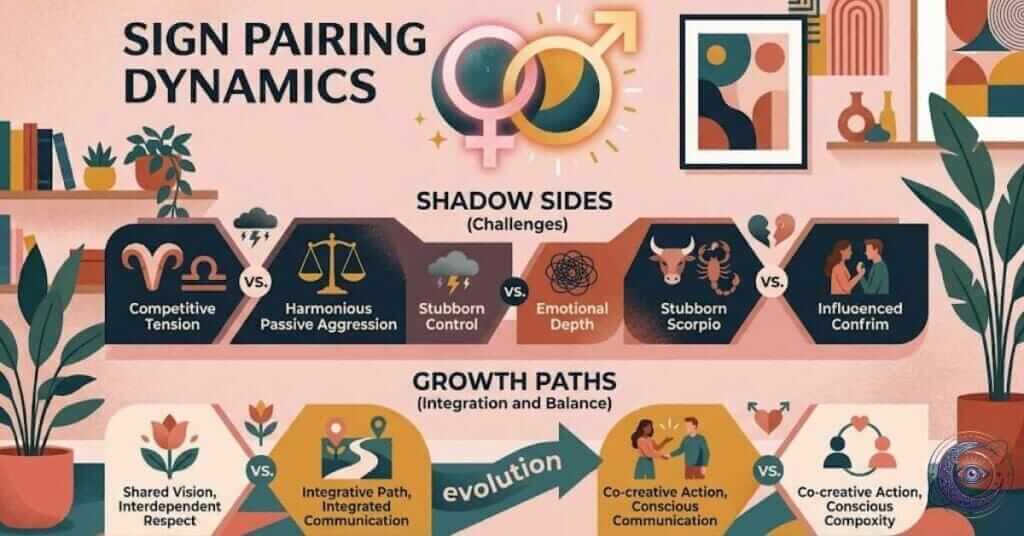
A sextile connects signs of the same element pair, two signs apart, so this breaks down cleanest by element rather than by all 12 individual sign combinations.
Fire and air pairings, such as Aries-Gemini, Leo-Libra, or Sagittarius-Aquarius type combinations, tend to create spontaneous, playful attraction. The shadow side is restlessness. Two people who never run out of fun things to say to each other can also avoid the harder conversations a relationship eventually needs. The growth path is adding consistency, meaning following through on plans and commitments instead of letting the connection stay in the fun and flirtation phase indefinitely.
Earth and water pairings, such as Taurus-Cancer, Virgo-Scorpio, or Capricorn-Pisces type combinations, tend to create steady, comforting chemistry. The shadow side is stagnation. Comfort can turn into routine so smoothly that neither person notices the relationship has stopped growing. The growth path is introducing intentional novelty on purpose, such as new shared experiences or direct conversations about where the relationship is headed, rather than waiting for outside circumstances to force change.
Both pairing types share one risk: mistaking ease for depth. A relationship can feel easy and still be shallow if neither partner ever has to stretch for the other.
| Fire and air | Spontaneous, playful attraction | Surface level, avoids hard conversations | Add consistency and follow-through |
| Earth and water | Steady, comforting chemistry | Complacency, avoiding change | Introduce novelty and intentional challenge |
For comparison, a trine in the same elements usually feels even more automatic than a sextile, sometimes to the point of laziness, while a square or opposition between Venus and Mars adds real friction and a stronger sexual charge, at the cost of more conflict. The sextile sits in the middle: pleasant, but it needs a bit of conscious effort to become something more than pleasant.
| Trine | Very easy, automatic | Very little | Taking the connection for granted |
| Sextile | Easy, cooperative | Some, to activate fully | Coasting on comfort |
| Square | Charged, motivating | Constant | Ongoing friction |
| Opposition | Magnetic, polarizing | Constant | Push and pull imbalance |
None of these four aspects is better than the others across the board. A couple who wants calm day to day tends to do well with a sextile or trine doing most of the work. A couple who wants a relationship that keeps forcing growth often does better with a square or two mixed into an otherwise supportive chart, since friction has a way of pushing two people to communicate things a purely easy connection lets them skip.
Technical deep dive: house overlays and this aspect
The sextile itself is only half the picture. Where each partner’s Venus and Mars land in the other person’s houses decides which area of life the chemistry actually shows up in.
Houses describe the life areas a planet is active in. A Venus or Mars that lands in a partner’s 1st house feels different from one landing in their 8th house, even with the same 60 degree angle involved.
| 1st | Identity, first impressions | Chemistry feels instant and personal |
| 4th | Home, family, security | Chemistry extends into domestic life |
| 5th | Romance, play, self-expression | Chemistry shows up as flirtation and fun |
| 7th | Partnership, commitment | Chemistry supports a partnership frame |
| 8th | Intimacy, merging, shared resources | Chemistry deepens into physical and emotional merging |
| 10th | Public life, ambition | Chemistry shows up as mutual admiration for goals |
A 5th house overlay and an 8th house overlay can come from the exact same sextile and still feel completely different day to day. The 5th house version tends to stay light: flirtation, shared hobbies, a sense of play that never quite loses its spark. The 8th house version tends to pull the couple toward merging finances, moving in together, or a physical connection that feels weighted rather than casual.
To find which house your partner’s planet falls into, you need their exact house system laid over your birth chart, which most synastry calculators generate automatically once both birth times are entered. An approximate birth time without a recorded hour can shift house placements enough to change this reading, so an exact time matters more here than it does for the sign and aspect alone.
Houses left off the table above still matter, even if they show up less often in relationship reading requests. A 2nd house overlay tends to bring the chemistry into shared finances and a sense of personal security. A 3rd house overlay shows up as constant talking, texting, and a friendship layer underneath the attraction. A 6th house overlay can bring the connection into daily routines and even health habits, for better or worse.
An 11th house overlay often feels more like friendship first, with romance building on top of that rather than leading it. The full 12 house breakdown follows the same logic as the six covered above: find the house, then read the theme of that house as the flavor the chemistry takes on.
Is venus sextile mars a soulmate indicator
Venus sextile mars supports ease and attraction, but it is not on its own a soulmate indicator. Soulmate connections usually involve multiple contacts across the Sun, Moon, and Ascendant, plus tighter or more karmic aspects such as conjunctions to the lunar nodes. This sextile reads best as a supportive, pleasant undertone.
That answer disappoints some people who go looking for this aspect specifically because a friend or an app told them it means something fated. It does not need to mean that to be worth having. A relationship with an easy Venus-Mars sextile and little else supporting it can still be a good, calm partnership. It is just not, by itself, evidence of destiny.
Working with this aspect instead of coasting on it
An easy aspect only stays easy if both people keep choosing to engage with it. Left alone, comfort can quietly turn into autopilot.
A few practical habits help. Check in on attraction directly instead of assuming it will always be there in the background. Bring in shared goals or challenges outside the relationship, since a couple with this aspect can lean too hard on their natural ease and skip the kind of shared effort that builds a deeper bond. Notice if the relationship has gone quiet in a way that feels like avoidance rather than genuine peace, since those two states can look similar from the outside but feel very different from the inside.
A few signs point to under-use rather than genuine peace. If both partners avoid any topic that might create disagreement, that is different from actually agreeing. If the relationship has not changed shape in a year, no new shared plans, no new depth, that stillness is worth a direct conversation rather than quiet acceptance. Comfort that comes from real trust looks different from comfort that comes from nobody wanting to disturb the calm.
Steven Forrest and Jodie Forrest cover this kind of nuance across their two volume book “Skymates,” which looks at synastry aspects in the kind of depth a single article cannot match. It is a useful next step for anyone who wants to go further than a single aspect.
Our chart observations
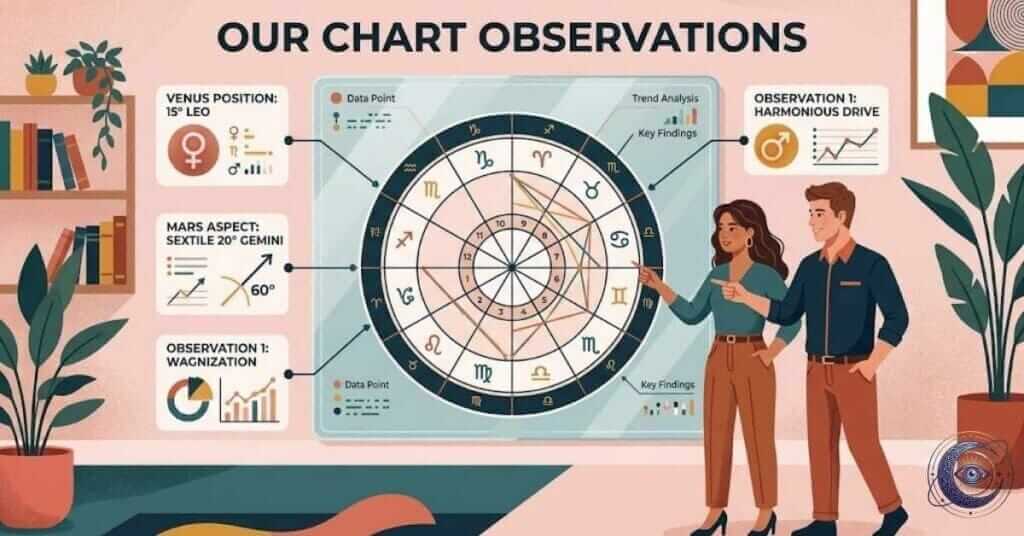
In the charts we have reviewed while building this guide, a clear pattern shows up. Couples with a tight Venus-Mars sextile, under 2 degrees, mention the chemistry unprompted, almost every time, without being asked directly about it. Couples with a wider orb, closer to 6 degrees, tend to describe the connection as comfortable rather than exciting, and often need a follow-up question before they mention the attraction at all.
We also notice that house placement changes the language people use more than the orb does. Couples with a 5th house overlay talk about fun and flirtation. Couples with an 8th house overlay talk about feeling merged or all in, even early in the relationship. That difference shows up consistently enough to be worth checking for in your own chart, using a synastry calculator or a professional reading, rather than relying on the sextile alone to explain the connection.
If you want to check your own placements, a synastry calculator can show you the exact degree and house for both people’s Venus and Mars, and a sun moon and rising sign calculator is a useful next step for seeing how this aspect sits inside the rest of each person’s chart.
None of this replaces a full reading with someone who can look at both charts side by side and weigh this sextile against everything else present. What it does give you is a starting point: a name for the ease you might already be feeling, a reason it shows up the way it does, and a few concrete ways to keep it from running on autopilot.
Frequently Asked Questions
Does Venus sextile Mars in synastry guarantee physical attraction?
It creates a very natural, easy physical pull, but it isn’t a blind spell. Think of it as easy conversational flow: it makes being close, flirting, and physical touch feel comfortable right out of the gate. Unlike high-friction aspects like a square or opposition that create intense “can’t stay away from you” obsession, a sextile feels more like an open invitation. You still have to choose to step through the door and build that connection.
What happens if our Venus sextile Mars has a wide orb (5 to 6 degrees)?
A wide orb simply means the volume is turned down a bit. With a tight orb under 2 degrees, the spark is usually obvious the moment you meet. With a 5 or 6-degree orb, the attraction is still there, but it feels more like a soft background hum. You might notice it most when you’re relaxing together or working on a shared project rather than feeling an immediate, dramatic spark.
Which partner feels Venus sextile Mars more?
Both feel it, but in slightly different ways that mirror traditional pursuit and reception. The Mars person usually feels motivated to pursue, take action, or express affection toward the Venus person. The Venus person feels appreciated, valued, and naturally receptive to how Mars reaches out. Because it is a 60-degree sextile, this back-and-forth usually happens without either person feeling pushed or uncomfortable.
Can a relationship survive with Venus sextile Mars as the main positive aspect?
It can be a wonderfully comfortable, low-stress partnership, but it might lack long-term staying power on its own. Venus sextile Mars gives you great day-to-day chemistry, but it does not automatically create emotional depth or structural commitment. For a relationship to last through major life challenges, you will want to see supporting contacts between the Sun, Moon, Saturn, or the Ascendant as well.
How can we reactivate this aspect if the romance feels like it is fading?
Because sextiles are gentle, the biggest trap is taking the ease for granted and slipping into autopilot. To wake it back up, break your daily routine:
For Fire and Air signs: Plan an unplanned weekend trip, try a new activity, or engage in playful banter to get the spark back.
For Earth and Water signs: Focus on intentional quality time: cook a meal together, plan a cozy date night, or have an honest chat about where you want to go next as a couple.
Hassan Raza is a dedicated digital tool architect and independent celestial researcher specializing in astronomical data modeling. Combining technical precision with deep cosmological studies, he develops intuitive astro-computational tools designed to make intricate natal charts, planetary transits, and celestial alignments accessible to everyone worldwide. Driven by accuracy and user-centric web design, Hassan ensures that every calculation on The Cosmic Calc bridges the gap between historical cosmic tracking and modern, real-time technology.