
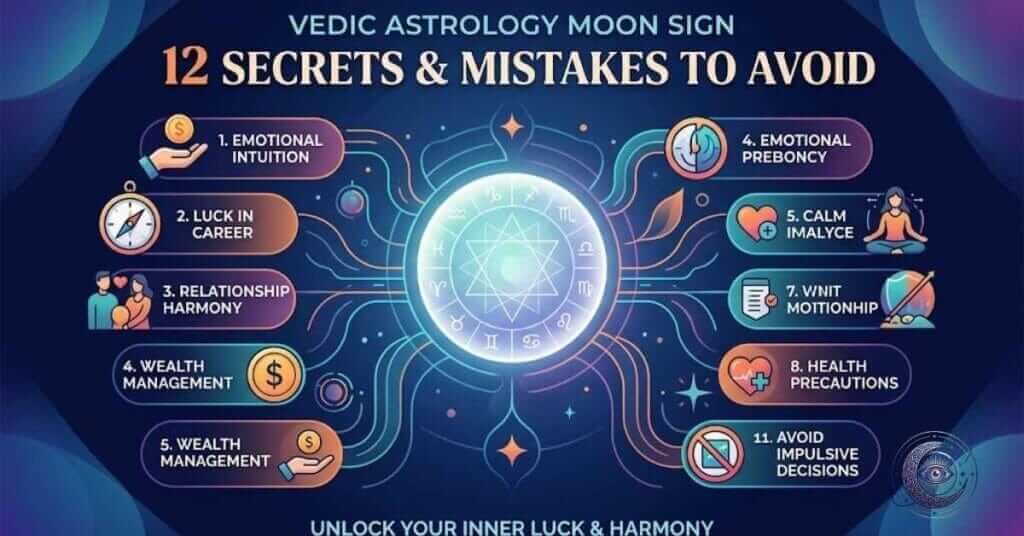
Your vedic astrology moon sign is often the reason a full moon leaves you with a heavy, unexplained feeling in your chest. It shows up as a sudden wave of emotion during a movie that never used to affect you, or the strange sense that your sun sign description reads like someone else’s life instead of your own.
After reading hundreds of birth charts for readers of TheCosmicCalc, one pattern keeps repeating. A person’s sun sign describes how they act in public. Their moon sign describes what happens when nobody is watching, the private emotional habits, comfort routines, and inherited reactions that rarely make it into a daily horoscope.
This guide covers what a vedic astrology moon sign actually measures, how it connects to your sun and rising signs, what the 2026 lunar eclipses change, and how each of the 12 moon signs handles emotion, shadow side included.
What does a vedic astrology moon sign actually mean
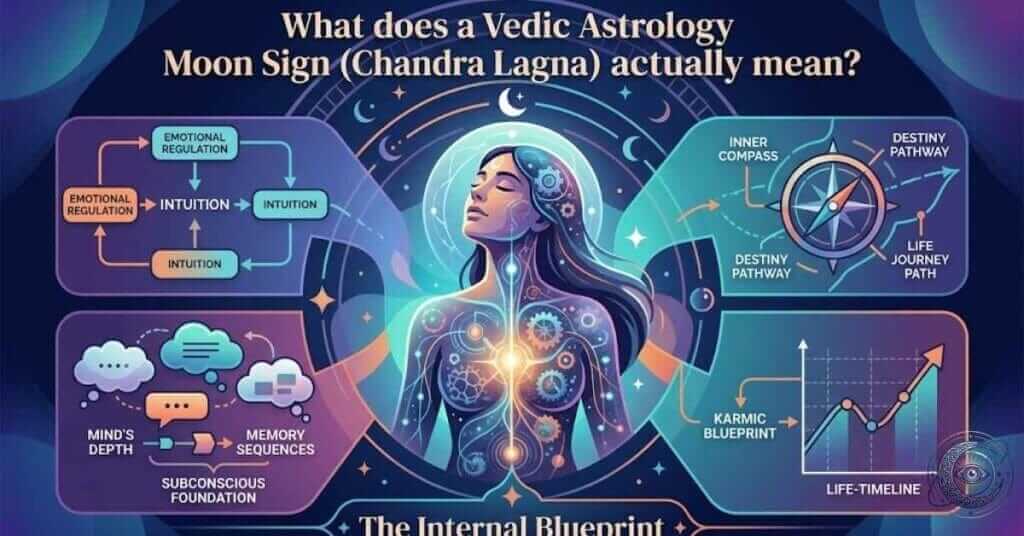
A vedic astrology moon sign is the zodiac sign the moon occupied at the exact time and place of birth, measured on the sidereal zodiac used in Jyotish. It marks a person’s emotional instincts, comfort needs, and the private mental patterns operating underneath conscious behavior.
In vedic astrology, every birth chart is called a natal chart, a map of where each planet sat in the sky at the moment a person was born. The moon in that chart is one of two luminaries, and it moves through a zodiac sign roughly every 2.5 days, far faster than the sun.
The Rigveda includes a line from the Purusha Sukta that vedic astrologers still quote today: chandrama manaso jatah, the moon was born from the mind. That single phrase is a big part of why Jyotish treats the moon sign as central to a person’s mental and emotional pattern, not a secondary detail.
Because the moon moves so fast, your vedic astrology moon sign can be completely different from a sibling born the same day, or from your own sun sign. It sets your zodiac placement for comfort, security, and instinct, separate from the astrological profile your sun sign builds around identity and will.
How does my moon sign fit with my sun and rising sign
The moon sign works with the sun sign and rising sign to form what astrologers call the Big 3. The sun shows identity and purpose, the rising sign shows first impressions, and the moon sign shows the emotional reactions and comfort habits underneath both of them.
Think of the Big 3 as three separate layers of one chart, each answering a different question. The sun sign answers who a person is trying to become. The rising sign answers how they come across in the first five minutes of meeting someone. The moon sign answers what they actually need to feel safe.
A person can have a bold, expressive sun sign and still cry alone in the car after a hard day, because their moon sign runs on a completely different set of rules. The two luminaries rarely match in personality, and that mismatch is normal. It is one reason a horoscope built only on the sun sign misses so much of a person’s actual emotional life.
Vedic astrologers also look at planetary aspects, the angles one planet makes to another, to see how the moon is being supported or challenged by the rest of the chart. A moon aspected by Jupiter tends to process emotion with more optimism. A moon aspected by Saturn often processes emotion slower and more cautiously.
Is my vedic moon sign different from my western moon sign
Yes. Vedic astrology uses the sidereal zodiac, adjusted for the earth’s slow axial shift, while western astrology uses the tropical zodiac tied to the seasons. That roughly 24 degree gap means a vedic astrology moon sign can land in a different sign than a western tropical moon sign for identical birth data.
This mismatch confuses a lot of people the first time they see it. A reader might grow up believing they are a Pisces moon based on a western app, then discover through a vedic reading that their moon actually sits in Aquarius.
The gap exists because the tropical zodiac is fixed to the spring equinox, while the sidereal zodiac used in Jyotish is fixed to the actual position of the stars. Over centuries, the difference between the two systems, called the ayanamsa, has grown to roughly 24 degrees. Most Jyotish software defaults to the Lahiri ayanamsa, the calculation standard adopted by the Indian government and used across most modern vedic astrology tools and calculators.
Neither system is wrong. They answer different questions. Vedic astrology tends to be used for precise timing methods, like dasha periods, while western tropical astrology leans toward personality description. For emotional pattern work specifically, most Jyotish practitioners recommend the sidereal moon sign, since that is the system the classical texts, including the Brihat Parashara Hora Shastra, were written around.
What do the 2026 lunar eclipses mean for my moon sign
2026 brings two lunar eclipses that affect moon signs differently depending on placement. The March 3 total lunar eclipse in Virgo pushes for release around routine, health, and self-criticism. The August 28 partial lunar eclipse in Pisces pushes for release around escapism, boundaries, and emotional overwhelm.
A lunar eclipse works like an intensified full moon. Whatever a full moon would normally stir up, an eclipse stirs harder, and the effects tend to linger for weeks on either side of the exact date.
On March 3, 2026, a total lunar eclipse lands in Virgo at roughly 13 degrees. Readers with a moon sign in Virgo, or a moon placed in a Virgo related house, often feel this one as pressure to drop perfectionism and overthinking. It is a good window for cleaning up a chaotic routine rather than starting something new. A simple, grounded practice for this window is picking one recurring source of self-criticism and writing down a single sentence about it each evening for a week, without trying to solve it.
On August 28, 2026, a partial lunar eclipse lands in Pisces at roughly 5 degrees. This one tends to land hardest for moon signs that already run emotionally sensitive, such as Cancer and Scorpio moons, and shows up as a pull toward daydreaming, escapism, or blurred boundaries with other people’s problems.
Neither date requires a person to do anything dramatic. Watching how a specific mood or memory surfaces in the days around each eclipse is usually enough to notice the pattern.
For readers checking their own placement against these dates, the free Sun, Moon, and Rising Sign Calculator on TheCosmicCalc gives an exact moon sign along with the full chart it sits in, so the eclipse dates above can be matched against a real placement instead of a guess.
Moon signs also share patterns by element. Here is how fire, earth, air, and water moons tend to differ in emotional needs, shadow traits, and self-care.
| Element | Emotional needs | Shadow traits | Best self-care practices |
|---|---|---|---|
| Fire (Aries, Leo, Sagittarius) | Independence and quick emotional release | Impatience, quick temper, constant need for validation | Physical movement, solo time to cool off before reacting |
| Earth (Taurus, Virgo, Capricorn) | Stability, routine, physical comfort | Stubbornness, self-criticism, emotional suppression | Slow rituals like cooking, gardening, or a fixed sleep schedule |
| Air (Gemini, Libra, Aquarius) | Mental connection and conversation | Overthinking, detachment, avoiding deep feeling | Talking it through with a trusted person, journaling to name feelings |
| Water (Cancer, Scorpio, Pisces) | Deep emotional safety and closeness | Moodiness, over-attachment, absorbing others’ emotions | Setting clear boundaries, quiet alone time to reset |
What is the shadow side and growth path for each moon sign
Every moon sign has a shadow side, the coping pattern that shows up under stress, and a growth path, the shift that turns that pattern into strength. Reading both together gives a fuller picture than a sign’s traits alone.
- Aries moon: reacts fast and needs to feel emotionally independent. The shadow side is a quick temper and impatience with anyone processing feelings more slowly. The growth path is pausing for a few seconds before responding, so the reaction becomes a choice instead of a reflex.
- Taurus moon: needs stability and physical comfort to feel emotionally safe. The shadow side is stubbornness and resistance to change, even change that would help. The growth path is practicing small, low-stakes shifts in routine to build tolerance for discomfort.
- Gemini moon: processes feelings by talking them through out loud. The shadow side is intellectualizing emotion until it stops feeling like emotion at all. The growth path is naming a feeling in one plain word before explaining or analyzing it.
- Cancer moon: is deeply nurturing and protective of the people it loves. The shadow side is moodiness and over-attachment, holding on past the point that serves anyone. The growth path is setting a boundary even when it feels unkind in the moment.
- Leo moon: needs to feel emotionally seen and appreciated. The shadow side is pride and a constant need for validation from other people. The growth path is finding a private sense of worth that does not depend on an audience.
- Virgo moon: manages emotion through order, routine, and problem solving. The shadow side is self-criticism and anxiety about getting things wrong. The growth path is practicing being imperfect on purpose, in small, safe situations, until it stops feeling dangerous.
- Libra moon: seeks harmony and calm in every relationship. The shadow side is avoiding conflict even when a hard conversation is overdue. The growth path is saying the uncomfortable thing early, before resentment has time to build underneath it.
- Scorpio moon: feels everything at full intensity and hides most of it. The shadow side is control and jealousy in close relationships. The growth path is practicing small acts of emotional trust with people who have already earned it.
- Sagittarius moon: needs emotional freedom and room to roam. The shadow side is restlessness and avoiding anything that feels too heavy or too close. The growth path is staying present in one relationship long enough to let it deepen.
- Capricorn moon: manages feeling through discipline and quiet control. The shadow side is suppressing emotion until it comes out sideways, usually as irritability. The growth path is allowing one safe person to see the vulnerable version, on purpose.
- Aquarius moon: processes emotion through logic and distance. The shadow side is detachment that reads as coldness to people who want closeness. The growth path is connecting a feeling to a specific thought, out loud, instead of skipping straight to analysis.
- Pisces moon: absorbs the emotional weather of everyone nearby. The shadow side is escapism and losing personal boundaries inside someone else’s problems. The growth path is building a clear line between empathy and responsibility for fixing things.
How does a moon sign change by house placement
The moon’s zodiac sign shows the type of emotion a person feels, while the house it sits in shows where that emotion plays out in daily life. A moon in the 4th house centers emotion on home and family. A moon in the 10th house centers it on career and reputation.
A birth chart splits into 12 houses, each covering a different area of life, from identity and money to relationships and career. The sign a moon sits in describes the type of emotion. The house it occupies describes where that emotion shows up.
For example, a Scorpio moon in the 1st house shows its emotional intensity openly, since the 1st house governs how a person presents to the world. The same Scorpio moon in the 12th house, the house of the subconscious, tends to hide that intensity, processing it privately or in dreams instead of in public.
Here is a quick reference for what each house tends to activate emotionally when the moon sign sits there.
| House | Life area | Emotional theme when moon sign lands here |
|---|---|---|
| 1st | Identity | Emotion shapes how a person comes across to others |
| 2nd | Money and values | Security is tied to financial stability |
| 3rd | Communication | Feelings come out through words and close family |
| 4th | Home | Strong pull toward maternal energy and childhood roots |
| 5th | Romance and creativity | Emotional fulfillment through self expression |
| 6th | Daily routine | Emotion surfaces through habits and health |
| 7th | Partnership | Emotional security is sought through close relationships |
| 8th | Transformation | Deep, often hidden emotional intensity |
| 9th | Belief and travel | Comfort found through meaning and distance |
| 10th | Career | Feeling shapes public reputation and ambition |
| 11th | Community | Fulfillment tied to friendship and shared goals |
| 12th | The subconscious | Emotion rooted in private, unconscious patterns |
How do I find my own vedic astrology moon sign
Finding your vedic astrology moon sign requires an accurate birth date, time, and location, run through a sidereal chart calculator. Even a 20 minute error in birth time can shift the moon into a neighboring sign, so exact timing matters more here than it does for a sun sign reading.
The moon moves through roughly one full sign every 2.5 days, so even a small gap in birth time can change the reading. A person born at 11:50 p.m. and their sibling born at 12:10 a.m. the next day could easily carry different moon signs.
To get an accurate reading, 3 details need to be correct: the exact birth date, the exact birth time down to the minute if it is available on a birth certificate, and the exact city of birth.
The Sun, Moon, and Rising Sign Calculator on TheCosmicCalc runs the sidereal calculation automatically once those 3 details are entered, showing all three placements together instead of the moon sign in isolation.
Our chart observations
Reading charts for TheCosmicCalc readers over time surfaces patterns that generic sign descriptions miss. Certain moon and house combinations show up again and again around emotional stress and relationship friction, in ways that line up with both classical Jyotish and modern psychology research.
In readings, moon in the 8th house and Scorpio moon placements come up more often than expected when someone describes emotional overwhelm during eclipse season, even before they know the exact eclipse dates. That lines up with the older idea from the Purusha Sukta, chandrama manaso jatah, the moon was born from the mind, since these placements sit closest to whatever is already moving through a person’s subconscious.
We also notice that readers with a moon in an earth sign, Taurus, Virgo, or Capricorn, respond well to one specific habit: writing down a single feeling in one sentence before trying to fix or explain it. That lines up with research outside astrology too. Psychologist James Pennebaker’s work on expressive writing, first published in 1986 and expanded in his 1997 paper in Psychological Science, has repeatedly linked short sessions of writing about emotion to lower stress and better emotional regulation over time.
A full reading with a trained Jyotish practitioner goes deeper than any general pattern can. This is simply one recurring pattern worth naming from years of chart work.
Readers who want a deeper technical grounding in Jyotish often start with Light on Life: An Introduction to the Astrology of India by Hart de Fouw and Robert Svoboda, a widely recommended primer on vedic astrology fundamentals, including moon sign interpretation.
For readers exploring emotional compatibility with a partner, the synastry between two moon signs, meaning how one person’s moon interacts with another person’s chart, is one of the clearest indicators of long-term emotional comfort. The Moon Soulmate Calculator on TheCosmicCalc runs this comparison directly from two birth charts.
Frequently asked questions
These are the questions readers ask most often about vedic astrology moon signs, answered in plain language first. Each answer stands on its own, though the sections above go deeper into the reasoning, the classical sources, and the specific 2026 dates behind each point.
What is a vedic astrology moon sign?
A vedic astrology moon sign, called the Rashi, is the zodiac sign the moon occupied at the exact moment of birth, calculated on the sidereal zodiac. It marks emotional instinct, subconscious reaction, and the private sense of comfort that sits underneath the sun sign’s identity.
How is a vedic moon sign different from a western moon sign?
Vedic astrology uses the sidereal zodiac, which accounts for a roughly 24 degree shift caused by the slow movement of the earth’s axis. A western tropical moon sign can land in a different sign than the vedic moon sign for the same birth data, sometimes changing the emotional reading entirely.
Why does vedic astrology treat the moon sign as more important than the sun sign?
Vedic astrology often anchors horoscope readings and timing systems, like dasha periods, to the moon sign rather than the sun sign. The moon governs the mind, and in Jyotish, the mind shapes how every other planetary influence is experienced day to day.
A vedic astrology moon sign shifts in relevance with every eclipse, every house transit, and every relationship a person enters. Running an accurate birth chart through the calculator above keeps that picture current.
Hassan Raza is a dedicated digital tool architect and independent celestial researcher specializing in astronomical data modeling. Combining technical precision with deep cosmological studies, he develops intuitive astro-computational tools designed to make intricate natal charts, planetary transits, and celestial alignments accessible to everyone worldwide. Driven by accuracy and user-centric web design, Hassan ensures that every calculation on The Cosmic Calc bridges the gap between historical cosmic tracking and modern, real-time technology.